It was going to happen eventually. Eventually I would crack and read the book that seems to have been universally praised. So here you go, a review for A Game of Thrones. Is it worth the hype?
So, the story. The story focuses largely on power struggles in the court of King Robert Baratheon, with lines being drawn between Lord Eddard Stark, the king's best friend and chief advisor, and Cersei Lannister, the queen and mother to Robert's heirs, as well as their respective families. At the same time as the power struggles there are occurring, the last heirs of the previous king, Aerys Targaryen, are living across the sea, plotting to regain the throne that their father was deposed from. That is the story at it's most basic. I shan't be giving any real details here, for fear of spoilers; the reason that I don't want to spoil this is that this is an incredibly well-written plot, one which I think should be experienced first-hand. There is so much that actually happens because of the different characters' subterfuge, that I couldn't give you an impression of the skill that this is brought together with. The one thing that I would mention is that I personally thought that the focus could have been more on Daenerys and her brother overseas, as it involves a more interesting setting than the main plot, which is pretty much just your standard medieval-Europe-style fantasy setting.
In terms of characters, there are a ton of them. So you're pretty much guaranteed to have your personal favourites and people you hope will meet a sticky end. Overall, I thought the character-building was pretty good. My only real problem was with the Lannisters, the main villains of the book. This is very much a personal thing, but I believe that a good villain needs to be entertaining as well as evil enough to make me wish for their defeat; the Lannisters have plenty of the latter, but none of the former, unfortunately. The only exception to this is Tyrion Lannister, the dwarf character. In contrast to the rest of his family, he has to manipulate the situation to his advantage, working for his rewards because of his disadvantages; in comparison, the rest of the Lannister family is just kind of boring, as they've become so sure of their power that they've devolved into using tactics worthy of the average playground bully. That is, of course, a very subjective point, but it's something that I thought I would mention.
Overall, I would definitely recommend A Game of Thrones. It's story is immense and complex, yet is written in such a way that it is easy to grasp. I have been reading fantasy for years now, but I imagine that it would be a good title to introduce non-fantasy fans to the genre, as the high fantasy elements are kept comparatively low. The only people I would not recommend it to are people sick to their back teeth with the medieval-Europe-style fantasy setting or those who aren't prepared to go the long haul, as the majority of the plot-lines aren't resolved in this book. 4/5
Next review: Among Thieves by Douglas Hulick
Signing off,
Nisa.
Search This Blog
Tuesday, 24 July 2012
Saturday, 21 July 2012
Adventures in Cooking: Australian Apple and Raisin Cake
It's a Mary Berry recipe again. Her most delicious yet.
The actual making of this couldn't have been much smoother. The only thing that I struggled with was coring the cooking apple, but that's because I'd not done it before. As for stewing the apple, that was easy after making a syrup mixture for my last recipe.
As for how this turned out, it was a little lop-sided, but then that was my fault. In terms of taste, it's lovely. The sponge itself tastes quite a bit of cinnamon and nutmeg, which might not be to some people's liking. The fruit softened up loads and is lovely and sweet.
I would definitely make this again. It's pretty much all I could ask for in a cake. All I would mention is that the mixture tended towards the sticky side, but was otherwise fine to work with.
Signing off,
Nisa.
The actual making of this couldn't have been much smoother. The only thing that I struggled with was coring the cooking apple, but that's because I'd not done it before. As for stewing the apple, that was easy after making a syrup mixture for my last recipe.
As for how this turned out, it was a little lop-sided, but then that was my fault. In terms of taste, it's lovely. The sponge itself tastes quite a bit of cinnamon and nutmeg, which might not be to some people's liking. The fruit softened up loads and is lovely and sweet.
I would definitely make this again. It's pretty much all I could ask for in a cake. All I would mention is that the mixture tended towards the sticky side, but was otherwise fine to work with.
Signing off,
Nisa.
Monday, 9 July 2012
Rule 34 by Charles Stross
There's a rather juvenile reason why I decided that I needed to read this. For anyone who hasn't trawled the Internet enough to have found this out, Rule 34 is the rule of the Internet that states the following: "If you can think of it, there's porn of it". Immediately, there will be people closing down this review wondering what kind of hideous pornography I could be reviewing. But you would be surprised by how tame Rule 34 actually is.
Rule 34 is a mystery novel. Set in a near future Edinburgh, the plot is sparked off by the suspicious death of a fetishist, who happens to have served time for scams and identity fraud over the Internet. For the most part, you follow three main characters over the course of the book. First is DI Liz Kavanaugh, the head of the Edinburgh's 'Rule 34 Squad'. It's her job to keep her eye on the Internet, observing memes and chasing down various acts of Internet crime; as such, she is quickly brought in on the case, due to the victim's history. Second is Anwar Hussein, a small-time ex-con trying to go clean; when he gets a job as a consul for a newly created country in Eastern Europe, he appears to have struck gold, although there are a few things that don't seem quite right. Finally, there is a mysterious man known only as 'The Toymaker', an agent of a sprawling organised crime syndicate. He's in Edinburgh to reinvent one of their outposts, but his plans keep getting foiled when his potential recruits keep getting killed; the fact that his meds keep gradually wearing out, causing him to imagine giant lizard people taking over, only makes things more difficult.
In terms of plot, there are quite a few threads to keep in mind. All three plot threads intersect at various points in the narrative, whether it's through main or side characters: for example, The Toymaker ends up having sex with Liz's on-again-off-again girlfriend, as well as meeting with Anwar at the consulate. All of these narratives are necessary to understand how the mystery may be unravelled, and they all provide quite a lot of overlapping information. Fair enough, you say, but this isn't all that uncommon in mystery novels these days. The thing is though, Rule 34 doesn't feel like your standard detective novel/police procedural. In contrast to most mystery novels that I've read, I don't think that this is a mystery that the reader could solve; don't get me wrong, in hindsight it is quite well signposted, but it just doesn't have an outcome that most mystery readers would even begin to consider. I don't personally have a problem with that though: while it caught me off-guard when I first read it, it does feel right and I'm actually kind of impressed at how the solution was reached. My only real problem is with the rest of the ending. You see, throughout the different plot-lines, the main focus characters have their own personal issues that they must attend to: for DI Kavanaugh it's her dissatisfaction with her life ever since her career went down the toilet, for Anwar it's his wife's disapproval with his criminal past and his inclinations for other men, and for The Toymaker it's the aforementioned giant lizard people; those are very basic summaries, with much more intricacy and messiness. Those plot-lines are just dropped, for the most part. In the rush to get to the solution, whatever character development that had occurred during the narrative sort of grinds to a halt, which is disappointing really. When you have such a wide and varied cast, it makes me sad to see all of their development left hanging; granted, it is given justification of sorts in the final chapter, and I suppose it does reflect real life more than most books, it just leaves me a bit disappointed.
The only other thing that I should probably mention is the writing style. It's written in the present tense, which I personally didn't notice until I checked just now, and also in the 2nd person. The use of 2nd person just confuses me. Not in terms of clarity, as it's pretty clear what's happening most of the time. I just don't understand why you would use it in a mystery novel. To my knowledge, the only other things that I've read that use the 2nd person perspective are Choose Your Own Adventure-style novels, as, for all intents and purposes, you are actually the main character in those. Here, it just seems different for the sake of being different; if there was some kind of hidden meaning behind it all, I certainly missed it.
Overall, a generally enjoyable mystery novel with some viciously cutting humour. Unfortunately, I do feel that I have to mark it down for a largely disappointing ending and the use of the 2nd person perspective that just seems pretentious really. 3.5/5
Next review: A Game of Thrones by George R. R. Martin
Signing off,
Nisa.
Rule 34 is a mystery novel. Set in a near future Edinburgh, the plot is sparked off by the suspicious death of a fetishist, who happens to have served time for scams and identity fraud over the Internet. For the most part, you follow three main characters over the course of the book. First is DI Liz Kavanaugh, the head of the Edinburgh's 'Rule 34 Squad'. It's her job to keep her eye on the Internet, observing memes and chasing down various acts of Internet crime; as such, she is quickly brought in on the case, due to the victim's history. Second is Anwar Hussein, a small-time ex-con trying to go clean; when he gets a job as a consul for a newly created country in Eastern Europe, he appears to have struck gold, although there are a few things that don't seem quite right. Finally, there is a mysterious man known only as 'The Toymaker', an agent of a sprawling organised crime syndicate. He's in Edinburgh to reinvent one of their outposts, but his plans keep getting foiled when his potential recruits keep getting killed; the fact that his meds keep gradually wearing out, causing him to imagine giant lizard people taking over, only makes things more difficult.
In terms of plot, there are quite a few threads to keep in mind. All three plot threads intersect at various points in the narrative, whether it's through main or side characters: for example, The Toymaker ends up having sex with Liz's on-again-off-again girlfriend, as well as meeting with Anwar at the consulate. All of these narratives are necessary to understand how the mystery may be unravelled, and they all provide quite a lot of overlapping information. Fair enough, you say, but this isn't all that uncommon in mystery novels these days. The thing is though, Rule 34 doesn't feel like your standard detective novel/police procedural. In contrast to most mystery novels that I've read, I don't think that this is a mystery that the reader could solve; don't get me wrong, in hindsight it is quite well signposted, but it just doesn't have an outcome that most mystery readers would even begin to consider. I don't personally have a problem with that though: while it caught me off-guard when I first read it, it does feel right and I'm actually kind of impressed at how the solution was reached. My only real problem is with the rest of the ending. You see, throughout the different plot-lines, the main focus characters have their own personal issues that they must attend to: for DI Kavanaugh it's her dissatisfaction with her life ever since her career went down the toilet, for Anwar it's his wife's disapproval with his criminal past and his inclinations for other men, and for The Toymaker it's the aforementioned giant lizard people; those are very basic summaries, with much more intricacy and messiness. Those plot-lines are just dropped, for the most part. In the rush to get to the solution, whatever character development that had occurred during the narrative sort of grinds to a halt, which is disappointing really. When you have such a wide and varied cast, it makes me sad to see all of their development left hanging; granted, it is given justification of sorts in the final chapter, and I suppose it does reflect real life more than most books, it just leaves me a bit disappointed.
The only other thing that I should probably mention is the writing style. It's written in the present tense, which I personally didn't notice until I checked just now, and also in the 2nd person. The use of 2nd person just confuses me. Not in terms of clarity, as it's pretty clear what's happening most of the time. I just don't understand why you would use it in a mystery novel. To my knowledge, the only other things that I've read that use the 2nd person perspective are Choose Your Own Adventure-style novels, as, for all intents and purposes, you are actually the main character in those. Here, it just seems different for the sake of being different; if there was some kind of hidden meaning behind it all, I certainly missed it.
Overall, a generally enjoyable mystery novel with some viciously cutting humour. Unfortunately, I do feel that I have to mark it down for a largely disappointing ending and the use of the 2nd person perspective that just seems pretentious really. 3.5/5
Next review: A Game of Thrones by George R. R. Martin
Signing off,
Nisa.
Wednesday, 4 July 2012
Adventures in Cooking: Apricot and Walnut Sandwich Bars
Ah, Mary Berry. We meet again. Why must your recipes look so yummy?
So, my experience with cakey things has been a much smoother road than my overall experience with bread. Give me a cake recipe and 99% of the time, it'll go smoothly. So I wasn't really worried about this one. The only thing that concerned me was the syrupy apricot mixture that I had to make for the sandwich filling, as I tend to be a bit wary about anything that involves burning on the stove.
As it turns out, I shouldn't have worried so much. It turned out about as well as I thought it would; it was different than I anticipated, but still good. In terms of ingredients, I ended up changing a couple of them. First, I used crushed hazelnuts instead of chopped walnuts as part of the dough. Second, I used white self-raising flour as opposed to the recommended wholemeal self-raising flour, simply because the former was all that I could find. I think that these changes in ingredients might explain why the final product was more cakey than I would have assumed from the picture provided in the recipe book. Not that this was a negative point, it was just a bit unexpected.
What I would mention for those who are looking to make this, is that in spreading out the top layer of dough, I may well have displaced the apricot mixture from the centre of the sandwich bar mixture, so I ended up with a situation where I would have nothing but cake in the middle and all the apricot mixture would be pushed to the edge. As the dough is an odd kind of consistency, due to the oats that make up a portion of the mixture, it needs to be pushed out to make it fill the space correctly. So I'm not really sure how to remedy the problem.
Overall though, I would readily give the recipe another shot at some other time. I would probably change what I did a bit more, but otherwise I'm perfectly happy with this recipe. Now I just have to stop trying recipes with nuts so that I won't kill my boyfriend accidentally.
Signing off,
Nisa.
So, my experience with cakey things has been a much smoother road than my overall experience with bread. Give me a cake recipe and 99% of the time, it'll go smoothly. So I wasn't really worried about this one. The only thing that concerned me was the syrupy apricot mixture that I had to make for the sandwich filling, as I tend to be a bit wary about anything that involves burning on the stove.
As it turns out, I shouldn't have worried so much. It turned out about as well as I thought it would; it was different than I anticipated, but still good. In terms of ingredients, I ended up changing a couple of them. First, I used crushed hazelnuts instead of chopped walnuts as part of the dough. Second, I used white self-raising flour as opposed to the recommended wholemeal self-raising flour, simply because the former was all that I could find. I think that these changes in ingredients might explain why the final product was more cakey than I would have assumed from the picture provided in the recipe book. Not that this was a negative point, it was just a bit unexpected.
What I would mention for those who are looking to make this, is that in spreading out the top layer of dough, I may well have displaced the apricot mixture from the centre of the sandwich bar mixture, so I ended up with a situation where I would have nothing but cake in the middle and all the apricot mixture would be pushed to the edge. As the dough is an odd kind of consistency, due to the oats that make up a portion of the mixture, it needs to be pushed out to make it fill the space correctly. So I'm not really sure how to remedy the problem.
Overall though, I would readily give the recipe another shot at some other time. I would probably change what I did a bit more, but otherwise I'm perfectly happy with this recipe. Now I just have to stop trying recipes with nuts so that I won't kill my boyfriend accidentally.
Signing off,
Nisa.
Sunday, 1 July 2012
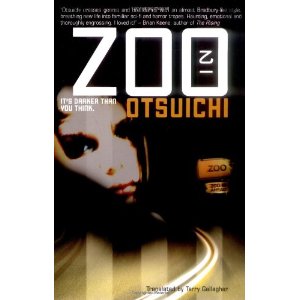
ZOO by Otsuichi
There are some books that you just pick up on a whim. ZOO was one of those books: as it was one that was being given away for free at a convention, I was hardly going to pass it up. But now that I've gotten around to reading it, will it be a case of complaining about things that I didn't have to pay for?
Now, as this is a collection of short stories, I will be taking a slightly different approach to my usual one. Instead of discussions of plot and character, I will talk a little bit about each story in the collection.
The title story of the collection, 'ZOO', is probably one of the more disappointing stories included. When the story is about a man who receives pictures in the post of his ex-girlfriend's body as it progresses through decomposition, you expect it to really wow you. While it is admittedly creepy, I thought that it could have been paced better, to make better use of the tension created by the situation.
'In a Falling Airplane' is one of the more interesting stories from a more critical viewpoint, as it focuses on the actions of people who have nothing to lose as they are confronted with a life-threatening situation.
'The White House in the Cold Forest' more than delivered the eeriness that 'ZOO' was missing, as it follows a girl who has grown up with almost nothing but abuse as she is unleashed into the world. The narrator's lack of comprehension regarding her own actions is incredibly creepy.
'Find the Blood!' is a mystery story of sorts, as a family try to figure out who could have stabbed their father figure in the back as well as finding the bag of blood that could potentially save his life. I was surprised by the humorous tone that it took, but it was unexpectedly effective.
'In a Park at Twilight, a Long Time Ago' is the shortest of the bunch, and is enjoyably creepy for the two pages or so that it lasts.
'Wardrobe' is another mystery story, revolving around a woman who hides the dead body of her brother-in-law in his wardrobe. This was actually another disappointment, as I didn't feel that the mystery actually worked. While I did enjoy the twists and turns that events took for the majority of it, when the ending came up, I couldn't help but feel cheated as I felt that I had been denied information.
'Song of the Sunny Spot' kinds of feels like it should be in a different collection, as it contains none of the macabre features present in the other stories. That isn't to say that this is a bad story though; on the contrary, I think it's one of the stronger stories, with a genuinely touching relationship between the narrator and the dying old man who built her to look after him.
'Kazari and Yoko' brings the collection back to the nightmarish end of the scale, as it follows the wildly different treatments of the two eponymous sisters. It is a seriously messed up story, with seriously messed up people inhabiting it. I can't help but still feel wary when I look back at it, but then I suppose that is the sign of a good horror story.
'SO-far' is a strange one. Granted, that statement doesn't mean much in light of the rest of the collection, but even compared to the rest of the book, this story is strange. In it, the reader follows a young boy as he has to act as a mouthpiece for his parents when it appears that they can no longer see, hear or perceive each other. If that isn't odd enough, there is a plot twist at the very end of it that I was genuinely not expecting.
'Words of God' is another strange one. This one is more on the unpleasant side though, as a teenage boy goes through life, occasionally influencing things through the power of his voice. I couldn't help but feel really uncomfortable with this one; while unpleasant or morally dubious characters are more common here than I'm used to, this was one of the few characters that made me feel really uncomfortable.
'Seven Rooms', the final story and probably the longest of the collection, is utterly terrifying when you're actually reading it. Considering that it involves a brother and sister as they get caught in a death trap that takes a week to kill you, that's understandable. The problem that I had was that after I had finished reading it, I couldn't help but realise that the killer and his MO are really impractical and would never be able to operate without the police investigating. That might just be me, but if you're going to use horror involving things that are plausible, such as serial killers, then everything needs to be plausible for it to be truly scary. I felt it failed a bit there, but it was really thrilling to read nonetheless.
Overall, I was very impressed with this collection. The dark tone and macabre characters that inhabit these stories were very refreshing, considering the lighter material that you often find in shorter prose. I would definitely recommend these to someone who enjoyed horror or the darker end of the fantasy spectrum. 4/5
Next review: Rule 34 by Charles Stross.
Signing off,
Nisa.
Thursday, 28 June 2012
Henry VI Part Three by William Shakespeare
Thus are the Henry VI plays concluded. Having thoroughly enjoyed the second part of this trilogy I was quite looking forward to the conclusion of the story. I find myself kind of confused by it. There will be spoilers for Henry VI Part Two.
Having read an adaptation of Richard III into comic form, I couldn't help but think of this as a prequel to that play. While this play isn't bad, it seemed a bit odd from a dramatic standpoint, as the end of this play is largely the same as the end of the second. Granted, this is probably due to the adherence to overall historical events, but it still felt odd. The only major differences between the two are the death of Richard, Duke of York, in the first act and the set-up of Richard, Duke of Gloucester, as a thorn in the side of his brother's ambitions. Otherwise, it is a similar mix of political intrigue and outright war that was showcased in Parts One and Two.
As for the BBC's adaptation, I must commend Julia Foster for her performance as Queen Margaret: she manages to be both sympathetic, as she fights to win back the throne that she believes to lawfully belong to her husband Henry as well as her son, yet at the same time she is genuinely unpleasant as she taunts and curses her foes. The rest of the cast turn in very good performances and I can't fault the production overall.
Overall, this is a fairly simple review to write. If you enjoyed the first two parts, you will enjoy this part. I would also recommend this trilogy to those who enjoyed Richard III. 3.5/5
Next review: ZOO by Otsuichi
Signing off,
Nisa.
Thursday, 21 June 2012
Scarlet and Black by Stendhal
This is another of those books that I pretty much picked up on a whim. Since I bought Scarlet and Black at a used book stall, I've had an opportunity to learn more about its author, Stendhal. As I knew at least a little bit about the author's life, and sympathised with his low self confidence amongst other things, I was looking forward to reading this more, so that I could see how my initial impressions of the man measured up to against his work. For that reason, this review could get awkward.
Scarlet and Black follows the life of a young man named Julien Sorel as he tries to make his way and be successful in Romantic-era France. As he is a peasant by birth, he can rise in the ranks in one of two ways: that of a soldier or that of a priest. He is enamoured by the success and the politics of Napoleon, and would love to follow in his footsteps by becoming a soldier; unfortunately, this is post-Napoleonic times, so the would-be conqueror of Europe is not in vogue. Thus Julien decides that the life of a priest will have to do if he is to achieve his ambitions. That as a story isn't a bad basis to start from, and indeed, it is written very well; there are just a few things that just bug me overall.
My main problem with the story is Julien himself. I just couldn't bring myself to liking him, for two simple reasons. Firstly, he didn't seem to be a particularly consistent character. It seems more like his emotions are devices that move the plot along, as opposed to examples of genuine feeling that people might have; for example, there is a point at which a girl who is in love with him asks him to climb up to her window in the middle of the night. He climbs up to her window because he doesn't want to seem like a coward, not because he has any feelings for her that are anything more than platonic; so far, a motivation that is not particularly nice, but it does make sense. Skip to a couple of days later, and he is head over heels in love with her. I'm sorry, but feelings don't work that way. If you've known a person for months and felt nothing romantic towards them thus far, it takes more than two days for those feelings to do a 180 degree change. Secondly, he just seems generally selfish and callous to those around him. By the end of the novel, all I could think of that he achieved was to completely break the spirits of two women through his seduction, and create turmoil within both of their respective families and social circles. I don't know what part of that I am supposed to like. The worst thing is that there are enough similarities between Julien and Stendhal's backgrounds that you just sort of instinctively realise that Julien is supposed to be Stendhal's idealised version of himself; at least that's what it feels like, and it's really uncomfortable.
The other things that bugged me, to a lesser extent anyway, were parts of the plot that I think could have been shortened or just cut completely. There are two instances that immediately spring to mind. The first involves that rendezvous in the middle of the night that I mentioned earlier. In the hours preceding the meeting, Julien tries to figure out whether she is genuinely in love with him or whether the meeting is a trap to humiliate him among her aristocratic peers; this question, the answer to which the audience is already privy, takes up an entire chapter. It did not need an entire chapter to itself, maybe a paragraph or two; any longer and it just seems indulgent. The other instance that springs to mind involves a political intrigue that Julien acts as a messenger for. The ultimate purpose of it, in terms of the plot, is for Julien to meet an old friend, who he asks for advice in love. With that in mind, I see no reason why the reader needs to know the exact details of the entire intrigue, considering that it doesn't actually have an effect on the plot other than Julien's need to travel out of Paris; Stendhal himself even admits that politics in a novel is both tedious and dating, so why include it?
On the positive side, this is written very well, and is actually fairly interesting if you look at it as a kind of portrait of France in the era during which it was written. I was much more taken by the descriptions of society and the intricacies of etiquette than I was by Julien's struggles, which were, in my opinion, largely brought on by himself.
Overall, I couldn't help but read this with a measure of disappointment. Despite the fact that Scarlet and Black is well-written, I just couldn't bring myself to like the main character and so I ended up dissecting most of what I read in my head. I almost had a review pre-written about fifteen chapters before it ended, which tends not to be a good sign for me. It may be of interest to people interested in Romantic-era France. 3/5
Next review: Henry VI Part Three by William Shakespeare.
Signing off,
Nisa.
Scarlet and Black follows the life of a young man named Julien Sorel as he tries to make his way and be successful in Romantic-era France. As he is a peasant by birth, he can rise in the ranks in one of two ways: that of a soldier or that of a priest. He is enamoured by the success and the politics of Napoleon, and would love to follow in his footsteps by becoming a soldier; unfortunately, this is post-Napoleonic times, so the would-be conqueror of Europe is not in vogue. Thus Julien decides that the life of a priest will have to do if he is to achieve his ambitions. That as a story isn't a bad basis to start from, and indeed, it is written very well; there are just a few things that just bug me overall.
My main problem with the story is Julien himself. I just couldn't bring myself to liking him, for two simple reasons. Firstly, he didn't seem to be a particularly consistent character. It seems more like his emotions are devices that move the plot along, as opposed to examples of genuine feeling that people might have; for example, there is a point at which a girl who is in love with him asks him to climb up to her window in the middle of the night. He climbs up to her window because he doesn't want to seem like a coward, not because he has any feelings for her that are anything more than platonic; so far, a motivation that is not particularly nice, but it does make sense. Skip to a couple of days later, and he is head over heels in love with her. I'm sorry, but feelings don't work that way. If you've known a person for months and felt nothing romantic towards them thus far, it takes more than two days for those feelings to do a 180 degree change. Secondly, he just seems generally selfish and callous to those around him. By the end of the novel, all I could think of that he achieved was to completely break the spirits of two women through his seduction, and create turmoil within both of their respective families and social circles. I don't know what part of that I am supposed to like. The worst thing is that there are enough similarities between Julien and Stendhal's backgrounds that you just sort of instinctively realise that Julien is supposed to be Stendhal's idealised version of himself; at least that's what it feels like, and it's really uncomfortable.
The other things that bugged me, to a lesser extent anyway, were parts of the plot that I think could have been shortened or just cut completely. There are two instances that immediately spring to mind. The first involves that rendezvous in the middle of the night that I mentioned earlier. In the hours preceding the meeting, Julien tries to figure out whether she is genuinely in love with him or whether the meeting is a trap to humiliate him among her aristocratic peers; this question, the answer to which the audience is already privy, takes up an entire chapter. It did not need an entire chapter to itself, maybe a paragraph or two; any longer and it just seems indulgent. The other instance that springs to mind involves a political intrigue that Julien acts as a messenger for. The ultimate purpose of it, in terms of the plot, is for Julien to meet an old friend, who he asks for advice in love. With that in mind, I see no reason why the reader needs to know the exact details of the entire intrigue, considering that it doesn't actually have an effect on the plot other than Julien's need to travel out of Paris; Stendhal himself even admits that politics in a novel is both tedious and dating, so why include it?
On the positive side, this is written very well, and is actually fairly interesting if you look at it as a kind of portrait of France in the era during which it was written. I was much more taken by the descriptions of society and the intricacies of etiquette than I was by Julien's struggles, which were, in my opinion, largely brought on by himself.
Overall, I couldn't help but read this with a measure of disappointment. Despite the fact that Scarlet and Black is well-written, I just couldn't bring myself to like the main character and so I ended up dissecting most of what I read in my head. I almost had a review pre-written about fifteen chapters before it ended, which tends not to be a good sign for me. It may be of interest to people interested in Romantic-era France. 3/5
Next review: Henry VI Part Three by William Shakespeare.
Signing off,
Nisa.
Subscribe to:
Posts (Atom)