Search This Blog

Showing posts with label Romance. Show all posts

Saturday, 17 March 2018

Abandon by Meg Cabot

Having been thoroughly disappointed with my last read, I was hoping that my next Young Adult book would be more my style. I had read Meg Cabot books previously, specifically the first couple of volumes of both her Princess Diaries series and her Heather Wells series. The latter series I was quite fond of, and the former was far enough in the past that my recollections of reading it were hazy at best. So I had hopes that Abandon would at least be decent.


Abandon follows Pierce Oliviera, a teenager who had a near-death experience. Following her parents' divorce and a mysterious incident that caused her to be expelled from her previous school, she moves with her mother to Isla Huesos in Florida. Wanting a fresh start, Pierce can't help but be fearful, because when she came back to life, she brought something strange and possibly cursed back with her.
I wanted to like this. I'm something of a Greek myth buff, and while the Persephone myth isn't my favourite, I was interested in seeing how it would be reinterpreted. But Abandon just seemed to defy my efforts at every turn.
First of all, since I've mentioned that it's a re-write of the myth of Persephone's kidnap/marriage to Hades, of course there will be a death-god figure for Pierce to both run from and fall in love with. That relation could be interesting, if you went for the whole "I love the person, but I can't give up my life or family to be with them" angle. But despite the in-depth descriptions of John's good looks and the attempts to do the whole "they bicker, so they must be in love!" trope, there is so little chemistry that it all falls flat. And honestly, you have to be concerned when your main character's attempts to reach out emotionally to him devolves to her consciously using tactics learnt from working with wild animals. If you're treating someone you're attracted to like some kind of humanoid badger, then you have issues. Additionally, they don't seem to have actually spent more than a few hours in each other's company over all their encounters, and yet they're quite happy to talk about loving each other. I can barely get a general impression of someone in a few hours, let alone fall in love, so it smacks of obligation more than anything.
This lack of chemistry stems largely from the second issue that I have with Abandon. Pierce doesn't really seem to have a great deal of personality beyond the fact that she died and now has a magic necklace that warns her of danger. And considering that a huge chunk of the plot doesn't deal with supernatural stuff, but her attempts to settle into a new school following some severe traumas, that's a problem. She just sorts of gets carried along by events there, and all that I could take from those sections is that she's drawn to meddling in other people's problems without permission, and isn't especially suited to it. After a while, her incessant whining that somehow people think you're crazy when you tell them "I can protect you from the evil!" get really annoying, along with her repeated exclamations of "Check yourself before you wreck yourself". I don't care if it's even a little bit sarcastic, it soon starts to grate on your nerves. It wasn't long before I had concluded that I couldn't care less what happened to her, which is the kiss of death for a first-person narrative.
The third issue that I have with Abandon is that it takes far too long to get Pierce's backstory over and done with. So, there are two main issues that have impacted on Pierce's life within the past two years that are deemed to be important: her near-death experience where she met and escaped from the Love Interest, and an incident at her former school involving scandal and one of her teachers. What I would have done is maybe dedicate a couple chapters to each event and intersperse them with present-day events, but focus on the entirety of the event at one time. Cabot instead decides to drip feed both of them over the space of two thirds of the book, with both events frequently interrupted by mundane bullshit like school assemblies and queuing for ice cream. This is aggravating to the extreme, as it's obviously meant to raise tension, but there's a massive flaw that means that whatever tension is achieved falls flat. The events themselves are easy to work out. The scandal at her old school for instance? As soon as I heard that a teacher was involved and that Pierce had gotten herself in hot water by trying to get evidence against him, I knew that it would involve the teacher being pervy with his female students. And wouldn't you know, I was absolutely right. Now, compare Abandon with a property that takes this tired "Hot for Student" scenario and makes it work, namely the game Persona 5. Being a video game, it amps the tension by making it the focus of the consumer's attention and it raises the stakes with elements like a time restriction. It also spends a decent amount of time actually building up the secondary characters, so that when they start being harmed because of the teacher's abuse of power, you actually give a shit. In comparison, Abandon spends so much time stalling that you're praying to get the backstory over and done with, rather than being left on-edge to find out how it all turns out.
The fourth issue that I have is the role of the Furies. The Furies are depicted as enemies of John, and by extension Pierce, because they are damned souls who are angry at their treatment. This bugs me for two reasons. Firstly because according to Greek myths, the Furies were deities of vengeance who would target those who committed crimes like matricide or swearing false oaths. They're vicious, but their targets have traditionally been guilty in some fashion, they're the idea that certain crimes won't go unpunished even if mortal justice proves inadequate. To make them mindlessly evil is disingenuous to their mythic origins. Secondly, it seems weird that these all-powerful beings who exist solely to torment the deity running the Underworld are just the souls of evil people. If it's such a problem that Furies are actively possessing and corrupting living people to carry out their plans, then surely you would try and find out what the fuck it is that Hell is doing to make these things and stop it, not just keep shipping souls in to become new Furies only to wonder why your quality of life has plummeted. There's a line from Shakespeare's The Tempest that states "Hell is empty and all the devils are here", but I somehow doubt that it was meant to be taken literally.
Fifth issue is a bit of a spoiler. So it turns out that Furies have been targeting Pierce, and John is concerned that he can't protect her. His solution is to kidnap her again. But it's okay this time, because it's for her own good, and hey, if she gives it time then maybe she'll come to like being in the Underworld. Seriously, what is it with my reading list at the moment? I can't seem to get away from YA books that try to tone down kidnapping at the moment. I explored my issues with this last review, so just assume that it applies here too. Also, it ends having resolved absolutely fuck all of the issues that had been brought up. What was the point of spending so much time with the nasty popular kids in order to help her cousin work through some undefined issues that he has with them, if the main character is ripped out of the world before anything happens with it?
The last issue is just something that bewildered me to the point of exasperation. It turns out that Furies like tassels, so whenever they turn up in the narrative they signal oncoming danger. Let me state that again for the record. Tassels are a legitimate harbinger of doom. I don't think I need to point out the idiocy of that.

Abandon is a book that I wanted to like, but it manages to brain itself at every hurdle. The main character is a charming mix of annoying and boring. Her relationship with the love interest lacks any chemistry, having spent at most a few hours in each other's company over the entirety of their encounters and at times she treats him more like a wild animal than a person. The backstory is spoon-fed to the reader at such an excruciatingly slow pace that whatever tension the author hoped to create is destroyed. The present-day plot is boring and more or less entirely pointless by the end. The mythology that it reports to take inspiration from is cherry-picked and not especially well. It tries to justify kidnapping by the time it ends, and TASSELS of all things are harbingers of doom. Do not bother. 1.5/5

Next review: Junky by William S. Burroughs

Signing off,
Nisa.

Thursday, 4 May 2017

Shards of Honor by Lois McMaster Bujold

I'll admit, when I got the Humble ebook Bundle I didn't have any idea of what I was getting into with Shards of Honor. I'd vaguely heard of the Vorkosigan Saga and generally they seemed good things, but I'd never really looked into the series enough to get a solid idea of what it was all about. I figured from the blurb that it would be military science-fiction of some sort, but not much beyond that. More or less completely blind going in. Nice.


Shards of Honor follows Cordelia Naismith, the captain of a scientific survey crew who becomes the prisoner of Aral Vorkosigan, a man of sinister reputation and the former commander of the soldiers who attacked her crew. But despite the initial mistrust, the two find themselves growing unexpectedly attracted to one another, and must face the possibility of being forever parted when their planets threaten to go to war.
I honestly didn't think I was going to like Shards of Honor when I first started reading it, as the narrative kind of throws the reader in at the deep end. I hadn't gotten further than maybe the first couple of pages in and it's throwing around new terms for planets and space-age weaponry with gay abandon. More than a little off-putting at first, not unlike trying to get your head around Nadsat in A Clockwork Orange for the first time. But like the aforementioned Nadsat, your head does manage to wrap itself around the more unusual terms with surprisingly little extra information.
Having adjusted myself to being thrust into the plot with a lot more speed than I am accustomed to, I realised that despite my initial reservations I was really enjoying myself. While the easiest way to describe the novel is military science-fiction with romance, Shards of Honor takes those base elements and does some really interesting things with them. So, first the military bit. I'm actually kind of surprised at how little fighting is actually shown directly. Possibly this is due to the main character being more or less a non-combatant, but the parts of war that are shown most often can be boiled down to internal politics and large scale battle strategy. Considering how much I love some politics and back-stabbing, I was totally in my element. Additionally, it was good to see that the sides aren't easily delineated into purely good or malign. While the invading Barrayaran army is mostly in the wrong, it has a mix of Caligula types versus more noble types like Vorkosigan. Similarly, while there are perfectly reasonable people on the side of Escobar and Beta Colony like Cordelia, there are a surprising amount of people unwilling to look beyond basic propaganda messages. And no-one gets out of war unscathed, even or perhaps especially those who got what they wanted from the conflict. I am definitely looking forward to reading more about this world.
Second, the romance. I was pleasantly surprised that the novel focused on a middle age romance. While I'm a sucker for most kinds of romance, I don't think I've really seen much in the genre where the people involved aren't in their mid-twenties or younger (aside from the supernatural stuff, but even then no-one thinks or looks over thirty). It was refreshing to see the romance unfold with more maturity and a more thoughtful pace. It's established pretty quickly that both Cordelia and Aral have been badly burned by their romantic attachments in the past, so their connection is less outwardly passionate, but no less powerful for it.

A bit of a slow burner at the start, but well worth the short period of confusion at the beginning. Shards of Honor is probably quite a good introduction to military science-fiction, if my reaction was anything to go by. I would definitely look into getting more of the Vorkosigan Saga as a result anyway. 4.5/5

Next review: Guards! Guards! by Terry Pratchett

Signing off,
Nisa.

Friday, 26 August 2016

Birdsong by Sebastian Faulks

First of all, just an apology for taking so long to review this one. It has been a hectic three weeks, as I have just moved into my first home. As you can probably guess, this is a long process of settling in, and as of yet I haven't had as much time to sit down and read as I used to have.
As for Birdsong itself, I picked this up because I had previously read it in high school, but couldn't really remember it terribly well. I remembered snatches of it, and have found reviews to be generally positive, so I found myself wondering if I would enjoy it the second time around.


Birdsong follows Stephen Wraysford, a strange and intense young Englishman, in the years of the First World War and those immediately preceding it. The narrative starts with his passionate and scandalous affair with the wife of his host whilst visiting France on business. Following that are the years spent in the front line of the Western front and his growing apathy towards the war effort. Additionally, there are sections set in the late 1970s, with Stephen's granddaughter attempting to piece together his life whilst also trying to deal with her complicated affair with a married man.
Re-reading Birdsong, I realised why I could only remember parts of this book. It is somewhat uneven in tone and quality. The narrative can be roughly divided into three strands, all of which have their own separate issues. The first is the pre-war section, with the focus on Stephen's affair. This is by far the best part of the novel, with an engaging and intense affair between two very suppressed, unhappy people. The second strand is the 1915-1918 period, which I found to be mostly positive, but not as engaging as the pre-war strand. While the mood is appropriately grim and deeply uncomfortable, I found it made less impact than it possibly could have done, because while the slaughter of trench warfare is very well expressed, it's difficult to keep track of the cast of characters when almost none of the average soldiers get character development beyond being given a name. While the sheer amount of bloodshed and the awful living conditions are impressive and sobering to read about, it lessens the impact when it's happening to a cast of cardboard cutouts. The third strand is the 1970s section about Stephen's granddaughter Elizabeth, and honestly it's a complete waste of space. If there is a particular era of films that I remember disliking from my university studies, I found that they all seem to have been made in the 1970s. There's something about that decade that lends itself to ennui and a conscious level of detachment, and it's really quite grating to me. In terms of the plot itself, it's only really relevant in its penultimate chapter, where you get some closure in regards to what happened to Stephen after the war. As for the rest of it, it follows a woman who has by all standards a wholly uninteresting life. Sure, she's having an affair with a married man, but compared to her grandfather's affair it comes off as boring, because no-one seems to want to upset the status quo. Her quest to piece together Stephen's life could have made a good story by itself, but here we know far more about what she's researching than she does for pretty much the entirety of her plot. It was an exercise in wordcount padding.

A powerful novel let down somewhat by some poor characterisation and an entirely useless and irritating plot strand set in the 1970s. While still powerful, it does hit harder when you give people more character than just a name before sending them to be mowed down by machine-guns. The less said about the 70s sections the better really. 3.5/5

Next review: Gone Girl by Gillian Flynn

Signing off,
Nisa.

Tuesday, 28 June 2016

Keeping It Real by Justina Robson

I started Keeping It Real with some rather mixed expectations. On the one hand, I had picked the book up in Forbidden Planet, saw the blurb and liked it. I mean, from the description, it sounded kind of similar to the setting of the Shadowrun games, but with more of a romantic slant to it, so what's not to like? On the other hand, my occasional guest poster has since read another of Justina Robson's books in the meantime, The Glorious Angels, and he absolutely despised it. I think it's the first time that I've ever actually seen him get disgusted that something like it got published, especially by Gollancz, an imprint that he seems to rather like. And having read some of that, I could see why. So what enthusiasm I had for the book initially had waned somewhat, but I still figured that I'd give it a go. What could go wrong?


Keeping It Real follows Lila Black, a secret agent who is assigned to her first mission after being rebuilt into a cyborg body. She is assigned to protect Zal, an elven singer who is causing controversy by being the decadent rock-star that the Elf realm is entirely opposed to. But there is more to this musician than he will admit to her, to the point where the fate of all the other realms may hinge upon his safety. The fact that there is some magically-enhanced sexual tension brewing between the two will only make Lila's job more difficult.
I really don't know why I still entertained a shred of hope that Keeping It Real would be in any way good. I want to try and talk about its failures in a structured way, but honestly there's a lot to cover. Let me just say to start with that my overwhelming impression of the book is that this is the result of telling an alien the basics of writing and certain genres, then telling it to have a go. The elements of a good or at least passable novel are in there, but they only seem to be there in order to push the plot along. The characters for example. I tried so hard to warm to them, to relate to them, but all seemed absolutely futile. Characters will be going along quite happily, sticking to the logical path for their attributed characteristics, only to then go and do something monumentally stupid or weird in order to push the plot along. Then they'll go right back to how they were, as if this were totally normal behaviour. As a result, this makes both the political intrigue and the sex scenes fall totally flat. For the political intrigue, the fact that I had no idea what anyone actually wanted or why made the latter chapters where Lila is pretending to be controlled by a ghost living in her body tedious and confusing; if I can't pick out a motive, connect it to a personality and understand why the two work together, then political intrigue turns into needless complexity. Normally I like intrigue. Normally I don't find myself urging the protagonist to just break the antagonist's neck because that's the quickest way out of this interminable situation. And as for the sex scenes. I should not be bored by a sex scene. Even badly written sex scenes have an element of humour to appreciate them with. The absence of personality from an otherwise decently written sex scene is an absolute kiss of death. It makes you pick holes in the entire scenario. The first one is particularly confusing to consider. Lila and her travelling companion are in a rush and being actively pursued, so why would they pick that exact moment for sexy times? For that matter, why with each other considering that said travelling partner is the reason that she is mostly robotic in the first place? I can appreciate putting differences aside when your goals are the same, but this is ridiculous unless it's hate sex (this isn't). And then it makes me think of more general questions about Lila having sex in the first place. Why would the government agency that put her back together include a fully functioning vagina alongside an arsenal of weaponry in each limb? That is, quite honestly, the last thing I think someone would include in their design for a walking death machine. Additionally, she's powered by a mini nuclear reactor, presumably somewhere in her abdomen. Does that not cause concern for any sexual partners, or does it take more exposure for that particular issue to become evident? In a more engaging book, I wouldn't be thinking about all the downsides of putting your dick next to a nuclear reactor, but here I am.
Additionally, the plot has an unpleasant habit of introducing setting and character details just as they become narratively important, almost like the author forgot until the last minute. Sure, I don't mind the odd surprise cropping up in a narrative, but it has to be properly set up first. The gun needs to appear in act one before you can fire it in act two, otherwise it just looks like the author is making shit up as they go along. For example, I mentioned above that Lila is possessed at one point. Whilst possessed, she destroys a little flower belonging to the ghost possessing her. Said flower was never mentioned before this point despite the rest of his earthly possessions being detailed, and yet it is monumentally important both in terms of the ghostly possession itself and in a more social context. That's just poor writing.

Don't bother. The characters are flat and do hugely stupid things that are out of character for any sane person, purely to move the plot along. The political intrigue is tedious because the motives are difficult to determine or so asinine as to be not worth mentioning. The sex scenes are competently written but devoid of any feeling, meaning you pick holes in the whole premise of the scene and the characters therein. And the plot introduces important elements mere moments before they come into play. It's so poorly constructed that I marvel that it was ever picked up in the first place. 1/5

Next review: Hotel du Lac by Anita Brookner.

Signing off,
Nisa.

Thursday, 19 May 2016

Beauty by Robin McKinley

If someone were to ask me what my favourite fairy tale was, I would answer "Beauty and the Beast" every single time. As such, whenever I saw Beauty on the shelves at whatever bookshop I happened upon, I found myself seriously tempted. It was quite some time before I finally caved and bought the damn thing, which is surprising considering how weak my willpower can be. After a couple of novels that were less than great, I was really hoping that I could rely on a retelling of my favourite fairy tale to get me back into a positive state of mind.


Beauty grows up finding her nickname more of a burden than anything else. Adopted as a result of a precocious outburst after her father tried to explain the meaning of her birth name, Honour, when she was a small child, it is something of a cruel irony that she instead grows up to be plain at best, especially when compared to her stunning older sisters. She dreams of becoming a scholar while her sisters look to good marriages, but they find that their world is soon to change. A storm ruins their merchant father's fortunes, forcing them to leave for the country and a humble life in a farming village. While in the country, Beauty's father becomes lost in a storm and takes shelter within a mysterious castle with seemingly invisible servants. But after he unwittingly abuses the hospitality offered to him, he must make a deal with the castle's bestial owner: in one month he must return to the castle, where either he or one of his daughters must stay as prisoner.
So, first thing's first, the story. If you've ever seen an adaptation of Beauty and the Beast, whether it be the Disney adaptation or one of the many modern retellings that seem to exist, then you have a pretty good idea of where the plot will be headed at any one time. There's not much in the way of surprises when it comes to Beauty, but honestly, were you really expecting any? If you aren't a fan of the original fairy tale, then Beauty probably won't change your mind. With that out of the way, on to the specifics.
Beauty is narrated by the title character and while I admittedly had a seriously positive expectations of her before I started the novel, I found that they were more than met here. While I have always identified with her book-worm nature, ever since I was a little girl, I was rather intrigued by the way that her bookishness is conveyed here. Normally you'll get bookish characters turning to classic works of fiction purely for the pleasure of reading, and while I don't mind that at all, I was quite pleased to see Beauty view her reading in terms of academic study as much as she does it for the fun of it. It gives her a much more practical and sober tone of narration, which was a far cry from the more whimsical tone I had expected. Additionally, I like that she isn't a beautiful girl like she is in other adaptations. While she tries not to let it bother her, it is a real sore spot for her and it made her feel all the more relatable; I think most women go through at least one point where they look around and don't feel pretty enough, and that feeling is captured almost painfully well through her fights with the servants trying to dress her in pretty clothes.
Oddly enough, I found that I liked the Beast less than I had initially thought I would. To put it simply, he didn't really seem all that bestial, which seems to be missing the point somewhat. When Beast was consistently polite and good-natured towards Beauty, I couldn't help but be disappointed. Because while the romance between him and Beauty does still develop at a nice gradual pace as she learns to look beyond his outer ugliness, it doesn't feel like there's as much character development for the Beast himself, it's all on Beauty's shoulders. Admittedly, it might be because he's quite a bit older than Beauty here, but I've always thought that Beast's sullen and bad-tempered nature is kind of necessary for the stakes to feel real. I've always seen his temper and mood swings as a kind of emotional defence: if she doesn't reciprocate because of his looks, then he can convince himself that he didn't care about her opinion in the first place, and if she's chased away by his personality he can attribute it to physical appearance. It's an issue for him to work through as a character arc. When Beast is always kind, it feels more like a waiting game, something that would happen at some point regardless. It by no means ruins Beauty, but I can't lie and say that I wasn't a little disappointed.
Finally, I feel that I should return to the story, and mention the ending in particular. It's no secret that a lot of fans are disappointed by Beast turning back into a human. After developing so much affection for him as a Beast, the reaction to the spell being broken tends to be, to quote Greta Garbo, "Give me back my Beast!" Beauty is no exception, but I don't think anyone was expecting anything different here. I will mention that the ending seemed a bit brief for my tastes, but it still isn't a bad ending considering the constraints set by the original fairy tale.

A solid, well-written retelling of Beauty and the Beast. For people who love the original tale, I can't see this being poorly received in the slightest. Beauty is a wonderful narrator, with a scholarly and vulnerable character that is really endearing. The Beast was perhaps too tame for my liking, but I feel that this will be a matter of personal preference, so make of that what you will. The ending disappoints with the Beast's curse being lifted, but then everyone was expecting that anyway, so it doesn't really feel like a wholly valid criticism. 4/5

Next review: The Murder at the Vicarage by Agatha Christie

Signing off,
Nisa.

Monday, 14 March 2016

Envy by Sandra Brown

I can't remember picking up Envy to buy, but I have a pretty good idea what attracted me to it initially. The way that the blurb played out, it sounded like it would have a lot of suspense and intrigue. All in all, it looked nice and sinister to my jaded little eyes.


In Envy, the reader follows Maris Matherly-Reed, a New York editor who seems to have the perfect life. Working with a plethora of talented writers as part of her job at her father's publishing house, and married to a remarkably handsome and talented man responsible for the creation of her favourite book. Yet when she picks up the prologue of Envy from the slush pile, she finds herself questioning everything she thought she knew as she gets more deeply involved with the story of friendship turned destructive and its mysterious author, Parker Evans.
I feel more than a little torn about Envy. On the one hand, there is a lot to be commended. For one thing, the characters are all vividly portrayed and distinct. My personal favourite was Parker, but that may just be because I have a real soft spot for curmudgeonly characters with a heart of gold, regardless of how tarnished that gold is. The plot is also written in such a way that it keeps the tension high throughout, which is probably the main thing that saves the plot of Envy from sinking under its main problem. My main issue with the book that leaves me torn is that I had guessed the basic structure of the plot probably around the point that I finished the third or fourth chapter. Admittedly, my predictions about the finer points of the conclusion were a bit off, but having guessed the general shape of the plot so early, it was difficult to keep feeling quite as tense as I had hoped. So while I feel justified in saying that I found Envy to be a highly enjoyable book, I find myself wondering if it actually works as a thriller, simply because of the demands of the genre. If your genre dictates that you need to create suspense by introducing threat while withholding crucial plot information, then I don't think that this works terribly well, simply because it's almost painfully easy to figure out what the likely outcome of these circumstances are. While I wasn't expecting certain particulars of the finale itself, I don't think that works in its favour either, because the information withheld from the audience feels kind of cheap compared with the twists that had come earlier, predictable as they may have been. So yeah, I have a weird situation where the novel doesn't work as a thriller right up until the very end, at which point it stops ringing entirely true. I will say that despite the shortcomings, I did enjoy the experience and would probably read it again if I were looking for some high quality popcorn reading.

If I were to sum it up, I would say that Envy is a thriller that surprises far less than it probably should, but it's well written enough that you can kind of gloss over it. Maybe not for those who are looking for more tension, but still a solid enough effort. 3.5/5

Next review: Vampire Hunter D by Hideyuki Kikuchi

Signing off,
Nisa.

Thursday, 18 February 2016

Bright Young Things by Anna Godbersen

So, here I am, going back to the roaring twenties again. I know, you're probably all sick of it by now, but there's something about the time period that I am inexorably drawn to.


Bright Young Things follows three young women trying to find their way in New York in 1929. There's Letty Larkspur, fresh off the train from Ohio and desperate to leave her old life behind by chasing her dream of being a famous singer. Cordelia Grey, who travelled down from Ohio with Letty, is looking for her long-lost bootlegger father and finds herself falling for the one boy he wants her to stay away from. And finally, there's Astrid Donal, a young flapper trying to navigate high society and her complicated feelings for her boyfriend, Charlie Grey.
After Das Boot, I needed something lighter and this may have been just about the perfect choice. Bright Young Things encapsulates just about everything that I want when I pick up a novel about 1920s America. There's a nice balance between the hard graft and sleaziness of your average working girl, and the backstabbing glamour of the upper classes. The emphasis on the bootlegging is a nice touch, as the presence of alcohol despite Prohibition is generally glossed over in novels that I've picked up previously. I also like that not all of the main girls want to be famous in some capacity. It's frustrating, I want to be more specific, but I like the book too much for my thoughts to coalesce right. I'm just really glad that I picked up Bright Young Things and I would be more than happy to pick up the next installment of the series.

Pretty much a perfect 1920s novel, with a nice blend of rich and poor, criminal and legitimate elements. Definitely one to pick up if you're interested in this period of history. 5/5

Next review: Aberystwyth Mon Amour by Malcolm Pryce

Signing off,
Nisa.

Monday, 4 January 2016

Last Dance With Valentino by Daisy Waugh

I cannot for the life of me remember buying Last Dance With Valentino, but I'm pretty sure it must have come from the second-hand book stall that they had at uni. It seems like the sort of thing that I'd pick up on a whim and judging by the order of the reading list, that makes most sense. As for why I picked it up, it's probably to do with my weird sort of fascination that I have with the interwar period. There's something about that whole doomed youth thing, living on the edge because they've survived what they think must be the worst that life can throw at them, unaware that worse is around the corner. Plus, you have to love the whole early Hollywood glamour thing.


Last Dance With Valentino follows a young Englishwoman named Jenny Doyle in the ten years after she comes to America with her father in an attempt to escape the hardships of Britain in World War I. The storyline focuses on her decade-long love affair with an Italian immigrant dancer Rodolfo Guglielmi, who later becomes beloved by millions as the silent actor Rudolph Valentino. It switches between two plotlines, one starting in 1916 where their budding love affair meets with a series of tragic events stemming from their involvement with the de Saulles family, while the other starts in 1926 and focuses on the pair trying to reignite their relationship, unaware that further tragedy is on the horizon.
I'll admit, I wasn't really familiar with Rudolph Valentino or his work, but I'm sort of fascinated to find out what a sex symbol from the 1920s must have been like. Because I didn't really get to see much of Valentino considering that he's our narrator's love interest. Instead of a tragic love story, it seemed more like an experiment on how much misery the author can pile on one person within a set ten year period. Honestly, it got really tiring because there's only so much suffering that one character can go through before you need something to lighten the mood. And there wasn't really anything like that in Last Dance With Valentino. It was more moving from one source of unrelenting misery to another source of unrelenting misery. I think the author tried to add light moments in the form of Jenny getting work as a photoplay writer and being surprisingly good at it, but when you compare it to the death, abuse and addiction problems that she has to deal with it seems utterly paltry in comparison. Honestly, it's a real shame, because the author does have a fair amount of actual writing talent, with a really good ear for dialogue and great skills with settings. But the balance just wasn't right for me.

Not really my sort of thing. An interesting enough premise, just spoiled by the fact that there's a bit too much tragedy to get you properly invested. If you don't have the bright moments as contrast, the dark tragic moments just make everything a murky shade of grey. Well-written, but I wouldn't read it again. Maybe something to pick up if you're a fan of silent movies. 3/5

Next review: The Winter Queen by Boris Akunin

Signing off,
Nisa.

Thursday, 10 September 2015

Meet Me at the Cupcake Cafe by Jenny Colgan

I picked up Meet Me at the Cupcake Cafe for two reasons. First, it looked adorable and easy to read. Second, it included recipes for cake. What possible reason could I have for turning down cake (apart from diet, but I'd rather not be reminded of that)? Besides, it was a cheap charity shop purchase, there wasn't much for me to lose.


Meet Me at the Cupcake Cafe follows Issy Randall, an admin clerk at an estate agents who is just sort of bumbling through her life. That all changes when she loses both her job and her boyfriend in one fell swoop. After a few weeks of moping around, she finds herself looking around a shop for rent more or less on a whim, and decides to set up a bakery/cafe. She soon finds that this venture may be a lot more complicated than she ever thought that it could be.
I was expecting this to be harmless and fluffy, and I got exactly what I expected. There's some romance and some angsty moments that come with it. There's the whole plucky lady underdog story which is nice, especially with some of the detail provided about actually running a business. The characters are pretty vivid, if a little on the simple side. Really, this is kind of a difficult book for me to review, because it is pretty much exactly as I thought it would be and I honestly don't know how to expand on that. Usually my thought process will compare and contrast my expectations with the actual results, picking out things that stood out to me, good or bad, as a result. Here, Meet Me at the Cupcake Cafe not only matched the blurb better than I've ever seen in a blurb before, but it fit the sort of cute and charmingly vintage but spunky feel that chick lit books seem to be best known for. It's that everywoman thing that many of them aim for, the woman who isn't stick thin and hates it in themselves while loving it in all of their equally curvy or chubby friends, the woman dissatisfied with her life but too nice to make a fuss until everything piles up too much. Someone relatable, or at least someone intended to be relatable. It's the sort of thing that, if I turned my brain to it and really focused on it, I could find incredibly artificial and weird, and I think part of me objectively knows that there are particular elements that will always find their way into chick lit because they're deemed relatable and will therefore sell. But honestly, when I pick up chick lit, it's because I'm drained from whatever I was reading before. So really, if you're looking for something cute and non-threatening, then you can certainly do a lot worse than this.

This is the sort of book that you will immediately know whether it will appeal to you or not. If you like cute things and romance, then this will work for you. If you're looking for something to relax with, then this isn't taxing in the slightest. If you want something with more depth, you might want to look elsewhere. The recipes also seem pretty solid, if the one that I've tried is anything to go by (although it is ugly as sin). 3/5

Next review: The Spook's Apprentice by Joseph Delaney

Signing off,
Nisa.

Tuesday, 8 September 2015

Born in Fire by Nora Roberts

I think I needed a break from books almost guaranteed to hurt me (in a good way). So part of me is relieved that the next installment of the Gentleman Bastard series isn't due to come out until next year, at least giving me some time to recover. In the meantime, I returned to my actual reading list and settled on reading another of the books that I picked up on a whim from a charity shop. Born in Fire sounded like just the sort of romantic mush that would allow me to relax a little.


Born in Fire follows Maggie Concannon, a glass blower living out in County Clare. She is making a modest living by selling her work when she catches the eye of Rogan Sweeney, the owner of several art galleries who is interested in promoting home-grown Irish artists. While the idea of needing an agent to sell her work needles at Maggie, she is more tempted by the potential for enough money to set up a home for her mother and, in the process, freeing her younger sister from their parent's anger and bitterness. But what starts as a business arrangement soon becomes more personal as Rogan and Maggie's personalities clash in a big way.
This is a curious book to review. In many ways, I would consider it well written and containing some surprising depth. In other ways, it jabs at me with little things that just don't mesh right. So instead of discussing pros and cons as has been my wont more recently, I'll pick elements and take them apart.
Oddly enough, the first thing that comes to mind is the setting, if only because of what I feared it could well have ended up. When I read the first couple of chapters, I got a horrible sinking feeling that this would end up being a horribly quaint, sanitised version of Ireland, very much the American view of what Ireland is. I am aware that parts of Ireland are very quaint and romantic, but there is always a part of me that sort of braces itself when I see depictions that brush away the darker aspects of the country. Maybe it's having grown up in Britain, but it always strikes me as intensely naive and at times intentionally ignorant when a whole bloody history is conveniently forgotten in favour of some harmless national stereotypes. But, thankfully, the actual setting is a lot more nuanced than I had feared. Indeed, central to Maggie's character arc is her relationship with her mother, which is unavoidably marked by Ireland's issues in regards to pregnancy outside of wedlock, given its large Catholic population. While it has moments where the depiction is squarely in the quaint, I can't find it in me to begrudge the author these moments, as the tone is overall pretty balanced and it isn't really meant to be a terribly grim and gritty book.
The other thing I'd like to focus on is the characters and their relationships. Most obvious to look at would be the romance between Rogan and Maggie, seeing as it is one of the book's selling points. It's okay, but really nothing that stands out amongst many other romantic novels. A part of the reason that I'm so lukewarm to it might be that there isn't really any tension around them getting together. Their main issue is instead commitment and exclusivity, which could have been really interesting. That is if it weren't juxtaposed with the far more absorbing family drama. Following the death of Maggie's father, she and her sister Brianna have to deal with taking care of their mother, a bitter and twisted hag of a woman who makes no secret of the fact that she believes her late husband and children to be the causes of all of her unhappiness. Maggie in particular is loathed for being the child conceived out of wedlock, and the deep personal issues that this and her parents' obviously deeply unhappy marriage cause is really well developed. Additionally, I do have a bit of an issue with the ending of their romance.
SPOILERS START 
I found that Maggie's complete turnaround from swearing off marriage entirely to accepting Rogan's marriage proposal a little weird. While I am a firm supporter of marriage (being currently engaged, it would be a tad strange not to be), I am also well aware that it isn't everyone's cup of tea. I have known people for whom it has turned out very badly, and for whom it is an archaic formality that they would rather forego. For Maggie, it made complete sense for her to believe that she was not suited for marriage considering the example that she grew up knowing. As a result, I find it more than a little in bad taste for Rogan to listen to her reasons for not wanting to get married and then continue to emotionally manipulate her into accepting his proposal anyway. It might not make the picture-perfect romance story ending, but a big part of me would have preferred if she stood her ground and tried to make the relationship work without marriage as an end goal.
SPOILERS END 

All in all, a bit of a mixed bag. If you're looking for a romance primarily, I'd look elsewhere as it's average at best. If you're more interested in a complex family drama, then this is a pretty good place to look. Also, if you're looking for a depiction of Ireland that isn't the Americanised vision of shamrocks and leprechauns, then this is a nice tone that has hints of the country's darker side without it sliding hopelessly into a story about the troubles. 3.5/5

Next review: Meet Me at the Cupcake Cafe by Jenny Colgan

Signing off,
Nisa.

Sunday, 6 September 2015

The Death House by Sarah Pinborough

Hello, another guest post by yours truly! This was the second book in the collection sent to me by Gollancz, a book whose description I wouldn't normally pick up. The line tagged onto the end of the blurb, "Because everybody dies, it's how you live that counts.", really didn't help. Cliché and predictable, I was worried the book would be full of the same.

Our protagonist is a young boy called Toby. He, and a group of other children of varying ages, have been sorted into one of the houses at the titular Death House. As the oldest he becomes the "leader" of the house. We follow Toby's story exclusively, all told through first person, but have chapters occasionally look at his life before. These really only follow the few days lead up to his forced move.

So what is the Death House? By the end of the book we're still not entirely sure. It's a place where children deemed to have the Defective Gene are taken, basically to die. They stay in this house with the rough semblance of life until they become sick, at which point they're whisked away in the night to the Sanatorium, and never seen again. This aspect was particularly eerie, as all their belongings, their bed, and every mention of them also vanishes into the Sanitorium. This whole Defective Gene is never explained fully. It appears to be some form of genetic predisposition that the world in the book has had for a long time. It used to be a big deal, but now there are tests and Death Houses for people who test positive. Toby hints that if he were to turn he'd be a risk to people around him, but the symptoms are different for everyone in the story. Some develop illnesses, some develop bruising, and they're always taken to the Sanitorium before anything happens.

Life at the Death House is, as I mentioned, a charade kept up to keep the children quiet. There are classes, nominal free time, meals provided, and several function rooms (music, reading etc.). All of the children know it's a farce, and the staff seem to be aware of this as well, as all lessons are taught in a drone with nobody even chastising students from staring out the window. At night they're all given "vitamin supplements"; sleeping pills. Toby knows they're sleeping pills and so regularly doesn't take his but spends his nights wandering and being alone.

Everything is in a state of equilibrium until a new delivery of people arrive, one of whom is Clara. Immediately Toby hates her for her attitude; she doesn't seem to care and is living lightheartedly and in the moment. Everyone else lives with the perpetual fear hanging over them, but she doesn't seem to let it affect her. Despite being the tough head of his house, this hits Toby hard and brings up how afraid he is in a rather uncomfortable manner.

The rest of the story follows the romance that builds between the two. Clara also doesn't take her "vitamins", and so they meet in the night. At first Toby sees this as the ultimate affront, Clara is barging into his nighttime space. Eventually they begin to spend time together in secret, and form a relationship.

It's difficult to talk about anything in the end of the book without spoiling it, and I really don't want to do that. For a book about kids waiting around to die, it's superbly written. The story is suspenseful and feels claustrophobic until Clara begins exploring outside the house. The characters all feel like rounded people, and the younger children remind you that these are just kids, no matter how brave a face they put on. There are a few scenes with a nurse who actually treats them like people, and the way several children instantly gravitate towards her as a mother figure is written perfectly.

The ending isn't what I'd call a happy one. It does feel like the right one, but it's not happy. The last half introduces information that punches you in the gut over and over until it's all done, but would I recommend reading it anyway? Most definitely. It's a book that's stuck with me for quite a while now whilst I formulated how to write this review, and I have a feeling it'll stick with me for longer still.

Friday, 10 July 2015

The Convenient Marriage by Georgette Heyer

It was a couple of months ago that I first read a book by Georgette Heyer, namely one of her crime novels, Footsteps in the Dark. I wasn't terribly struck by it, so when I remembered that I'd received one of her Regency novels as a present I wondered whether she would benefit from a change of genre. Plus, up until this point, I hadn't read much, if any, Regency Romance. The fact that it was quite a short book just decided the matter. So, was my second foray into Georgette Heyer's work any more successful?


The Convenient Marriage starts with the Winwood sisters, members of a proud but impoverished family in a rather difficult position. The Earl of Rule, a wealthy and eligible bachelor, has made an offer for the hand of the eldest sister, the renowned beauty Elizabeth. Unfortunately, she is head over heels in love with her childhood sweetheart, the equally impoverished army lieutenant Edward Heron, so the proposal has only succeeded in making her incredibly unhappy. The youngest sister, Horatia, decides that this just can't stand, and convinces the Earl that he would be just as satisfied marrying the youngest sister as he would the oldest. It's not as if this is a love match right? So they are married, and find themselves becoming more fond of one another whilst a long-time enemy of Rule's attempts to bring them to ruin.
I'm not sure how I really feel about this book. While I enjoyed this overall, there are a few things that prevent me from loving it wholeheartedly. The positive things first though. First, I absolutely adore the main heroine, Horatia. When I think Regency romance, the thing that comes into my head is the image of someone wholesome enough that they can win and change your stereotypical rake into upstanding husband material, most likely being the epitome of English Rose in looks. Horatia is a spirited and headstrong 17-year-old girl with enough naivety to propel her into making some decisions that are less than well thought-out. She states her mind quite openly and is a prolific (and generally unlucky) gambler. Her looks are described by others as essentially the sort of face that only family could love, with her primary physical feature being her "preposterous" thick eyebrows. And, to top it all off, she is the only main character that I have ever seen with a stammer. She is utterly glorious. Second, the plot becomes surprisingly humorous as it gets towards the end. It very much reminded me of The Marriage of Figaro at times, if not in terms of events then in regards to tone. It was a lot more farcical than I expected it to be, and very skillfully pulled off too. Third, the villain of the piece, Lethbridge, is a fascinating mix of cold, calculating and incredibly charming. His downfall is a fantastic scene that brings excitement just before it turns firmly onto the more romantic comedy parts.
So, now to the things that I wasn't so fond of. First, a minor point. I think that having a working knowledge of aristocratic fashion would really help. While I was aware of the general tendency that fashions took at the time (skirts as wide as a bus and big powdered wigs), it meant absolutely nothing to me when I was told things like Horatia's hair being styled a la capricieuse. I presume that the narrative is talking about different hairstyles, but I couldn't tell you what it meant in terms of actual visual description. And since Horatia is very fond of indulging in her husband's wealth, it means that there's a bevy of descriptions of clothes and fashion styles and the uses of what must be several miles' worth of ribbon. But they become less frequent as it goes along, so it's not too egregious. Second, for as much as I love Horatia, I found myself largely bored by Marcus, the Earl of Rule. I can see what Heyer was trying to do with his character: self-indulgent and mischievous, but with a good heart and surprising seriousness lurking beneath the veneer. But instead of a romantic hero, he put me more in mind of a father figure, which is technically the point in some ways. The hero and heroine of our story are 35 and 17 respectively, so for much of the narrative Rule acts in a weird hands-off but benevolent paternal figure. I'm all for depicting romances with age gaps, I mean I've tried writing a couple myself, but it's difficult to set up their relationship as quasi-paternal at the beginning to only then make the father figure to morph into a lover figure. Related to this, I wasn't quite convinced by the change in the main romantic relationship from marriage of convenience to love match, simply because the two didn't really interact enough. When they did interact, it was usually Rule gently admonishing his wife for associating with the wrong people or for gambling away the allowance that he'd given her. Admittedly, they were shown to get on from the day that they met and Horatia did find her husband attractive throughout, but there wasn't really a noticeable change in their behaviour. We're just supposed to agree that at some point Rule begins to love his wife, though I couldn't for the life of me point out where his eureka moment is supposed to be.

Overall, a bit of a mixed bag but mostly enjoyable. A feisty main heroine, a sinister but charming villain and surprisingly good humour save it from being an entirely disappointing romance. If you're looking for passionate romance, this isn't for you. If you're looking for something a bit more focused on married life in a convenience match, then you'll have better luck. 3.5/5

Next review: The Pickwick Papers by Charles Dickens

Signing off,
Nisa.

Tuesday, 19 May 2015

The Lost Art of Keeping Secrets by Eva Rice

This book was something of an oddity for me to pick up. I knew that I had read The Lost Art of Keeping Secrets before, I knew that I had finished it in a matter of days and I knew that I had enjoyed it. Could I remember a bloody thing about it? Not on your life. And that really puzzled me. I know that I tend to have a better memory of things after I've written about them, but even so, to forget so completely what the book was like was a feat of some magnitude matched only by my patchy recollection of my dad reading The Hobbit to me when I was very young. I picked this up mainly to find out what on earth my memory was playing at.


The Lost Art of Keeping Secrets follows Penelope Wallace, a young woman in the mid-1950s, as she tries to navigate her life with some semblance of decorum and just a little bit of daring. At home, she must contend with her pop-music obsessed younger brother and her incredibly beautiful and petulant widow of a mother on top of increasing debts that threaten to evict them from their ancestral home. But things start to change after she meets and, on a whim, decides to share a taxi with the chaotic Charlotte. She is in turn introduced to Charlotte's flamboyant aunt and her cousin Harry, who enlists Penelope's help in trying to win back the American woman he was previously wooing.
I think there are two main reasons why this book failed to stand out in my head. First, it's very much a slice of life sort of book. I have nothing against this style of narrative, but I personally find them a bit difficult to keep straight in my head. With the majority of plots, there's a clear progression of events and tangents tend to be few and far between, so it's easy to keep them neat and segmented in my mind. Slice of life narratives tend to lack these a little, so the story becomes fuzzier and vaguer in my head as time goes on; I'll remember little bits, especially as I approached them in the narrative, but the whole picture is patchy at best. It also makes plot summary paragraphs really difficult to write, so thanks for that.
The second reason that The Lost Art of Keeping Secrets was almost entirely forgotten was because it was, for lack of a better word, safe. There wasn't really anything that stood out as daring or exciting or really felt like it would have consequences. Instead it seemed to take place in a magical rose-tinted version of the 1950s, where youth and beauty is all you need to get ahead in life, where all the people that Penelope meets are utterly fabulous in some manner, and where all our aristocratic main leads aren't quite impoverished enough for surprisingly regular trips to Harrods to be out of the question. It has no real bite to it, but I don't think that this is necessarily a bad thing. I have used the term "popcorn book" before, and this is a prime example of that. It's not a book that you have to try particularly hard to read and can be perhaps inconsequential. It is a vital part of being a reader though, because it can get immensely tiring to always be reading intense, challenging books. And this one? As inconsequential as they come, but fun and charming enough that it doesn't matter at all when you're reading it.

The Lost Art of Keeping Secrets is a gentle, charming book that will work perfectly for you if you're looking for a quick read to switch your brain off for. There's no real bite or staying power with it, but it's a nice experience while it lasts. If you're a fan of romance or the aesthetics of the 1950s, then you're likely to enjoy this, if not remember it afterwards. 3.5/5

Next review: Velocity by Dean Koontz

Signing off,
Nisa.

Friday, 15 May 2015

Pride and Prejudice and Zombies by Seth Grahame-Smith

I got Pride and Prejudice and Zombies at around the same time as Sense and Sensibility and Sea Monsters, for largely the same reasons. In comparison to the book that I reviewed earlier though, this has taken off in a big way, to the point where there's actually a film adaptation coming out soon. I guess I decided to read this now because I wanted to see if there was any reason for the difference in general reception.


Pride and Prejudice and Zombies follows the Bennet sisters, a group of young ladies who are as proficient in the deadly arts of zombie slaying as they are in more traditionally feminine pursuits. The second sister, Elizabeth, is a particularly skilled warrior and as such derives great pride from her duty to slay hordes of unmentionables. She derives an equal amount of annoyance from her mother's constant attempts to marry off her and her sisters. In their mother's latest attempt, they are obliged to meet with their new neighbour, Mr Bingley. Whilst there, Elizabeth is insulted by one of their new acquaintances by name of Mr Darcy. While her warrior's sense of pride demands that she rend his head from his shoulders and crush his still-beating heart in his chest, she refrains out of respect for her older sister's new affection for their new neighbour. In the course of her association with Mr Darcy, Elizabeth may find that first impressions can be deceiving.
I wasn't as fond of this one as I was of Sense and Sensibility and Sea Monsters. In my previous review, I stated that if you like the concept then you will probably like the book. While I still think that that point is relevant to Pride and Prejudice and Zombies, there are a couple of things that I thought were done significantly better in the sea monster version. Firstly, the zombie addition was kinda poorly implemented. While saying that it could be taken out entirely is something of a redundant statement, I think that the zombies could have been used in a more interesting way. In Sense and Sensibility and Sea Monsters, the monster attacks were used to underscore moments of emotional conflict and contrasted nicely with the characters' more frivolous concerns. In Pride and Prejudice and Zombies, the zombies just sort of turn up whenever and don't really pose much of a challenge. I guess I'm so used to seeing zombies used as a metaphor for some fear of humanity's that I was expecting something a little smarter. It screams of a first attempt really badly. Secondly, some of the humour is a bit off-colour for my tastes, mainly the parts involving vomiting. It might fit with the zombie thing, but it wasn't funny at all, just kind of crude and distracting.

Overall, while I enjoyed reading this, I think the parts that I enjoyed most of all were largely from the original Pride and Prejudice. The zombies could have been really fun, but ended up not really lending themselves to the plot well. Additionally there was some humour that wasn't really to my taste. A bit of a disappointment really. 3.5/5

Next review: The Lost Art of Keeping Secrets by Eva Rice

Signing off,
Nisa.

Sunday, 26 April 2015

Sense and Sensibility and Sea Monsters by Ben H. Winters

I got Sense and Sensibility and Sea Monsters mainly because it looked just the right amount of silly. With a title like that, it couldn't be anything else, right?


The story follows the Dashwood family, comprised of three sisters named Elinor, Marianne and Margaret, and their widowed mother, as they attempt to make their way in a world where an alteration in the world has caused aquatic creatures to become actively aggressive against humanity. After their father is eaten by a hammerhead shark and evicted from their childhood home, the Dashwoods find a new home on Pestilent Isle where they meet both new friends and strange eldritch creatures. While Elinor must face the prospect of being parted from her beloved, Marianne finds herself courted by both the dashing treasure hunter Willoughby and the wise if tentacle-faced Colonel Brandon. Meanwhile, Margaret finds herself drawn into the mysterious goings-on around the island.
As you can probably guess from my summary, Sense and Sensibility and Sea Monsters is a very silly combination of Jane Austen's Sense and Sensibility and something very reminiscent of the Cthulhu mythos. It was about as ridiculous as I had initially expected it to be, but also surprisingly cutting and in some ways a lot smarter than I had given it credit for. Still thoroughly stupid though, so if you're in the mood for something a little bit surreal and deliberately uneven in tone then this is definitely going to whet your appetite. I don't know quite how this would read to huge fans of Austen's work, but it didn't have a particularly reverent feel to it. It's odd, but this is quite a difficult book to review. Sense and Sensibility and Sea Monsters does exactly what it says on the blurb, and if that concept sounds great to you then you will most probably enjoy the book itself. Personally, I loved it, but I feel like this is very much a love it or hate it sort of book.

In conclusion, I loved this book, but it is the sort of novel that will appeal to some and leave others utterly cold. If you like Regency romance and eldritch abominations of an aquatic nature, then the combination of the two will probably tickle you. If the concept doesn't appeal, then there's not much chance that reading it will change your initial perception of it. 4.5/5

Next review: The Stand by Stephen King

Signing off,
Nisa.

Saturday, 18 April 2015

The Lord of the Sands of Time by Issui Ogawa

I got The Lord of the Sands of Time at around the same time as All You Need is Kill, when I was really heavily into my anime. This one has been less widely publicised in the meantime, so I had very little impression of what it would be like, as compared to the latter novel which has the Americanised film version that I still cringe at the thought of. I remembered trying to read it when I first got it, but that first impression has been long lost in my memory. So, an essentially blind read, how did it fare?


The Lord of the Sands of Time follows Messenger O, a cyborg that has been sent into the past following a devastating alien attack that has annihilated all life on Earth. The last pockets of mankind that is left on the off-planet settlements give him the mission of going to a time where the aliens have not reached Earth yet and unite humanity in an attempt to stop the alien invasion before it has a chance to begin properly. In doing so, O must face up to not only leaving behind the woman that he loves, but potentially erasing her from time entirely.
This is a simple enough novel to read if you're familiar with time travel in science fiction. The chapters alternate between Messenger O's battles in the Iron Age era of Japan and the other eras that he has previously fought in, with each era reaching back further and further into the past. The year and location of each chapter is clearly stated at the beginning of each chapter, so it's easy enough to keep everything organised as the plot progresses, and yet it also boasts some of the more in-depth looks at time travel problems that usually crop up within this genre. In particular, I liked the fact that the numbers of cyborgs who can fight this threat is constantly changing due to the changes that they make to the timestream that they currently inhabit. When they interfere, certain events happen differently, meaning that different individuals live and die; sometimes an ancestor of some of the cyborgs' creators will die and thus erase the circumstances of their creation, while at other times new cyborgs will be sent back as creations of people whose ancestors had previously never lived to reproduce. It's an interesting dynamic that I haven't ever seen happen in a time travel story before. Additionally, it's nice to see the whole "history repeating itself" thing come up. I hadn't really considered it before, but it really makes sense that the Messengers end up having to travel back so far in time, because in all of the modern eras, humanity essentially dooms itself because of the far-reaching conflicts and endless amounts of red tape that can be thrown down as a barrier to progress. It was an interesting, if somewhat alarming, assessment of our current ability to actually unite effectively against an aggressive outside threat. The one thing that did sit weirdly with me was the ending. The threat keeps mounting in the fight in Japan, until all seems utterly hopeless, only for things to basically come to a stop. I had hoped for a more definite resolution, but instead it just runs out of steam and settles for a stopping point. Disappointing, but far from a game-changer.

A definite recommendation to anyone who likes time travel, especially the ones that present some form of interesting play on the conventions. It is quite grim in tone, if a little detached when it comes to details of battles. The ending is kind of weak, but it doesn't detract too much from a really solid piece of writing. I'd most certainly pick up more of this author's work. 4/5

Next review: Sense and Sensibility and Sea Monsters by Ben H. Winters

Signing off,
Nisa.

Wednesday, 18 March 2015

Persuasion by Jane Austen

I've been put off reading Jane Austen's books for a long time, because I tried reading Pride and Prejudice when I was probably too young. But, as I've grown older, I've heard nothing but praise for her work, and so my university self couldn't help but pick up Persuasion. Why this one in particular? I had heard very good things about it, and I found myself warming to the idea of a shy and ignored heroine.


Persuasion follows Anne Elliott, the daughter of a baronet whose vanity and desire for high living far outweigh his finances. As a result, he finds it necessary to move his family to cheaper accommodation in Bath and rent out their ancestral home to bolster their finances. Anne is not consulted in this or anything else, and so it is with dread that she finds out that their new tenants will bring her back into contact with Captain Wentworth, the man that she was persuaded to reject by friends and family who thought he wasn't rich or important for her attention. Eight years have passed and she finds that she hasn't found his equal in all their time apart, but will he have any affection left for her after being so thoroughly rejected? 
The main positive point to be made about Persuasion is undoubtedly our protagonist Anne. She's a refreshingly sensible and perceptive character, surrounded by people who only really listen to her in times of crisis. And while she wants more than that, wants to feel the love and connection that she felt in her youth with Captain Wentworth, and it's something that she most definitely deserves. But it's nice to see a character in a romance story who doesn't seem to feel entitled to their love interest's romantic attentions; in fact, for most of the book she's convinced that the man she loves has his attention turned elsewhere. I also like that she's a character in her late twenties, positively an old maid by the standards of the time it was written. Captain Wentworth is a little harder to comment on, as he's in surprisingly not a lot of the book all things considered. I was kind of expecting him to have a much bigger presence in this, but the biggest impression I got was of how disappointing other people seem to Anne in comparison. Which kind of works. Kind of. I'd have liked to get more certain an impression of him, but what I got was thoroughly likeable and sensible enough to match Anne, though maybe not as perceptive. 
The writing overall was very enjoyable to read and there was a general pleasantness that was refreshing after a fair few books that were either serious or grim in tone. I found myself getting caught up in Anne's slowly repairing relationship with her first love and the scheming of other, older nobles in their intentions for their children's marriage prospects. There are a few other couples getting together that add extra notes of sweetness throughout the plot, which were perhaps a bit predictable, but nonetheless heartwarming. My only real issue is that once the main romantic conflict, that of Anne and Wentworth being aware of one another's rekindled feelings, has been resolved, the other plot threads are neatly summarised in a few pages. Apparently the extended schemings of people who are less than well-intentioned are a pathetic challenge to the power of a couple wanting to get married. Literally, everything is solved by them going up to the people who rejected their match years before and saying, "Hey, still want to get married, and he's rich now." It seems a tad too simple, especially after one character was so hyped up as a villain. But it's far from a deal breaker. 

A very gentle romance that is nothing but a pleasant experience from beginning to end. While I'm not a fan of the very brief ending, I would still readily recommend this to any fan of classic literature who hasn't read this yet and to romance fans looking for something quieter and considered. 4.5/5 

Next review: The Affair of the Bloodstained Egg Cosy by James Anderson 

Signing off, 
Nisa. 

Tuesday, 28 October 2014

A Long Long Sleep by Anna Sheehan

I knew very little about this book when I first received it, other than what could be gleaned from the blurb. The only other thing that I had to go on was that the person who gave it to me was so liberally applying praise that I was almost surprised she didn't get tongue-tied. I'll admit, the memory of her enthusiastic take on the book was the main thing that stuck, as the blurb was not really enough to make me pick it up otherwise.


A Long Long Sleep follows Rosalinda Fitzroy, a girl who wakes up from stasis to find that 62 years have passed. Her presence forgotten after the deaths of her parents, Rose must now navigate a world in which not only are her parents and her first love gone, but has also gone through some pretty major upheaval after a series of pandemics have ravaged the human population. While she tries to adapt to this new life, she may have to confront what is left of her past before one of the remnants comes back to take whatever she has left to lose.
Holy cow, I did not expect this to be so good. It's a bit of a slow start, as both the reader and Rose have to get used to a strange new world that we've been basically dropped in, but the writing is surprisingly engaging and lures you in slowly but surely. By the end, I was crying like a little girl. That might well be because the ending decides that after all the excitement is through, it'll batter what's left of you with all of the feels. ALL of them. It is a tad on the predictable side, although I wasn't able to completely foresee all of the twists, so it kind of met a nice balance of surprise and making me feel smart. The only real problem I have with it is that some of the plot's details are revealed towards the end in a way that doesn't make much sense; it kind of feels like the author got stuck on how she was meant to reveal the main bad guy and applied a liberal dose of handwaving and desperate hope.
The characters are the main strength of A Long Long Sleep, and it's the desire to see them come out okay that makes it as emotionally powerful as it is. The three main people to talk about are Rose and her two school friends, Bren and Otto. I could talk about her first love, Xavier, but that could very easily stray into spoiler territory, so I shall refrain from doing so here. Rose is our main protagonist and the narrator of the majority of the novel. She starts off very fragile and passive, qualities that I first assumed were because of the shock of waking up to find that over 60 years have passed. But as the novel goes on, you begin to realise that there's a lot to Rose's personality that she denies herself and the main plot largely corresponds to her internal journey to understand what made her this overly passive, self-loathing person and how to grow out of it. The descriptions of what made her this way were probably what endeared her to me most, because, while I may not have gone through situations anywhere near as awful as she did, I completely understand what it feels like to think that you're worthless after people tell you this constantly. It's not a comfortable journey to read about, but I personally found it to be an incredibly cathartic one.
Possibly the most fascinating character is Otto, a boy who was part of an experiment involving genetically modified human embryos and has had to fight his whole life just to be considered human. I found him particularly interesting because the combination of the whole "having to fight a legal battle to be granted personhood" and the fact that he is effectively mute, communicating primarily through touch telepathy and instant messaging, reminded me really strongly of some of the politics that I've come across in researching autism and other disabilities. Earlier in the year, I was diagnosed as being on the autism spectrum; since then, I've been looking more closely at a community that I had had tangential connection with all my life, but never really knew a huge deal about. As a result, I've found a lot of politics involving trying to prove to particularly stubborn and bigoted people that autistic people are just as able to live full and healthy lives as their neurotypical brethren and should be allowed to do so unmolested. I imagine that anyone who could be considered disabled, particularly those with invisible disabilities, would find Otto's story particularly engaging, but I can, of course, only speak from my own experience. In particular, I liked the way that his telepathy is handled. After briefly communicating with Rose in this way, he refuses to touch her throughout most of the book, because he finds her mind frightening and overwhelming. It very much reminded me of the reactions that I've gotten in response to sensory overload and that deliberate withdrawal from the offending stimulus felt very real to me.
The only one left to really discuss is Bren. He was most definitely the weakest out of the main characters. He's an overall nice guy, dependable, reasonably pretty. He fit the kind of Prince Charming role and had the hint of an underlying inner conflict about what he wants his future to be, but he seemed kind of underdeveloped compared to Rose and Otto. Basically he's inoffensive but bland.

Definitely a flawed novel in regards to plotting and some of the characterisation, but it packs one hell of an emotional punch. I would recommend it simply for the joy of getting to know Rose and Otto. It's a good place to start teen readers with science fiction, especially those who are less concerned with worldbuilding and more with engaging characters. If you get triggered by scenes of emotional abuse, you might want to skip this though; it can get pretty scary at times. 4.5/5

Next review: The Guardians by Andrew Pyper

Signing off,
Nisa.

Saturday, 25 October 2014

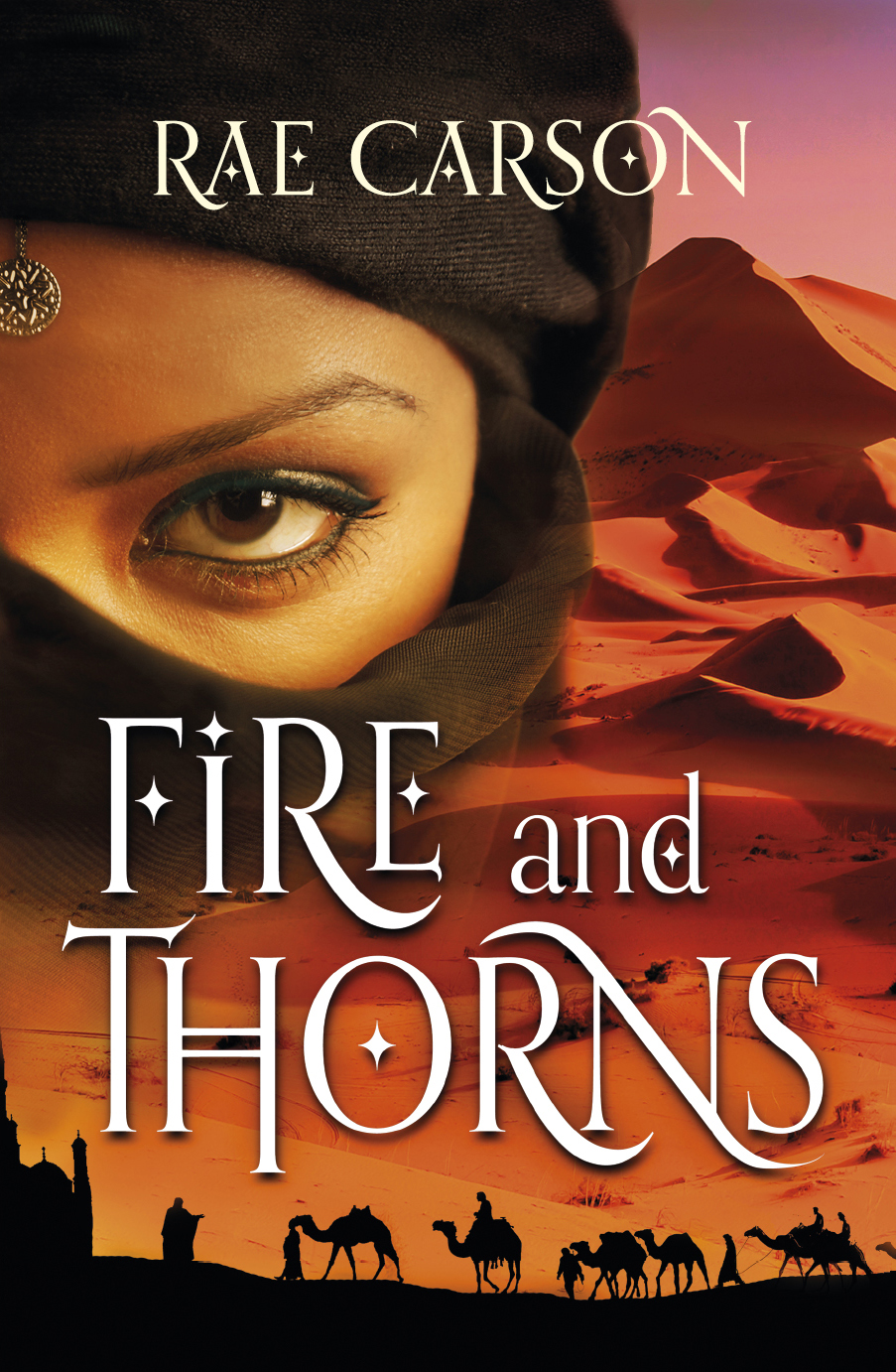
Fire and Thorns by Rae Carson

I've been looking forward to this book for quite a while now. Why? It was the first fantasy that I had ever seen that was set in an Arabian-style world, as opposed to yet another generic pseudo-Medieval, pseudo-European excuse for lazy writing. It meant different customs, different kinds of heroes and heroines. And I was really in need of a change.


Fire and Thorns is the first book in a trilogy of the same name, in which we follow the adventures of Princess Elisa. She lives in a world where once every century, God bestows upon someone a Godstone, a living jewel in their navel, that acts as a sign that they have been chosen for an act of great heroism and faith. Elisa is the current bearer of the Godstone, and at sixteen she has done little to prove that she is worthy of God's faith. She does little but pray and study ancient texts, and her crippling feelings of inferiority regarding her own abilities expresses itself through comfort eating. The first scene in the book is her ripping her hastily sewn wedding dress through bulk alone. She only feels worse when she is given away in political marriage to a man who won't even acknowledge her as his wife in his home country. But she finds that her time of service is much closer at hand than she ever imagined, and that she is in possession of greater strengths than she ever dreamed.
There is something incredibly comforting about having the main protagonist be an obese teenage girl. Not only is the humiliation of not fitting into your own clothes realised here in uncomfortably familiar detail, but it actually addresses something that you don't really see in much fiction. Fat people very rarely being the main protagonist, or in the main cast at all, and all that jazz. It confronts a weird social perception that people seem to make between weight/body shape and skill/intelligence. When Elisa starts the book, she is treated with condescension, with people more impressed than should really be warranted when they realise that she has an incredibly sharp academic and strategic mind. She has spent her entire life learning about classical texts, including texts on military strategy, and yet they're surprised by the evidence that is presented to them. Because of events in the text that I shan't spoil, she slims down quite drastically by the end. At which point she is suddenly everybody's favourite person and taken much more seriously. Admittedly, her actions up to that point must have had some impact, but maybe not quite so drastic. I guess I was just really charmed by Elisa, who really comes into her own over the course of the narrative, though I did feel somewhat predisposed towards liking her.
The plot is pretty cool, with a nice mix of political intrigue, adventure, quest and even a little bit of romance. It's pretty slow in the first part, where it's mainly courtly intrigue, but that has never really been much of an issue for me. I love courtly intrigue, so I was loving it. The second part ups the pace a fair bit and moves away from the intrigue and more towards the adventure and military sort of aspects. It took me a bit longer to warm to this bit, but still enjoyable. The romance was the most obviously weak part of the narrative. There are two main love interests, but neither go anywhere. The first is her much older husband Alejandro, which, given that she's sixteen, puts him maybe in his 30s or 40s. Either way, he's incredibly beautiful and charming, but initially has no interest in her and is pretty spineless. The second is a comrade that she meets in the second part, who seems to love her almost from the start, despite his friends' doubt in her. He's pretty sweet. Neither go anywhere and the endings of both romantic sub-plots is pretty swift and brutal. More realistic I guess, but at the same time just a tad bit confusing. My gut wants a romance sub-plot to be realistic-ish, but with an ultimately happy ending. Fire and Thorns sort of started the sub-plots, then did take-backsies and I don't know how to feel about it. In either case, the romance aspects seemed more rushed than other parts of the narrative even when they were there, so I wasn't too gutted when they were abruptly cut off.
The fantasy elements were really cool. The way that the Godstone instinctively acts towards friendly and not-so-friendly intentions, the way that Elisa can activate it through prayer, the further-reaching consequences of previous bearers' Godstones now that they aren't part of a living body. The main enemy of the narrative, the Inviernos, were kind of interesting, but not really explored much. I wanted to know more about them, what they wanted, how they lived and such. But nope. All we got was "they're pale and burn people with evil blood magic." Kind of took a page from Dragon Age there, huh? Maybe more will turn up in the following books, but it would have been nice to get a little bit more concrete info than "they're evil, run with it".

A very well written book, if a little simple at times. Definitely something to get teens into fantasy, especially girls. I would have killed for a protagonist like Elisa when I was younger. I'll probably pick up the next book in the series if I see it, although this does stand on its own quite nicely. 4/5

Next review: A Long Long Sleep by Anna Sheehan

Signing off,
Nisa.

Monday, 13 October 2014

Two Gentlemen of Verona by William Shakespeare

Wow, this is embarrassing. I did not expect to fall behind schedule quite so dramatically. Having made the first few steps toward becoming more organised though, I finally got round to reading Two Gentlemen of Verona. Not quite what I was expecting, I will admit.

Plotwise, Two Gentlemen of Verona was a lot sillier than I had initially assumed. It starts with two friends, Proteus and Valentine; the former begins the play in the process of proclaiming his undying love to the fair maiden Julia, a sentiment that the latter finds utterly ludicrous. Valentine sees no value in courting love, instead choosing to move into the court of the Duke of Milan to see and experience more of the world. As if God were just waiting for the most ironic moment, Valentine soon falls in love with the Duke's daughter, Silvia. All seems to be going well until Proteus finds himself inadvertently sent to the same court, so that he might benefit in similar ways to Valentine, where he too falls in love with Silvia. Literally the scene after he has sworn undying love with Julia. This was the point where I realised that this might be a tad on the ludicrous side. Not as rife with unbelievable coincidences as Comedy of Errors was, but still firmly on the silly side. I can very much get behind a play that looks at the conflict between what you want in relationships with different people: Proteus' betrayal of his friend to further his own suit with Silvia could be a really interesting and in-depth character study of a deeply conflicted person. The thing that makes it feel silly is the pacing: while the right dramatic beats are there, they feel shallow at best. Maybe this is something that would work for me better if I saw a production of it, but having only read it, it feels like Shakespeare was racing through these scenes as quickly as he possibly could. As a result, nothing really seems to go beyond the surface and that was a bit disappointing.
The comic relief could have been better. I realise that Proteus' idiot servant, Launce, was just a dramatic means for the main actors to have time to change between scenes, I just wish his monologues could have been more entertaining. As it is, they seem more like confused ramblings than anything actually funny. Though that may well be the Elizabethan sense of humour being lost in translation. Or maybe it's funnier on-stage. Either way, my loss, I'm sure.

Overall, a pretty harmless play. It's restored my faith in Shakespeare somewhat after the disaster that was Comedy of Errors. It would be nice to have something a little more involved next time though. 3/5

Next review: White Cat by Holly Black

Signing off,
Nisa.