So A Heartbreaking Work of Staggering Genius was another book that I picked up in a bundle. It wasn't necessarily something that I would have picked up on the strength of its blurb or subject matter alone, but I did find my interest piqued by the fact that it won the Pulitzer Prize. I have found prize winners to be something of a mixed bag, but there's still something about them that makes me want to try them, just to see how I compare to an "expert" panel.
A Heartbreaking Work of Staggering Genius is a memoir following the author's life in the years following his parents' cancer-related deaths. He must take responsibility for his younger brother, Toph, who is only 8 when their parents pass away. Thrust suddenly into the role of parent, he has to try and deal with the fact that his new responsibilities prevent him from a lot of activities that he would like to do as a man in his early-twenties.
I haven't actually finished A Heartbreaking Work of Staggering Genius. I honestly tried, but the thought of trying to slog through any more of this tripe is just depressing. Until this point, I couldn't understand how there are people out there who genuinely don't like reading, but I think this book has made me realise how they feel.
So, I suppose the big question is what made me not want to finish this one. What it was that made me break the one rule that I have had since starting this blog in January 2011. It was the writing style. While I have expressed a liking for postmodern fiction in previous blog entries, there was something a little too manufactured and artificial about the way that it was presented in A Heartbreaking Work. Metafiction is just one of those things that needs to be properly signposted, instead of thrown into the mix whenever you feel like it. Eggers also seemed to have a grudge against the humble full stop, as his book was full of sentences that went on for-fucking-ever. I get it, you like fragments. How about a sentence that doesn't make me want to throat punch you and force you to draw breath like a regular human being. Overall, I just got an impression of some dumb twenty-something who is trying to be way too clever in order to compensate for some deep-seated issues that he really should have worked out with a therapist beforehand. Maybe that's exactly the sort of impression that I was meant to get, but it doesn't do anything for my enjoyment of the novel. And it's sort of a shame, because from what I've read of him, Eggers seems like a nice guy, with a lot of worthy philanthropic causes that he supports. I feel like he could have given a better account of himself.
So there's a thing that I feel that I should probably address. Why did this book make me DNF and not one of the other books that I have rated 1/5? It's a fair question. I think the reason that I got through some other terrible books successfully because they invoked an active emotion out of me. Most of the time my response to my 1/5 rated books has been anger, or occasionally horrified amusement. Regardless of which, both of those states make me feel energised, make me feel like my mind is going a mile a minute, and I absolutely love those moments when I can get that on paper. Since starting this blog, A Heartbreaking Work of Staggering Genius is the first book that made me feel like my soul was being sapped with every extraneous fragment and with every time he referred to himself or his brother as god-like. Usually my less pleasant reads leave me feeling shaky or overwrought, but never before have I felt sapped of energy. The only word that I can think of for this is grey, like it's wrung out all the interest in my brain and left me with dishwater for a soul. If this is what some people's experience of reading is, then I can see why you wouldn't want to try it again. So yeah, I'm altering my rule. I will now allow for DNFs if a book makes me actively wonder why I like reading in the first place.
Never before has a book left me so drained of enthusiasm. Usually I get angry at books I don't like. This time, I just don't have the energy. It's the first book I've DNF'd in over 7 years, and I am just stunned that I found something that could beat even my stamina for not-so-great books. I'm sure there's an audience for this, but I couldn't even begin to understand who it would consist of. 1/5
Next review: Lords and Ladies by Terry Pratchett
Signing off,
Nisa.
Search This Blog
Showing posts with label Literary. Show all posts
Monday, 14 May 2018
Wednesday, 6 September 2017
The Fires by Rene Steinke
The reason for me picking The Fires to read is going to sound really stupid and dull. For my birthday one year, I received a load of ebooks on a USB stick, some of which were some series that I had been very keen to get. But I'd also never transferred anything like that onto my tablet, so I picked a book at random to test out the process. That book was The Fires and since I never got round to removing it from said tablet, I figured that I might as well give it a whirl.
The Fires follows a young woman called Ella in the aftermath of her grandfather's suicide. She finds herself struggling with her grief, which is only compounded by her mother and grandmother's refusal to acknowledge that the cause of death was anything but natural causes. To try and cope, she tries to find her estranged aunt to pass on the news of his passing, and when that isn't enough to quiet her state of mind, she sets things on fire.
This is something of an odd novel. Its most obvious strength is the writing style, which is very lyrical and vivid. The problem arises because instead of accentuating intriguing characters and a dark, tormented family drama, it accentuates just how much the characters and plot lack in depth. With regards to character development, Steinke seems to have gone to the school of characterisation that dictates that the key to good characterisation involves mounting dysfunction on dysfunction like you're playing a particularly poor taste bingo game. Ella is a particularly egregious example. She sets fires, then she's an insomniac, then she has alcohol dependency issues from her attempts to medicate her insomnia, then she has body confidence issues stemming from burn scars from a childhood accident. And all of that is before you begin to touch the myriad of tedious micro-traumas that she has heaped on with her family members. What could be interesting character flaws individually becomes a featureless mass of depression. None of her flaws are aggravating, but neither can I really think of any positive qualities. She's not a racist, so there's that.
As for the plot, it seemed like it was going somewhere interesting, but then Steinke drops the biggest plot bombshell right in the middle. After that, nothing really tops that shock and the further revelations are a bit weak and predictable in comparison. If they'd been paced in a different order, then it would probably have worked out better, but as it is it's strong until the mid-point then an exercise in stretching out time and patience.
There's the basis of what could have been a really good novel in the mess that is The Fires, but it's just put together all wrong. The main character Ella is more an amalgamation of dysfunctions that probably aimed at making someone intriguing and tortured, but only leaves a confused impression of a person where her sole good quality is that she isn't a racist. The plot has a lot of revelations about Ella's family that are good on paper, but presented in the wrong order so that the tension leeches out almost immediately after the first big plot twist at the plot's mid-point. I wanted to care, but couldn't in the end. 2.5/5
Next review: Reaper Man by Terry Pratchett
Signing off,
Nisa.
The Fires follows a young woman called Ella in the aftermath of her grandfather's suicide. She finds herself struggling with her grief, which is only compounded by her mother and grandmother's refusal to acknowledge that the cause of death was anything but natural causes. To try and cope, she tries to find her estranged aunt to pass on the news of his passing, and when that isn't enough to quiet her state of mind, she sets things on fire.
This is something of an odd novel. Its most obvious strength is the writing style, which is very lyrical and vivid. The problem arises because instead of accentuating intriguing characters and a dark, tormented family drama, it accentuates just how much the characters and plot lack in depth. With regards to character development, Steinke seems to have gone to the school of characterisation that dictates that the key to good characterisation involves mounting dysfunction on dysfunction like you're playing a particularly poor taste bingo game. Ella is a particularly egregious example. She sets fires, then she's an insomniac, then she has alcohol dependency issues from her attempts to medicate her insomnia, then she has body confidence issues stemming from burn scars from a childhood accident. And all of that is before you begin to touch the myriad of tedious micro-traumas that she has heaped on with her family members. What could be interesting character flaws individually becomes a featureless mass of depression. None of her flaws are aggravating, but neither can I really think of any positive qualities. She's not a racist, so there's that.
As for the plot, it seemed like it was going somewhere interesting, but then Steinke drops the biggest plot bombshell right in the middle. After that, nothing really tops that shock and the further revelations are a bit weak and predictable in comparison. If they'd been paced in a different order, then it would probably have worked out better, but as it is it's strong until the mid-point then an exercise in stretching out time and patience.
There's the basis of what could have been a really good novel in the mess that is The Fires, but it's just put together all wrong. The main character Ella is more an amalgamation of dysfunctions that probably aimed at making someone intriguing and tortured, but only leaves a confused impression of a person where her sole good quality is that she isn't a racist. The plot has a lot of revelations about Ella's family that are good on paper, but presented in the wrong order so that the tension leeches out almost immediately after the first big plot twist at the plot's mid-point. I wanted to care, but couldn't in the end. 2.5/5
Next review: Reaper Man by Terry Pratchett
Signing off,
Nisa.
Sunday, 13 November 2016
The Dice Man by Luke Rhinehart
The Dice Man was another book that I picked up because I adored the concept as presented by the blurb. Having had that method of picking books to read backfire on me more recently, I came to this perhaps a little more warily than I may have initially picked it up. But I am ever optimistic, so the book was not to be abandoned regardless of wary preconceptions.
Presented as an autobiography, The Dice Man follows Luke Rhinehart, a respected psychiatrist and happily married father of two, who finds that despite his life being successful in all areas deemed socially acceptable he is unhappy and bored. Whilst drunk one night, he decides to base his next decision on the roll of the dice: roll a one and he is to have sex with his colleague's wife, roll any other number and he is to go to bed and continue life as normal. When he gets a one, he finds that leaving the decision-making to chance has opened up possibilities that he could never have expected.
Having now finished reading The Dice Man, I find myself a little lost with regards to how it should be reviewed. Because the issue with a main character who compulsively bases his decisions and behaviour on dice rolls can't really have a character arc as such. While your average novel would focus on a change from one status quo to another via a period of conflict. So when your main character has their character arc within the first third of the novel, transitioning from regular socialised human being to a diceman, the rest of the novel becomes watching the rest of the world reject or accept the radically different main character. While that can be an interesting prospect, I will admit that it does make the events of the novel blur somewhat. It was by no means uninteresting, but when your protagonist's reaction to every major decision is "as the Dice wills" then the only way for them to have any meaning is by measuring the reactions of secondary characters, all of whom are essentially pitied by not being dicepeople. So yeah, I can see why a lot of readers would find this a bit on the bloated side.
Another thing to consider when picking up The Dice Man is that it is set in the late 1960s-early 1970s, and the attitudes really reflect this. It's weird how things like black-suffrage and the anti-Vietnam protests are mentioned, but don't really get much focus beyond "I work in a mental facility and many of these people are sectioned". Honestly, it can get a bit uncomfortable with how unsympathetically they can be portrayed at times. Probably not a thing that you'd want to focus on for your psychology novel, but perhaps a bit unfortunate.
The only thing that honestly bothers me is that the book doesn't so much end as stop. In the middle of a sentence too. While I don't think that the subject matter would ever really allow for a proper, satisfying ending, I do somewhat object to stopping in the middle of a sentence.
A weird novel that kind of defies definition. While an interesting concept, it does suffer from the fact that the main character's changes are all artificially dictated, so the majority of the novel's events suffer from blurring together. Might still be worth it if you are ready for this when first picking it up. 3/5
Next review: The Benson Murder Case by S. S. Van Dine
Signing off,
Nisa.
Labels:
Literary,
Psychology
Tuesday, 19 July 2016
The House of Mirth by Edith Wharton
Ever since starting my blog, I had heard good things about Edith Wharton. She wasn't an author that I had heard of before then despite being what one could class as a "classic" writer. Considering that the praise for her writing was immense from the blogs that I followed, I thought that it might be an idea to try out one of her books that I had seen particularly touted, The House of Mirth.
The House of Mirth follows Miss Lily Bart, a beautiful young woman who seeks to climb the ladder of her social circle amongst New York's nouveaux riche. Brought up with a strict aversion to dinginess despite her family's comparatively modest means, she aims to marry a husband who can provide her both with luxury and endless admiration. She finds herself, however, meeting a succession of obstacles born out of missteps of conduct that would be harmless enough were her peers not morally bankrupt to one extent or another.
I already mentioned that I had heard good things about Edith Wharton's books, but damn could that lady ever write. It has been a long time since a book has been well-written enough that I have been so torn between putting it down because it's too tense, and continuing reading because I need to know what happens. Admittedly, I do have a weakness for books that fall into the comedy of manners, especially those that are particularly sharp and backstabbing, but there is something particularly engaging about The House of Mirth. I believe that the key to its success is the main character, Lily Bart. She is the feminine epitome of the classic tragic hero: have a particular flaw that causes her to make a mistake great enough that she suffers a great fall and enough pride that she cannot undo the mistake once she has made it. What makes Lily interesting is that her flaw is essentially that she has scruples. At the beginning of the novel, she knows that in order to attain the wealth that she wants, she needs to act in a certain way to attract a particular rich gentleman. But she fails at the last hurdle because she finds herself unable to tolerate the idea of the vapid life that she would lead as a result, always having to keep up these lies in the process. And this continues throughout the novel: she meets an obstacle or fixes on a goal, gets most of the way there through scheming and manipulation, but is brought up short by an abhorrence towards the very underhanded tactics that can only benefit her. It's a fascinating inner struggle to watch, but certainly not an easy one to stomach at times. Towards the end, it also becomes increasingly obvious what the end has to be, but it is no less enthralling because of that .
A fascinating look at one woman's struggles with the social mores of her peers, and her incompatible needs for integrity and wealth. Fantastically written and definitely one to pick up if you have the time. 5/5
Next review: Perfume: The Story of a Murderer by Patrick Suskind
Signing off,
Nisa.
The House of Mirth follows Miss Lily Bart, a beautiful young woman who seeks to climb the ladder of her social circle amongst New York's nouveaux riche. Brought up with a strict aversion to dinginess despite her family's comparatively modest means, she aims to marry a husband who can provide her both with luxury and endless admiration. She finds herself, however, meeting a succession of obstacles born out of missteps of conduct that would be harmless enough were her peers not morally bankrupt to one extent or another.
I already mentioned that I had heard good things about Edith Wharton's books, but damn could that lady ever write. It has been a long time since a book has been well-written enough that I have been so torn between putting it down because it's too tense, and continuing reading because I need to know what happens. Admittedly, I do have a weakness for books that fall into the comedy of manners, especially those that are particularly sharp and backstabbing, but there is something particularly engaging about The House of Mirth. I believe that the key to its success is the main character, Lily Bart. She is the feminine epitome of the classic tragic hero: have a particular flaw that causes her to make a mistake great enough that she suffers a great fall and enough pride that she cannot undo the mistake once she has made it. What makes Lily interesting is that her flaw is essentially that she has scruples. At the beginning of the novel, she knows that in order to attain the wealth that she wants, she needs to act in a certain way to attract a particular rich gentleman. But she fails at the last hurdle because she finds herself unable to tolerate the idea of the vapid life that she would lead as a result, always having to keep up these lies in the process. And this continues throughout the novel: she meets an obstacle or fixes on a goal, gets most of the way there through scheming and manipulation, but is brought up short by an abhorrence towards the very underhanded tactics that can only benefit her. It's a fascinating inner struggle to watch, but certainly not an easy one to stomach at times. Towards the end, it also becomes increasingly obvious what the end has to be, but it is no less enthralling because of that .
A fascinating look at one woman's struggles with the social mores of her peers, and her incompatible needs for integrity and wealth. Fantastically written and definitely one to pick up if you have the time. 5/5
Next review: Perfume: The Story of a Murderer by Patrick Suskind
Signing off,
Nisa.
Friday, 8 July 2016
A Method Actor's Guide to Jekyll and Hyde by Kevin MacNeil
Continuing in my literary vein, I decided to pick up A Method Actor's Guide to Jekyll and Hyde. I am something of a fan of the original Robert Louis Stevenson story, and the theme of duality is always an interesting one to explore. Add in the promise of a bit of the supernatural and I was really looking forward to this.
Robert Lewis is a young actor currently rehearsing for the dual role of Jekyll and Hyde in a new production of the Stevenson play. When he is the victim of a bike accident one foggy morning in his home city of Edinburgh, he leaves the hospital and finds the world stranger and darker than he remembered it. He must try and resume his life as best he can when the world seems to be actively conspiring against him.
I hated this novel so damn much. There are two principle reasons for why A Method Actor's Guide to Jekyll and Hyde just does not work, and conveniently it works out as one reason for each part that the novel is split into.
So, the reason I didn't like Part 1? The main character Robert. He was a reasonably well fleshed-out character, but that didn't matter, because apparently all this guy could do was whine and gripe about how much better an actor he is than everybody else and why does nobody love him?! When your plot for the entirety of the first part is a complaining two-bit hack being repeatedly humiliated by similarly awful people and planning to get revenge on his not-quite-ex-girlfriend, it gets really pathetic really quickly. I had hoped for it to improve as he got more into the role of Jekyll and Hyde, but then Part 2 happened and it just plummeted even further in my estimation than I ever thought it could.
The reason I didn't like Part 2 is some major spoiler material, but at this point I doubt that I am selling this piece of trash to anyone, so here goes anyway. Part 2 is where you find out that it was all a dream. Honest to god, it turns out that the entirety of the previous part was a dream experienced while a writer was in a coma following a bike accident. I didn't think that a twist this hackneyed and cliched actually passed through publication houses. I don't think I've actually seen this twist played out since I was in pre-school, and that was only because people assume that children have ridiculously low standards. So not only have I suffered through Robert's bitching and snivelling in the first place, but it then turns out to be entirely pointless because he's not actually real. Great. I am still considering burning A Method Actor's Guide to Jekyll and Hyde, it pissed me off that much. You cannot pull bullshit like this and then parade it around like it's high art. No.
I am just so angry at this book for wasting my time. The first part is marred by a protagonist so up his own arse that he could probably count as a genuine ouroboros, and then the second part manages to make it even worse with a twist that is usually confined to the worst and most patronising of children's fiction. Don't bother with this at all. 1/5
Next review: Mrs Dalloway by Virginia Woolf
Signing off,
Nisa.
Robert Lewis is a young actor currently rehearsing for the dual role of Jekyll and Hyde in a new production of the Stevenson play. When he is the victim of a bike accident one foggy morning in his home city of Edinburgh, he leaves the hospital and finds the world stranger and darker than he remembered it. He must try and resume his life as best he can when the world seems to be actively conspiring against him.
I hated this novel so damn much. There are two principle reasons for why A Method Actor's Guide to Jekyll and Hyde just does not work, and conveniently it works out as one reason for each part that the novel is split into.
So, the reason I didn't like Part 1? The main character Robert. He was a reasonably well fleshed-out character, but that didn't matter, because apparently all this guy could do was whine and gripe about how much better an actor he is than everybody else and why does nobody love him?! When your plot for the entirety of the first part is a complaining two-bit hack being repeatedly humiliated by similarly awful people and planning to get revenge on his not-quite-ex-girlfriend, it gets really pathetic really quickly. I had hoped for it to improve as he got more into the role of Jekyll and Hyde, but then Part 2 happened and it just plummeted even further in my estimation than I ever thought it could.
The reason I didn't like Part 2 is some major spoiler material, but at this point I doubt that I am selling this piece of trash to anyone, so here goes anyway. Part 2 is where you find out that it was all a dream. Honest to god, it turns out that the entirety of the previous part was a dream experienced while a writer was in a coma following a bike accident. I didn't think that a twist this hackneyed and cliched actually passed through publication houses. I don't think I've actually seen this twist played out since I was in pre-school, and that was only because people assume that children have ridiculously low standards. So not only have I suffered through Robert's bitching and snivelling in the first place, but it then turns out to be entirely pointless because he's not actually real. Great. I am still considering burning A Method Actor's Guide to Jekyll and Hyde, it pissed me off that much. You cannot pull bullshit like this and then parade it around like it's high art. No.
I am just so angry at this book for wasting my time. The first part is marred by a protagonist so up his own arse that he could probably count as a genuine ouroboros, and then the second part manages to make it even worse with a twist that is usually confined to the worst and most patronising of children's fiction. Don't bother with this at all. 1/5
Next review: Mrs Dalloway by Virginia Woolf
Signing off,
Nisa.
Tuesday, 5 July 2016
The Upright Piano Player by David Abbott
I picked up The Upright Piano Player at around the same time as Hotel du Lac, as I was evidently in a literary fiction kind of mood. This does contrast nicely with my last read though: older vs within the last decade, established writer vs debut writer, that kind of thing. And with a hint of a thriller about it, I had some moderately high hopes for this one.
In The Upright Piano Player, the reader follows Henry, a man well known for both his business sense and his strong set of principles. After he takes early retirement, however, he finds his well-ordered life beginning to fall apart around him. His ex-wife contacts him with news that she's terminally ill, his son reappears in his life after years of estrangement, and he finds himself the victim of sustained harassment starting with an assault on the eve of the new millennium. All of these stand to test the defences that he has built up over the course of his lifetime.
After all the cover quotes describing The Upright Piano Player as wise and moving and elegant, I was severely disappointed by the jumbled mess of a book that I actually got. I think that the main problem that this book has is a lack of focus, a flaw that mires the entirety of the book in self-congratulating meandering that believes itself to be deep words of wisdom. Mostly this can be seen in the two main plot strands that trouble Henry throughout: his turbulent history and reintegration with his estranged family, and the harassment that he suffers at the hands of a stranger. If this were a competent debut, the two plot threads would at some point become entwined with one another and feed into each other's tension. As it is, the two never meet in any meaningful way, often being split by a literal ocean. It feels very much like the author was torn between writing a thriller and writing the next great novel about the human condition. Apparently unable to pick between the two, he slaps both of them onto the page and cobbles together a semblance of a plot where both could maybe happen simultaneously.
Another example of this lack of focus is the glaring difference between the main body of the novel set in 1999-2000 as described above, and the brief section of Henry's life in 2004 that is narrated at the beginning. I am in two minds about this section. On the one hand, it is the only section that isn't desperately pedestrian in writing style, and it actually manages to convey a startling amount of emotion in a very short space. When I read that first part, with Henry attending the funeral of his own grandson whose death he feels more that partly responsible for, I was really excited for the rest of the story. On the other hand, it is completely and utterly pointless in regards to the actual story. It never comes up again. I don't know, maybe Abbott had to bump up the word count or something, but I cannot forgive the way that such a heartfelt piece of writing could just be stapled on at the beginning like that, with no intent to resolve anything brought up as a result of that funeral scene. I would have read the novel about a grandfather trying to deal with guilt and grief, that could have been interesting. As it was, it is an impressive opening to a damp squib of a book. Highly infuriating.
The last thing that bothers me is the weird way that the characters act sometimes, especially Henry's family. There are times during the novel where characters do things that seem to serve no other purpose than to cause Henry suffering, even if it was something that people generally wouldn't do in those circumstances. The most obvious example of this is the breakdown of Henry's marriage to his ex-wife Nessa, and the subsequent estrangement from the rest of his family. So, Henry's marriage ends when Nessa has an affair to make up for her husband's frequent absences at work; when it comes out publicly and her new squeeze leaves her in the lurch, Henry rejects her when she tries to come back to him. All well and good so far. It's tragic, but I can understand why he wouldn't want to be with someone who can so easily betray his trust. What I can't understand is his son's decision to side entirely with his mother to the point of cutting off all contact with Henry. Sure, the man is curmudgeonly and a workaholic, but this is not something that people decide to do lightly and it certainly isn't a cruel decision of his regardless of what the book would like us to think. As such, the son's decision is utterly mind-boggling, especially when you find out that Henry was a grandfather for 4 years without even knowing that his son had gotten married, let alone had children. That the son doesn't once consider whether that was a bad decision is kind of horrifying. That's a level of callousness that I would hope most people would never deliberately inflict on their family. The fact that Nessa appears to be characterised as only a step below the second coming of Christ only makes this whole family debacle all the more frustrating. Just because she's dying doesn't mean you can't depict her like the flighty bitch that she is.
This is a mess through and through. The lack of focus is the biggest flaw, with the narrative vacillating between a story about family ties and a thriller, with a partially written study on grief stuck to the beginning with apparently no thought of how it affects or interacts with the rest of the novel. Additionally, it would appear that some characters do things specifically so that the main character can suffer a bit more. And to add the cherry on top, the title of The Upright Piano Player doesn't have any significance whatsoever. It would have been more accurate if they'd titled it "Misery for Misery's Sake". 1.5/5
Next review: The Last Battle by C. S. Lewis
Signing off,
Nisa.
In The Upright Piano Player, the reader follows Henry, a man well known for both his business sense and his strong set of principles. After he takes early retirement, however, he finds his well-ordered life beginning to fall apart around him. His ex-wife contacts him with news that she's terminally ill, his son reappears in his life after years of estrangement, and he finds himself the victim of sustained harassment starting with an assault on the eve of the new millennium. All of these stand to test the defences that he has built up over the course of his lifetime.
After all the cover quotes describing The Upright Piano Player as wise and moving and elegant, I was severely disappointed by the jumbled mess of a book that I actually got. I think that the main problem that this book has is a lack of focus, a flaw that mires the entirety of the book in self-congratulating meandering that believes itself to be deep words of wisdom. Mostly this can be seen in the two main plot strands that trouble Henry throughout: his turbulent history and reintegration with his estranged family, and the harassment that he suffers at the hands of a stranger. If this were a competent debut, the two plot threads would at some point become entwined with one another and feed into each other's tension. As it is, the two never meet in any meaningful way, often being split by a literal ocean. It feels very much like the author was torn between writing a thriller and writing the next great novel about the human condition. Apparently unable to pick between the two, he slaps both of them onto the page and cobbles together a semblance of a plot where both could maybe happen simultaneously.
Another example of this lack of focus is the glaring difference between the main body of the novel set in 1999-2000 as described above, and the brief section of Henry's life in 2004 that is narrated at the beginning. I am in two minds about this section. On the one hand, it is the only section that isn't desperately pedestrian in writing style, and it actually manages to convey a startling amount of emotion in a very short space. When I read that first part, with Henry attending the funeral of his own grandson whose death he feels more that partly responsible for, I was really excited for the rest of the story. On the other hand, it is completely and utterly pointless in regards to the actual story. It never comes up again. I don't know, maybe Abbott had to bump up the word count or something, but I cannot forgive the way that such a heartfelt piece of writing could just be stapled on at the beginning like that, with no intent to resolve anything brought up as a result of that funeral scene. I would have read the novel about a grandfather trying to deal with guilt and grief, that could have been interesting. As it was, it is an impressive opening to a damp squib of a book. Highly infuriating.
The last thing that bothers me is the weird way that the characters act sometimes, especially Henry's family. There are times during the novel where characters do things that seem to serve no other purpose than to cause Henry suffering, even if it was something that people generally wouldn't do in those circumstances. The most obvious example of this is the breakdown of Henry's marriage to his ex-wife Nessa, and the subsequent estrangement from the rest of his family. So, Henry's marriage ends when Nessa has an affair to make up for her husband's frequent absences at work; when it comes out publicly and her new squeeze leaves her in the lurch, Henry rejects her when she tries to come back to him. All well and good so far. It's tragic, but I can understand why he wouldn't want to be with someone who can so easily betray his trust. What I can't understand is his son's decision to side entirely with his mother to the point of cutting off all contact with Henry. Sure, the man is curmudgeonly and a workaholic, but this is not something that people decide to do lightly and it certainly isn't a cruel decision of his regardless of what the book would like us to think. As such, the son's decision is utterly mind-boggling, especially when you find out that Henry was a grandfather for 4 years without even knowing that his son had gotten married, let alone had children. That the son doesn't once consider whether that was a bad decision is kind of horrifying. That's a level of callousness that I would hope most people would never deliberately inflict on their family. The fact that Nessa appears to be characterised as only a step below the second coming of Christ only makes this whole family debacle all the more frustrating. Just because she's dying doesn't mean you can't depict her like the flighty bitch that she is.
This is a mess through and through. The lack of focus is the biggest flaw, with the narrative vacillating between a story about family ties and a thriller, with a partially written study on grief stuck to the beginning with apparently no thought of how it affects or interacts with the rest of the novel. Additionally, it would appear that some characters do things specifically so that the main character can suffer a bit more. And to add the cherry on top, the title of The Upright Piano Player doesn't have any significance whatsoever. It would have been more accurate if they'd titled it "Misery for Misery's Sake". 1.5/5
Next review: The Last Battle by C. S. Lewis
Signing off,
Nisa.
Sunday, 3 July 2016
Hotel du Lac by Anita Brookner
I vaguely remember picking up Hotel du Lac at a hospital bookshop, though I probably couldn't tell you why. I would imagine that I had heard good things about it from other bloggers that I followed at the time, which would probably go further in my mind than it winning the Booker Prize would. I suppose I wanted something a bit gentler after the cluster of awful that was Keeping It Real, and when one of the reviews calls it "a smashing love story" I had at least pleasant expectations.
Hotel du Lac follows Edith Hope, a romance novelist who has been exiled by her friends after she commits a social scandal that has left all those involved humiliated. Retreating to the eponymous Hotel du Lac, she intends to take advantage of her arrival taking place out of season by powering through her current novel while she waits for things to die down at home. Without intending it, she is drawn into the personal dilemmas of the other out-of-season residents and finds herself re-examining who she is as a person.
That quote I mentioned above about this being a smashing love story was from the Times. I am almost certain that whoever they got to review Hotel du Lac didn't actually read it, since this is most definitely not a love story. Unless it was a half-hearted attempt to try and define what it is genre-wise, since that is a bit of a tough question to answer. If I were to try and define it as anything, then I would call it a character study, although it is strangely static and timeless. I hear that there is a film adaptation by the BBC, but I honestly can't see that translating well to screen considering that almost all the actual development is in Edith's head. In terms of her behaviour towards her other guests, she is more or less treated like a sounding board throughout her stay as she plays the quiet and unassuming spinster. So to try and translate major alterations that play out in such an understated character must be difficult if not impossible. It felt weirdly like a long, protracted dissociative episode of Edith's, where everything feels both unreal enough that events must be happening to other people and yet grave enough that she must pay attention to see how it will affect her. I don't think I'm selling it particularly well, but I did quite enjoy it in a muted and kind of unsettled way. I think that if you have the patience to read it and mull over it a little, then you could get a lot out of it, if not necessarily in a way that you could describe with ease.
I will just mention the gender politics, since that seems to come up as a negative point in some of the more recent reviews that I have found for Hotel du Lac. Edith comes out pretty quickly and says that she prefers the company of men to that of her own gender, which is why it frustrates her a little to find that most of her company both at home and at the hotel are female. And she slowly builds up a picture of her view of gender that is inherently combative: the interactions that one has with their own gender leads them to instinctively seek out company outside of that, and will generally lead to marriage. At one point she states that women bond over shared sadness, but will use happiness as a weapon against other women. I can definitely see why people find that an uncomfortable thing to read, especially given that it was written in the 80s and shouldn't we have known better by then. I would argue though that this is perhaps a little unfair. This is coming from a woman fast approaching her forties, constantly being told by her publishers that her protagonists need to be harder and edgier to better suit the ideal of the era, and constantly having to ward away attempts to set her up by her friends. She is being told on all sides that she does not fit the standards of an ideal woman and will therefore be doomed to loneliness. And given that our society is constructed in such a way that marriage is often perceived to be the ultimate goal for women, a stance propagated both by men and women, it must feel very much like she is under attack for the way that she lives. So while I don't entirely share her sentiments, I feel that it makes sense for her character and that she definitely has reason for thinking as she does.
A languid novel that shows Edith's character changing in response to the weirdly static nature of her surroundings and the oddly flat characters that live within it. It is a curious read, like stepping into a dissociative bubble where places and events are both momentous and utterly inconsequential. If you have the patience to mull it over, I think you could gain a lot from reading Hotel du Lac. I know that some have issues with some of the gender politics stated by the main character, but while they are not something that I entirely agree with, I think that they make sense for an unmarried woman stuck in a marriage-obsessed world. 4.5/5
Next review: The Upright Piano Player by David Abbott
Signing off,
Nisa.
Thursday, 16 October 2014
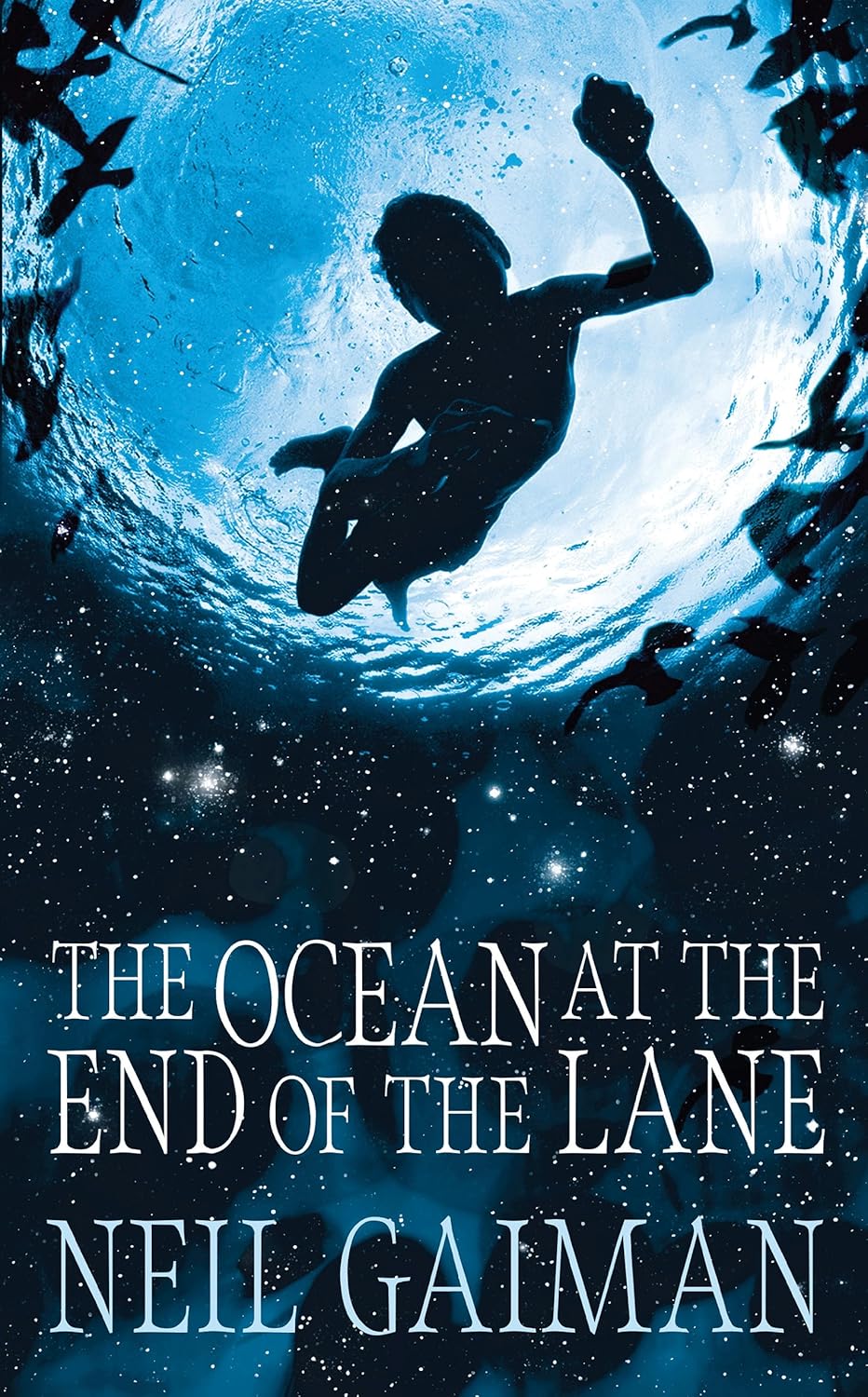
The Ocean at the End of the Lane by Neil Gaiman
The Ocean at the End of the Lane is probably a book that I would have eventually gotten around to reading, for two reasons. One, I had heard very good things about it, even from people who don't normally like fantasy. Two, I had read some of his work before, mainly the first couple volumes of the Sandman comics and liked what I'd seen. As it was, my fiance practically begged me to read it next, and seeing as that was several months ago, I can't really keep putting it off.
The Ocean at the End of the Lane follows the unnamed narrator as he returns to the country lane where he spent his early childhood, and finds himself drawn to the house at the very end of the lane. There, he reminisces about the childhood friend, Lettie Hempstock by name, who used to live there with her mother and grandmother and believed that the duck-pond in her garden was an ocean. At first, his childhood looks to be normal, if unusually solitary for a seven year old boy. It is only when a lodger of his parents' kills himself in the family car that strange things begin to occur, and the narrator finds himself a mostly unwilling participant in the upcoming events.
I finished this book this morning, and my first thought was "Well, that happened." While that sounds flippant, it was meant in the kind of distressed bewilderment that accompanies the ending of a very well-written book that you have no clue what the meaning of it was meant to be. I suppose the thing that really caught me off-guard was the surreal, languid sort of tone that it had. Things certainly happened, quite distressing things at times, but it always seemed like it was happening at arm's length somehow. I suppose that the closest thing that I can compare it to would be a fairy tale: vivid events told in such a way that they are given distance and a strange, off-kilter viewpoint. The other thing that caught me out at the end was the feeling that the story wasn't finished. Not in terms of actual plot-line, that was absolutely fine. I mean in a more deliberate way; the story feels unfinished because the narrator isn't ready to let it go yet. The overall effect of this, mixed with the aforementioned tone, seems to be that of a myth for adults, the kind of simple story that we kind of forget about and underestimate as we grow older.
As I've ruminated over the course of the day, I was wondering what Ocean at the End of the Lane was about, at least for me. I kept coming back to a line of dialogue that turns up towards the end. The line in question was, "Does it make you feel big to make a little boy cry?" It wasn't a moment that initially seemed huge in context, but it stayed in my head far longer than other parts, and when that happens it's usually a sign to pay attention. So I guess for me, it's become a kind of fable about the damage that can happen to children when they come into conflict with adults; you sort of assume that with age comes wisdom, but there are a lot of essential things that you sort of deliberately forget as you grow. When that comes into conflict with what we've decided is "grown-up" behaviour, then the child is almost guaranteed to lose, regardless of whether that's right or not. It's something that Gaiman keeps pointing to throughout the story and it got more than a little uncomfortable. Maybe I needed to feel a little uncomfortable.
It's an odd book to recommend. I wouldn't recommend it to anyone who wants the feelings to be simple and clear-cut, because that is as far from what you'll get as is possible to define. The Ocean at the End of the Lane is a book that reads simply, but feels much bigger than you would expect from 243 pages. I've done my best to define what it's left me, but I think that personal experience will always trump my descriptions. 5/5
Next review: White Crow by Marcus Sedgwick
Signing off,
Nisa.
Thursday, 4 July 2013
The Late Hector Kipling by David Thewlis
This was a weird purchase for me. I'm more familiar with David Thewlis' work as an actor, specifically his work in the Harry Potter films, so when I found out that he'd written a novel I had mixed feelings. On the one hand, I like what I've seen of him. On the other, I only knew him as an actor, so there was no real guarantee of whether he'd be as good in a different profession. But I decided to pick it up anyway, because I've started reading something on far worse expectations before.
The Late Hector Kipling is an odd book, to say the least. It follows the catastrophic fall of the eponymous Hector Kipling, an artist known for painting giant heads. He starts the novel in that odd place found by those who are moderately successful: famous enough that the name rings a bell, but not quite successful enough to be widely known and discussed. In comparison, he has two other artist friends: Kirk Church, a failed artist obsessed with painting cutlery, and Lenny Snook, an artist up for the Turner Prize (and very much in the vein of Damien Hirst and Tracey Emin). So far, so innocuous. It is only when Kirk announces that he has a brain tumour that Hector's life starts to spiral out of control.
The characters populating this book tend to fall into one of two categories: unlikeable or just kind of bizarre. In the first category, there is Hector himself, as he manages to single-handedly destroy his whole life through the combination of selfishness, cowardice and a weird apathy and detachment towards others. He is not wholly detestable though, which helps things hugely. Most of the other characters tend to fall more in the bizarre category, simply because of their oddly two-dimensional natures. This might be because of Hector's strange outlook on things though, which could bring up some interesting discussions.
As to who I would recommend this to, there are a few things to consider. The writing is, on the whole, pretty damn good. It can get a bit overly-snobbish when it comes to art, but then that fits Hector's character as a second-rate artist. At the same time, it does have quite a bit of bad language, which may bother some. And overall, there are some very strange, if interesting, metaphors sprinkled liberally through the narrative. So there's that to consider. If you're on the fence, I would say give it the benefit of the doubt. I would definitely recommend it if you've been looking for an author similar to Will Self, although I would say that David Thewlis is perhaps more accessible than Self is.
A part of me is still a little nonplussed by The Late Hector Kipling, but I am definitely glad that I read it. I'd try it if you're a Will Self fan, or if you're trying to work yourself up to him. If I were to see more of Thewlis' work, then I would be more than happy to read it. 3.5/5
Next review: Worldstorm by James Lovegrove
Signing off,
Nisa.
The Late Hector Kipling is an odd book, to say the least. It follows the catastrophic fall of the eponymous Hector Kipling, an artist known for painting giant heads. He starts the novel in that odd place found by those who are moderately successful: famous enough that the name rings a bell, but not quite successful enough to be widely known and discussed. In comparison, he has two other artist friends: Kirk Church, a failed artist obsessed with painting cutlery, and Lenny Snook, an artist up for the Turner Prize (and very much in the vein of Damien Hirst and Tracey Emin). So far, so innocuous. It is only when Kirk announces that he has a brain tumour that Hector's life starts to spiral out of control.
The characters populating this book tend to fall into one of two categories: unlikeable or just kind of bizarre. In the first category, there is Hector himself, as he manages to single-handedly destroy his whole life through the combination of selfishness, cowardice and a weird apathy and detachment towards others. He is not wholly detestable though, which helps things hugely. Most of the other characters tend to fall more in the bizarre category, simply because of their oddly two-dimensional natures. This might be because of Hector's strange outlook on things though, which could bring up some interesting discussions.
As to who I would recommend this to, there are a few things to consider. The writing is, on the whole, pretty damn good. It can get a bit overly-snobbish when it comes to art, but then that fits Hector's character as a second-rate artist. At the same time, it does have quite a bit of bad language, which may bother some. And overall, there are some very strange, if interesting, metaphors sprinkled liberally through the narrative. So there's that to consider. If you're on the fence, I would say give it the benefit of the doubt. I would definitely recommend it if you've been looking for an author similar to Will Self, although I would say that David Thewlis is perhaps more accessible than Self is.
A part of me is still a little nonplussed by The Late Hector Kipling, but I am definitely glad that I read it. I'd try it if you're a Will Self fan, or if you're trying to work yourself up to him. If I were to see more of Thewlis' work, then I would be more than happy to read it. 3.5/5
Next review: Worldstorm by James Lovegrove
Signing off,
Nisa.
Friday, 23 September 2011
Room by Emma Donoghue
Obviously I'm a little late in reviewing this, seeing as most of the hype occurred over a year ago with the Booker Prize 2010. To be honest, I'm not quite sure what I was expecting of Room, and now that I've finished it I'm still not quite sure what to think.
The story concerns a young boy called Jack who lives with his Ma in an 11x11' room. We as the audience know that there's something very wrong about the situation, but to Jack it's his entire world. For me, this set-up poses certain issues that don't particularly work for me. First is the whole confinement thing: considering the similarities between this and the case of Josef Fritzl, I found this a tad uncomfortable, like the author was trying to profit from the situation; that probably wasn't the intention, but it certainly feels that way at times. Second is the use of Jack as the narrator. Don't get me wrong, I think Donoghue nails the voice of a 5-year-old; I just don't think that the mind-set of children are particularly interesting to see events from. Personally, I was more interested in Ma's perspective on the situation, with a focus on how she's adapted to being confined, especially as it's compounded by the pressures of motherhood.
On the other hand, while I wasn't fond of the similarities that the book bore to the Fritzl case, it did make for engaging reading. From the second part onwards I was gripped, desperate to know how it would end. Now that it's ended though? It feels like watching programmes about true crime: you're gripped while you watch it, then pretty much forget it when it's all over.
This is a bit of an odd one to summarise, but I'll give it my best shot. Overall, I think that this is a good book. I think that it's a book that I would recommend reading, but only once; if you're looking for a read with more staying power, I'd look elsewhere. 3.5/5
Next review: The Divine Comedy by Dante Alighieri.
Signing off,
Nisa.
The story concerns a young boy called Jack who lives with his Ma in an 11x11' room. We as the audience know that there's something very wrong about the situation, but to Jack it's his entire world. For me, this set-up poses certain issues that don't particularly work for me. First is the whole confinement thing: considering the similarities between this and the case of Josef Fritzl, I found this a tad uncomfortable, like the author was trying to profit from the situation; that probably wasn't the intention, but it certainly feels that way at times. Second is the use of Jack as the narrator. Don't get me wrong, I think Donoghue nails the voice of a 5-year-old; I just don't think that the mind-set of children are particularly interesting to see events from. Personally, I was more interested in Ma's perspective on the situation, with a focus on how she's adapted to being confined, especially as it's compounded by the pressures of motherhood.
On the other hand, while I wasn't fond of the similarities that the book bore to the Fritzl case, it did make for engaging reading. From the second part onwards I was gripped, desperate to know how it would end. Now that it's ended though? It feels like watching programmes about true crime: you're gripped while you watch it, then pretty much forget it when it's all over.
This is a bit of an odd one to summarise, but I'll give it my best shot. Overall, I think that this is a good book. I think that it's a book that I would recommend reading, but only once; if you're looking for a read with more staying power, I'd look elsewhere. 3.5/5
Next review: The Divine Comedy by Dante Alighieri.
Signing off,
Nisa.
Thursday, 1 September 2011
Stranded by Esther Tusquets
Warning: There may well be more spoilers for The Same Sea As Every Summer and Love is a Solitary Game as this is the third in her (really) loose trilogy.
I'm sure you're all sick to death of hearing about her, but today I'm reviewing Esther Tusquets' novel Stranded; as far as I know this is the last one of her books that has been translated into English, if that's any consolation. So, this novel starts with Elia, a different Elia from Love is a Solitary Game as far as I could gather, as she reels from her husband questioning the love that has been the basis for pretty much her entire life. As she tries to cope, she goes to the seaside town with her best friend Eva, Eva's husband Pablo who has reached his mid-life crisis and Clara, a severely disturbed girl who has been taken in by Eva. With an assortment of unstable personalities like that, things can only go wrong. They don't go wrong all at once though, which I wasn't really expecting considering what the blurb gives away; this is another slow burner, meaning that the blurb gives away events that happen over halfway into the narrative.
Now, you'll notice that one of the characters that turns up is Clara. Now, this is our link to The Same Sea As Every Summer and Love is a Solitary Game: Clara presumably moves on from Elia and gets involved with Eva and her family and friends. Well, moving on is perhaps an optimistic assessment, considering that she's gone from a young woman who is, admittedly, rather timid but otherwise perfectly normal to a young woman who is totally dependent on the approval and love of Eva. On the one hand, this is a good development for her, as the reader finally gets to see more of her character; on the other, she is fairly loopy now, so what the reader really sees is how the events of the previous two books, amongst other things, have unhinged her. But, Clara is not the only character whose view-point we see events through. Firstly, there's Elia, who has based all her happiness on her husband, only for him to ask "Has it occurred to you that we might not love each other any more?". There's Eva, whose purpose has seemingly always been to help other people and to control people's lives in order for them to be happy, but who is beginning to tire of being the only responsible one. Finally, there's Pablo who has gotten to a point in his life where he realises that his life is hugely different to the one he envisioned he would have when he was younger. These are all deeply flawed characters and so easy to relate to: one of them reminds me of myself at times, another reminds me of my best friend and so on and so forth. It looks at universal issues that people go through, and the way in which people always think that no-one understands them despite this. Writing this now, I think I'm beginning to appreciate this more now than I did when I was actually reading it, which probably reflects the slow, thoughtful pace that Tusquets has down pat.
Overall, another novel of Tusquets' that I really love. It's a slow, thoughtful journey that I think people need to take in this overly fast, self-centred culture that we have now. 4/5
Next review: The Gun Seller by Hugh Laurie
Signing off,
Nisa.
Next review: The Gun Seller by Hugh Laurie
Signing off,
Nisa.
Friday, 26 August 2011
Delirium by Laura Restrepo
Delirium is one of those books where I just looked at the blurb and thought 'yes, this will be good', because the premise is really striking. A man goes on a business trip for three days and in the time that he's gone his wife goes mad, so he decides to delve into her past, to see what could have caused it. Did the book live up to the possibilities that the premise presented? I would say mostly.
Delirium's narrative structure is quite odd at first, as it switches between four different narratives. There's Aguilar, the husband, who recounts his desperate attempts to find out what happened while he was away and the effects that his wife Agustina's madness have on home life; there's Midas, a former lover of Agustina's and a drug dealer, who recounts his downfall and the inadvertent effects that he and Agustina have on each other; there's Agustina's fragmented memories of her childhood; and finally there's a third person narrative telling the story of Agustina's grandparents Nicholas and Blanca, essentially showing that madness could be hereditary. Together, these four narratives create the story of a family that is entrenched in lies and constricted by the 'necessary' behaviours of an upper class that is slowly dying out. To be honest, I think that the narrative about the grandparents could have been cut, because, despite the fact that it is interesting to read, it doesn't really add anything to the story apart from a confirmation of what the reader could figure out for himself: that Agustina's family are a bunch of screwed up people. Overall, it's a very well-written and engaging storyline.
But, of course, a good plot isn't the only thing necessary for a book to work. The characters here are similarly well-written, with such variant personalities as Agustina who oscillates between carefree sanity and various violent expressions of insanity, Midas who starts as a cocksure materialist and who eventually becomes a ruined man and Bichi, Agustina's younger brother, who is constantly berated and beaten by his father for not being enough of a man. The only two characters whose characterisation I wasn't fond of were those of Aguilar and Aunt Sofi, for very different reasons. In Aguilar's case, there really wasn't anything to make him especially interesting; this may be down to his being surrounded by other characters who are more obviously interesting, but my personal feeling is that he would still be uninteresting no matter who was in the rest of the cast. My problem with Aunt Sofi, who comes to help Aguilar care for Agustina, was that I didn't really feel that her past and present selves matched up quite right: to me the past Sofi, with her real sense of sexuality and sensuality, felt like a different character to the present Sofi, who could be any grandmother you care to think of; I know that people do change as they age, but it felt like too much change in the context.
My only real problem with this was the ending. Skip to the end if you want to avoid spoilers, should you decide to read this. My problem with the ending was that she just gets better. I can understand that she might have gotten better after a long period of therapy and whatnot, but up until she got better, she had been getting progressively worse and progressively more deranged. So to suddenly just be better seemed a bit of a cop-out to be honest.
So overall, a very strong piece of literature, but I'm still a bit annoyed by the abrupt nature of the ending. I'd still recommend it though, despite its flaws. 3.5/5
Next review: Stranded by Esther Tusquets.
Signing off,
Nisa.
Friday, 12 August 2011
Love is a Solitary Game by Esther Tusquets
Warning: This review contains spoilers for The Same Sea as Every Summer, as this is a kind of sequel.
So, as I said in the warning, Love is a Solitary Game is sort of a follow-up to The Same Sea as Every Summer. How are they similar? In two main ways: the love affair that the story is based around and the character of Clara.
I'll start with Clara, as I may as well get the spoilers over and done with. From the description that the reader is given of Clara, I came to the conclusion that this was the same Clara as the Clara in the other Esther Tusquet novel that I've read. In this case she's now living with her parents after her unnamed lover betrayed her at the end of The Same Sea as Every Summer. To be honest, the change of scenery hasn't done her any good.
The other similarity is the focus on the love affair between a dissatisfied housewife, named Elia, and a university student. In this case, however, Clara does not play the part of the younger lover, much as she would like to be. No, in this case the younger lover is a poet named Ricardo. To be honest, I never knew how to feel about this love affair. On the one hand, they do seem to get along well and, while the love affair is undoubtedly only a summer fling, it does seem to be largely harmonious. That is until one considers Clara's position in all this. She is quite obviously in love with Elia and quite obviously finds Ricardo utterly repulsive, despite acting as his confidante, so to consider this pairing is utterly bewildering to her. It's made even worse by Ricardo giving her a blow-by-blow account of the affair. The climactic scene at the end of the novel makes this situation dip to possibly the lowest of lows; I shan't spoil the ending, but suffice to say that it nearly made me physically ill and is thus a testament both to the absolute lack of compassion in Ricardo and Tusquet's writing ability.
Speaking of the writing, it is once again very dreamy and languid in tone which works very well in building up atmosphere, whether it be dread or something more positive. There are a lot more obviously erotic scenes in this than in The Same Sea as Every Summer, which are, thankfully, very tastefully written.
This is another fantastic effort from Tusquet, which makes me immensely glad I got them, considering their obscure nature. This was more uncomfortable than her previous novel, but no less interesting and considering the increased part afforded to Clara, I'm looking forward to reading her next, and last, entry into this loose trilogy. 4/5
Next review: Battles in the Desert and Other Stories by Jose Emilio Pacheco.
Signing off,
Nisa.
P.S.
If you're wondering why I suddenly have Internet, I'm visiting home for the weekend.
So, as I said in the warning, Love is a Solitary Game is sort of a follow-up to The Same Sea as Every Summer. How are they similar? In two main ways: the love affair that the story is based around and the character of Clara.
I'll start with Clara, as I may as well get the spoilers over and done with. From the description that the reader is given of Clara, I came to the conclusion that this was the same Clara as the Clara in the other Esther Tusquet novel that I've read. In this case she's now living with her parents after her unnamed lover betrayed her at the end of The Same Sea as Every Summer. To be honest, the change of scenery hasn't done her any good.
The other similarity is the focus on the love affair between a dissatisfied housewife, named Elia, and a university student. In this case, however, Clara does not play the part of the younger lover, much as she would like to be. No, in this case the younger lover is a poet named Ricardo. To be honest, I never knew how to feel about this love affair. On the one hand, they do seem to get along well and, while the love affair is undoubtedly only a summer fling, it does seem to be largely harmonious. That is until one considers Clara's position in all this. She is quite obviously in love with Elia and quite obviously finds Ricardo utterly repulsive, despite acting as his confidante, so to consider this pairing is utterly bewildering to her. It's made even worse by Ricardo giving her a blow-by-blow account of the affair. The climactic scene at the end of the novel makes this situation dip to possibly the lowest of lows; I shan't spoil the ending, but suffice to say that it nearly made me physically ill and is thus a testament both to the absolute lack of compassion in Ricardo and Tusquet's writing ability.
Speaking of the writing, it is once again very dreamy and languid in tone which works very well in building up atmosphere, whether it be dread or something more positive. There are a lot more obviously erotic scenes in this than in The Same Sea as Every Summer, which are, thankfully, very tastefully written.
This is another fantastic effort from Tusquet, which makes me immensely glad I got them, considering their obscure nature. This was more uncomfortable than her previous novel, but no less interesting and considering the increased part afforded to Clara, I'm looking forward to reading her next, and last, entry into this loose trilogy. 4/5
Next review: Battles in the Desert and Other Stories by Jose Emilio Pacheco.
Signing off,
Nisa.
P.S.
If you're wondering why I suddenly have Internet, I'm visiting home for the weekend.
Sunday, 31 July 2011
The Same Sea As Every Summer by Esther Tusquets
The Same Sea As Every Summer is one of those books that I wasn't even vaguely aware of until it turned up on my university reading list. It was also one of those books that is very difficult to actually get a copy of, so when it actually got to the top of my TBR pile I was hoping that it would be worth the difficulty that finding it caused. I would say that it was definitely worth the time spent reading it, if only because I can see it staying with me for a very long time to come.
The plot is quite a simple one really. The narrator, an unnamed middle-aged housewife, who decides to move back in to her childhood home after her husband begins the newest affair in a long string, where she tries to recover the person she was before she grew up and begins an affair of her own with a university student, Clara. The plot alternates between the past and the present, interweaving the myths and fairy tales that the narrator has grown up with throughout the narrative. Along with the detailed descriptions and long rambling sentences, this gives the book a languid pace, giving the atmosphere and tone more than enough time to sink in.
The characters are a little harder to pin down, as for the most part they tend to act more as archetypes that affect the actions of the narrator rather than fully rounded characters, which adds to the fairy tale theme that I mentioned above. The narrator is a dissatisfied housewife, most accustomed to isolation from her peers and family, causing her to associate closely with characters like Ariadne and the Little Mermaid: princesses who are abandoned by their princes and left to flounder in whatever is left. The narrator's mother is similarly described in mythic terms, as a distant perfect Olympian, constantly disappointed in her daughter. Clara is an interesting character to see in hindsight, but considering the twist that was both frustrating and yet completely understandable there's only so much that I can say without spoiling the ending; what I can probably say for Clara is that she is the Beauty to the narrator's Beast (and vice versa) and is romanticized as "the most princesslike of princesses" in the narrator's view. If I'm honest, the lack of characterisation beyond the fairy tale archetypes would probably have annoyed me if it were another book, but considering the dreamy quality of the pace and the themes it actually works really well.
Overall, it's a difficult book to talk about, as not a whole lot actually happens. I hope that I've done it at least some justice in this review, as I really want to say why I like it but keep finding that it's more a feeling that I've been left with as opposed to one or more elements in the actual book. I suppose it's like a fairy tale in that respect as well, where it's just the simplicity and dream-like quality of the story that makes it stay with you. 4/5
Next review: The House of the Spirits by Isabel Allende.
Signing off,
Nisa.
The plot is quite a simple one really. The narrator, an unnamed middle-aged housewife, who decides to move back in to her childhood home after her husband begins the newest affair in a long string, where she tries to recover the person she was before she grew up and begins an affair of her own with a university student, Clara. The plot alternates between the past and the present, interweaving the myths and fairy tales that the narrator has grown up with throughout the narrative. Along with the detailed descriptions and long rambling sentences, this gives the book a languid pace, giving the atmosphere and tone more than enough time to sink in.
The characters are a little harder to pin down, as for the most part they tend to act more as archetypes that affect the actions of the narrator rather than fully rounded characters, which adds to the fairy tale theme that I mentioned above. The narrator is a dissatisfied housewife, most accustomed to isolation from her peers and family, causing her to associate closely with characters like Ariadne and the Little Mermaid: princesses who are abandoned by their princes and left to flounder in whatever is left. The narrator's mother is similarly described in mythic terms, as a distant perfect Olympian, constantly disappointed in her daughter. Clara is an interesting character to see in hindsight, but considering the twist that was both frustrating and yet completely understandable there's only so much that I can say without spoiling the ending; what I can probably say for Clara is that she is the Beauty to the narrator's Beast (and vice versa) and is romanticized as "the most princesslike of princesses" in the narrator's view. If I'm honest, the lack of characterisation beyond the fairy tale archetypes would probably have annoyed me if it were another book, but considering the dreamy quality of the pace and the themes it actually works really well.
Overall, it's a difficult book to talk about, as not a whole lot actually happens. I hope that I've done it at least some justice in this review, as I really want to say why I like it but keep finding that it's more a feeling that I've been left with as opposed to one or more elements in the actual book. I suppose it's like a fairy tale in that respect as well, where it's just the simplicity and dream-like quality of the story that makes it stay with you. 4/5
Next review: The House of the Spirits by Isabel Allende.
Signing off,
Nisa.
Thursday, 14 July 2011
Jealousy by Alain Robbe-Grillet
Another book that I read for uni, I went into the book with no expectations or standards for it to meet, mainly because I'd not really heard of it before. And now, having just finished it, I can't say I have many more impressions of it than I did before I began.
So, first things first, the plot. What is it about? A very good question and not one that I can answer particularly well. At it's most basic, it's a story about life on a banana plantation somewhere in Africa. That is also the plot at it's most certain and comprehensible. To be quite honest, I had very little idea of what was actually going on at any one time, as there are virtually no segues between setting and due to the routine nature of the characters' lives there is very little sense of actual time scale; I couldn't tell whether this was a linear storyline, a circular storyline or whether the author just decided to take random leaps in the allotted time scale he'd written about. Now I'm all for experimental novels and circular time scales that add to a scene the more times you see it, but this seems to have forgotten the part about adding extra things. Plus, the scenes themselves are very inconsequential, so I've finished reading this wondering what the story was actually about, which is highly dissatisfying.
The characters aren't much better. There are a fair few characters mentioned, but the only ones worth really mentioning are A..., Franck and the nameless narrator. A... is our female lead, the person whom the narrator mainly focuses on. She is a mystery. The narrator does hint several times that there may be more to her beneath the surface, and frankly I'd like to believe that because if we only go by what is on the surface, she has all the personality of an automaton. All she is seen to do throughout the novel is act as a near-silent hostess, write letters, brush her hair and occasionally get scared of centipedes. The regular guest at the plantation is Franck, a man whose entire purpose seems to be to drive A... places, make in-jokes with her about a novel they're both reading, squash centipedes and have constant troubles with one of the trucks on his plantation. And then there's the narrator. Where do I begin with this? The narrator was one of the few things with actual potential in this book. He's constantly there with A... and Franck, but they never make reference to him. So who is he? Husband, friend, relative? What?! It's a question that is never answered, but I could deal with that; a nameless narrator has worked many a time before. The problem with the narrator here is that he is hinted to be an actual character (he does occasionally interact with the servants a little bit and he has a place laid each night at dinner) but doesn't do anything noteworthy throughout the entire narrative. For all the impact he made, he might as well not have been an actual character at all.
So far, I've essentially ripped this book to shreds. Is there anything I actually liked about this? The writing style is admittedly interesting. I felt I got to know the setting better than the people simply because the narrator spends a huge amount of time describing every single detail of whatever part of the house/plantation the reader is supposed to be looking at. It's quite difficult to imagine at first as it's stuff that the eye would take in immediately, but after a while you do get used to it and it is very well written, even cinematic at times. But to be honest, it's still not really enough to redeem the non-existent plot and paper-thin characters.
My final opinion of this is one of disappointment really. At first I was intrigued by the fact that there was very little given away detail-wise, combined with the unusual writing style. But then nothing was added to all the mystery, which is frustrating because you can't create an emotional attachment to an enigma. 2/5
Next review: Lolita by Vladimir Nabokov.
Signing off,
Nisa.
So, first things first, the plot. What is it about? A very good question and not one that I can answer particularly well. At it's most basic, it's a story about life on a banana plantation somewhere in Africa. That is also the plot at it's most certain and comprehensible. To be quite honest, I had very little idea of what was actually going on at any one time, as there are virtually no segues between setting and due to the routine nature of the characters' lives there is very little sense of actual time scale; I couldn't tell whether this was a linear storyline, a circular storyline or whether the author just decided to take random leaps in the allotted time scale he'd written about. Now I'm all for experimental novels and circular time scales that add to a scene the more times you see it, but this seems to have forgotten the part about adding extra things. Plus, the scenes themselves are very inconsequential, so I've finished reading this wondering what the story was actually about, which is highly dissatisfying.
The characters aren't much better. There are a fair few characters mentioned, but the only ones worth really mentioning are A..., Franck and the nameless narrator. A... is our female lead, the person whom the narrator mainly focuses on. She is a mystery. The narrator does hint several times that there may be more to her beneath the surface, and frankly I'd like to believe that because if we only go by what is on the surface, she has all the personality of an automaton. All she is seen to do throughout the novel is act as a near-silent hostess, write letters, brush her hair and occasionally get scared of centipedes. The regular guest at the plantation is Franck, a man whose entire purpose seems to be to drive A... places, make in-jokes with her about a novel they're both reading, squash centipedes and have constant troubles with one of the trucks on his plantation. And then there's the narrator. Where do I begin with this? The narrator was one of the few things with actual potential in this book. He's constantly there with A... and Franck, but they never make reference to him. So who is he? Husband, friend, relative? What?! It's a question that is never answered, but I could deal with that; a nameless narrator has worked many a time before. The problem with the narrator here is that he is hinted to be an actual character (he does occasionally interact with the servants a little bit and he has a place laid each night at dinner) but doesn't do anything noteworthy throughout the entire narrative. For all the impact he made, he might as well not have been an actual character at all.
So far, I've essentially ripped this book to shreds. Is there anything I actually liked about this? The writing style is admittedly interesting. I felt I got to know the setting better than the people simply because the narrator spends a huge amount of time describing every single detail of whatever part of the house/plantation the reader is supposed to be looking at. It's quite difficult to imagine at first as it's stuff that the eye would take in immediately, but after a while you do get used to it and it is very well written, even cinematic at times. But to be honest, it's still not really enough to redeem the non-existent plot and paper-thin characters.
My final opinion of this is one of disappointment really. At first I was intrigued by the fact that there was very little given away detail-wise, combined with the unusual writing style. But then nothing was added to all the mystery, which is frustrating because you can't create an emotional attachment to an enigma. 2/5
Next review: Lolita by Vladimir Nabokov.
Signing off,
Nisa.
Subscribe to:
Posts (Atom)