I'd mainly heard of True Grit from my dad. See, he's a big fan of both John Wayne and the Coen Brothers, so he was quite keen on both movie adaptations. When I got this as part of a bundle, I wasn't sure how I'd find it, as until recently I hadn't really read any westerns before Blood Meridian last month. I had heard good things about True Grit though, so I went in hopeful.
True Grit follows Mattie Ross, a 14-year-old girl who travels to Fort Ross upon hearing that her father has been shot and killed by his hired hand, Tom Chaney. Determined to avenge her father's death, she hires Rooster Cogburn, a deputy marshal known for his meanness and quick trigger finger, to help her find Tom Chaney and bring him to justice, either by the hangman's noose or at the end of a gun.
True Grit would be a fairly straightforward revenge story if it weren't for the fact that Mattie has such a distinct and interesting voice. For a 14-year-old, she is strong-willed and no-nonsense, with a particularly good mind for business. It's refreshing to see a character that in any other book set in the era would be meek and timid, and they're powering on ahead, taking absolutely no shit from anyone. It gets her in trouble, because of course it does, but she's all the more interesting for taking this strength/weakness to its logical conclusion.
The setting is definitely less bleak than the one presented by Blood Meridian, but the violence depicted stands out a lot more comparatively. It comes as more of a surprise when it does come, highlighted in particular by Mattie's comparative naivety. It ends up being a mid-point between the sort of heroic cowboy narrative that my dad grew up with and the unrelenting "humanity is scum" viewpoint that Blood Meridian settles on. There are clear distinctions between who is "good" and who is "bad", but there's a definite moral flexibility that can be seen in the characters, especially Mattie's reluctant travelling companions.
Despite my initial concerns, I found myself falling almost instantly in love with Mattie and her no-nonsense attitude. I would definitely give True Grit a read if you're looking to try out the Western genre, as it seems to be a nice middle ground between unrelentingly bleak and entirely ignoring the negative aspects of Reconstruction America. 4.5/5
Next review: K-ON! Volume 2 by kakifly
Signing off,
Nisa.
Search This Blog
Showing posts with label Classic. Show all posts
Tuesday, 7 August 2018
Sunday, 8 July 2018
Blood Meridian, or the Evening Redness in the West by Cormac McCarthy
So Blood Meridian took me longer to get through that I was hoping. Evidently audiobooks are not something that I get on with. I've been looking to read some of Cormac McCarthy's ever since seeing the film adaptation of No Country for Old Men, cliche as that may be. It was such an odd film that I was curious to see how much of that was the Coen Brothers' direction and how much was from the original source material. But I got my hands on Blood Meridian first, so that will have to be my introduction to his works.
Blood Meridian follows a runaway known as the Kid during his violent coming-of-age as a member of a group of scalp-hunters, headed by the infamous John Joel Glanton and the eerie and erudite Judge Holden. As part of the Glanton Gang, he is tasked with collecting the scalps of natives attacking settlements at the Mexico-USA border.
Right, so something quick to start the review off: if violence is not your thing, then Blood Meridian is not for you, as it comes up startlingly often and usually in a great deal of detail. If I were to guess, I would say that the majority of the narrative can be filed into one of three things: an act of mass and/or out-of-proportion violence, travelling in some truly wonderful descriptions of the landscape, or sitting around the camp-fire listening to the Judge preach about the world.
Weirdly enough though, I found that the violence wasn't all that shocking. I have read that many readers who have gotten through to the end experience desensitisation, but it probably says something about me that, while the violence is vivid and utterly brutal, I just had a weird sense of dissociation. There was something about the stark nature of the writing style and the bleak, lawless setting that meant that when the violence did come along, it just felt like a natural extension. It didn't feel as shocking to me as, for example, Chuck Palahniuk's violent scenes, which stick out because they're meant to be set in modern day and contrast with mundanity.
The thing that really stuck out for me was the Judge's speeches, just because he's such a well-written Devil figure. He is an unusual figure in pretty much every way compared to the company that he keeps, from his huge stature and arresting lack of hair, to the eloquence with which he completely runs circles around his uneducated travelling companions, to the obvious enjoyment that he takes in the violence that he inflicts as opposed to killing from necessity or for money. In addition to his unusual features, he seems to get a lot more spotlight than the nominal protagonist, the Kid, which gives the reader a better idea of his nature, if not his true origins. For me, I couldn't shake the idea that he was meant to be Satan, considering some of his actions appear to have no physical explanation at times, which gave the whole book a weird kind of Biblical parable feel to it. It felt like if new chapters of the Old Testament were written, but God never interjects as a guide, leaving the world to descend further and further into evil in their absence.
A fascinatingly grim book, Blood Meridian is definitely not for those who can't stomach violence. Personally I found the Judge's speeches to be the far more disturbing part of the narrative, but I can understand it would be a deciding factor. I had this as an audiobook, but I would be really interested in re-reading it as a print or e-book at some later date. 4/5
Next review: K-ON! Volume 1 by kakifly
Signing off,
Nisa.
Sunday, 25 March 2018
Junky by William S. Burroughs
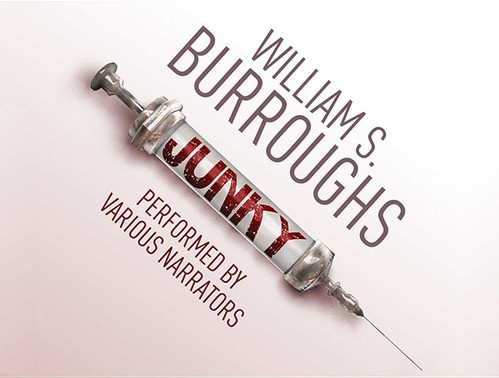
Growing up, my dad was part of Customs and Excise, or Border Force as it is now (though for how long remains to be seen). As such, there was a loudly spoken rule in my house that drugs were bad and that under no circumstances should my sister or I ever partake in them. Considering that we lived in the most bumfuck nowhere type of village whilst still having a bus connection, I'm not sure looking back how they expected me to initiate such a habit, let alone maintain it. In any case, since starting further education my opinions on drug use have somewhat softened, with my perspective shifting more from the criminal to the medical. But I still hadn't ever read what addiction was like, so when Junky turned up on my shelf, I saw an opportunity to delve into a topic that is somewhat dangerous to look into first-hand.
Junky is the semi-autobiographical tale of Burroughs, under the pseudonym William Lee, and his experiences of opioid addiction. It covers the experience of the drug itself, the process of pushing drugs, run-ins with the law across the United States, and several episodes of withdrawal.
I don't know quite what I expected, but I hadn't expected the experience of drug addiction to be so mundane. After the first description of his initial kick, any positives are kind of toned down. It soon becomes just a background element of the narration, the way that you assume that characters in books obviously eat, sleep and clean themselves but don't need to explicitly say so unless there is something to be implied from this routine. There's a point where he states that no-one deliberately sets out to be a drug addict, and instead fall into it out of a lack of passion for anything else. It's kind of a weird realisation, and it makes the scenes of withdrawal all the more intense. You can usually see them coming as they're signposted by some downturn in personal circumstances, whether that be a lack of funds or increasing pressure from the law, but each is sufficiently different from the previous detox to maintain interest. It's in these moments where Burroughs describes trying to minimise the symptoms of "junk sickness" that the writing is at its most vivid, where all the visceral processes are drawn out with grotesque, but somehow still clinical, detail.
It's a strange realisation, but the main thing that I took away from Junky is the feeling that this was just a drawn out musing on the nature of decay. Once a habit is sufficiently established, maintaining the habit is described more in terms of staving off the symptoms of junk sickness rather than for any kick that the addict may get. There doesn't seem to be any pleasure in it after a while, but just a resigned continuation of a state of self-poisoning in order to avoid the worst of the symptoms. And oftentimes, the attempts at a self-administered cure make the addict worse off than they otherwise would have. Bodies seem to decay at alarming rates, and often at odds with the personalities behind them.
Junky is a strange read, although that may be due in large part to my aggressively anti-drug upbringing. The drug itself sort of fades into the background, fuelling a tone of low-key desperation and disquietude. What stands out most are the episodes of withdrawal, where the body seems to fall apart in the most agonising ways possible. Honestly, I'm not sure why anyone thought that this would encourage people to try drugs, because I come away from this with a sense of sadness more than anything. 3.5/5
Next review: Found by Margaret Peterson Haddix
Signing off,
Nisa.
Junky is the semi-autobiographical tale of Burroughs, under the pseudonym William Lee, and his experiences of opioid addiction. It covers the experience of the drug itself, the process of pushing drugs, run-ins with the law across the United States, and several episodes of withdrawal.
I don't know quite what I expected, but I hadn't expected the experience of drug addiction to be so mundane. After the first description of his initial kick, any positives are kind of toned down. It soon becomes just a background element of the narration, the way that you assume that characters in books obviously eat, sleep and clean themselves but don't need to explicitly say so unless there is something to be implied from this routine. There's a point where he states that no-one deliberately sets out to be a drug addict, and instead fall into it out of a lack of passion for anything else. It's kind of a weird realisation, and it makes the scenes of withdrawal all the more intense. You can usually see them coming as they're signposted by some downturn in personal circumstances, whether that be a lack of funds or increasing pressure from the law, but each is sufficiently different from the previous detox to maintain interest. It's in these moments where Burroughs describes trying to minimise the symptoms of "junk sickness" that the writing is at its most vivid, where all the visceral processes are drawn out with grotesque, but somehow still clinical, detail.
It's a strange realisation, but the main thing that I took away from Junky is the feeling that this was just a drawn out musing on the nature of decay. Once a habit is sufficiently established, maintaining the habit is described more in terms of staving off the symptoms of junk sickness rather than for any kick that the addict may get. There doesn't seem to be any pleasure in it after a while, but just a resigned continuation of a state of self-poisoning in order to avoid the worst of the symptoms. And oftentimes, the attempts at a self-administered cure make the addict worse off than they otherwise would have. Bodies seem to decay at alarming rates, and often at odds with the personalities behind them.
Junky is a strange read, although that may be due in large part to my aggressively anti-drug upbringing. The drug itself sort of fades into the background, fuelling a tone of low-key desperation and disquietude. What stands out most are the episodes of withdrawal, where the body seems to fall apart in the most agonising ways possible. Honestly, I'm not sure why anyone thought that this would encourage people to try drugs, because I come away from this with a sense of sadness more than anything. 3.5/5
Next review: Found by Margaret Peterson Haddix
Signing off,
Nisa.
Sunday, 25 February 2018
The Satanic Verses by Salman Rushdie
Of all the books that I have on my reading list, this was the one that I had most trepidation about starting. There was the inevitable concern that the controversy about it and the possibility that it would eclipse whatever actual merit the book would contain. But, as I had received the book as part of a larger bundle of audiobooks, it seemed a bit of a waste to just leave it languishing on my computer unread. The fact that my attempts to listen to it on my tablet made it sound like Alvin and the Chipmunks were narrating did somewhat mar the experience too.
The Satanic Verses follows two Indian actors who miraculously survive the explosion of a hijacked plane over the English Channel, and the strange changes that come over them following this. First there is the popular Bollywood star Gibreel Farishta chasing after a lost love, who finds himself taking on the personality and divine powers of the archangel Gibreel. The other is Saladin Chamcha, a long-time resident of London returning from an unsuccessful reunion with his father, who takes on the rather more unfortunate shape of a satyr-like devil. Interspersed in their narratives about their lives after these unusual and distressing changes, are dreams that Farishta has about events in his celestial persona's past. First is the sequence starting with the episode of the Satanic verses. Second is a sequence focusing on a modern day Imam in exile. Third is a sequence following a seer named Ayesha, who convinces her village to go on a foot pilgrimage to Mecca, claiming that she will invoke God's will and part the sea for them to reach their destination.
Before I continue onto the review properly, there is something that I feel should tackle, if only briefly, lest it become an elephant in the room. I've been able to find out the basics of why The Satanic Verses was so controversial with some Islamic readers, mostly in response to the dream sequence about the Satanic verses themselves. And while I can definitely understand that some of the imagery and allegorical naming would be considered incendiary, I won't pretend to know enough in the realm of religious scholarship to comment too deeply on them. In addition, I would rather not start up a discussion about free speech here, because it is a complex subject that I would only be able to scratch the surface of. All I suppose I would commit to here is that while I am all for people facing up to the consequences of their proclamations, it is a step too far to try and kill someone for those statements.
Right then, so onto the actual book. The Satanic Verses is an ambitious work focusing primarily on the immigrant experience in Thatcher-era Britain, and the strict divide between white and non-white cultures. Chamcha's insistence throughout the majority of the book to model himself off of the ideal aristocratic, stiff-upper-lip style of Englishman, only becomes more pathetic and futile as the narrative goes on and he finds that London has retained all of the smugness inherent in conquerors but none of the sophistication. Similarly, Farishta's increasingly unhinged attempts to mold London to his city of ideals only ends with disillusionment. The book does a lot of clever things to create multiple, interconnecting stories of isolation and the conflict between being unyielding and maintaining one's cultural identity vs compromise and changing to suit your new culture. It does a lot of interesting things, but still I find myself quite content to never re-read this book. I think I may have a similar reaction to Salman Rushdie that I do to Gabriel Garcia Marquez: the books they write may be very clever and worthy of study, but it does nothing for me emotionally. The Satanic Verses is a book that, were I still in university, I would be quite happy to study and analyse to death, but I very much doubt that I will revisit it for reasons of pleasure. This is a matter of personal taste though, and I do wonder whether I would have been more forgiving if I had been allowed to tackle the text at my own pace instead of in the irregular intervals where it would be appropriate to be anti-social for hours at a time.
A clever and interesting novel about the immigrant experience in Thatcher-era Britain that unfortunately didn't really do much for me. Definitely more a text for debate and analysis than it is for pleasure. For those readers who are Islamic, then there are definitely elements that could be controversial, but I don't feel that I am really the person most qualified to discuss how inflammatory the novel is or isn't. 3/5
Next review: Stolen by Lucy Christopher
Signing off,
Nisa.
The Satanic Verses follows two Indian actors who miraculously survive the explosion of a hijacked plane over the English Channel, and the strange changes that come over them following this. First there is the popular Bollywood star Gibreel Farishta chasing after a lost love, who finds himself taking on the personality and divine powers of the archangel Gibreel. The other is Saladin Chamcha, a long-time resident of London returning from an unsuccessful reunion with his father, who takes on the rather more unfortunate shape of a satyr-like devil. Interspersed in their narratives about their lives after these unusual and distressing changes, are dreams that Farishta has about events in his celestial persona's past. First is the sequence starting with the episode of the Satanic verses. Second is a sequence focusing on a modern day Imam in exile. Third is a sequence following a seer named Ayesha, who convinces her village to go on a foot pilgrimage to Mecca, claiming that she will invoke God's will and part the sea for them to reach their destination.
Before I continue onto the review properly, there is something that I feel should tackle, if only briefly, lest it become an elephant in the room. I've been able to find out the basics of why The Satanic Verses was so controversial with some Islamic readers, mostly in response to the dream sequence about the Satanic verses themselves. And while I can definitely understand that some of the imagery and allegorical naming would be considered incendiary, I won't pretend to know enough in the realm of religious scholarship to comment too deeply on them. In addition, I would rather not start up a discussion about free speech here, because it is a complex subject that I would only be able to scratch the surface of. All I suppose I would commit to here is that while I am all for people facing up to the consequences of their proclamations, it is a step too far to try and kill someone for those statements.
Right then, so onto the actual book. The Satanic Verses is an ambitious work focusing primarily on the immigrant experience in Thatcher-era Britain, and the strict divide between white and non-white cultures. Chamcha's insistence throughout the majority of the book to model himself off of the ideal aristocratic, stiff-upper-lip style of Englishman, only becomes more pathetic and futile as the narrative goes on and he finds that London has retained all of the smugness inherent in conquerors but none of the sophistication. Similarly, Farishta's increasingly unhinged attempts to mold London to his city of ideals only ends with disillusionment. The book does a lot of clever things to create multiple, interconnecting stories of isolation and the conflict between being unyielding and maintaining one's cultural identity vs compromise and changing to suit your new culture. It does a lot of interesting things, but still I find myself quite content to never re-read this book. I think I may have a similar reaction to Salman Rushdie that I do to Gabriel Garcia Marquez: the books they write may be very clever and worthy of study, but it does nothing for me emotionally. The Satanic Verses is a book that, were I still in university, I would be quite happy to study and analyse to death, but I very much doubt that I will revisit it for reasons of pleasure. This is a matter of personal taste though, and I do wonder whether I would have been more forgiving if I had been allowed to tackle the text at my own pace instead of in the irregular intervals where it would be appropriate to be anti-social for hours at a time.
A clever and interesting novel about the immigrant experience in Thatcher-era Britain that unfortunately didn't really do much for me. Definitely more a text for debate and analysis than it is for pleasure. For those readers who are Islamic, then there are definitely elements that could be controversial, but I don't feel that I am really the person most qualified to discuss how inflammatory the novel is or isn't. 3/5
Next review: Stolen by Lucy Christopher
Signing off,
Nisa.
Friday, 5 January 2018
Lady Audley's Secret by Mary Elizabeth Braddon
It's been a while since I read a classic, but of the many classics out there, why pick up Lady Audley's Secret, a book by an author that I had never heard of in my life? Well, the blurb promised all sorts of scandalous acts that shouldn't come anywhere near the neutered Victorian ideal, so of course my interest was peaked.
After three years spent gold prospecting in Australia, George Talboys is keen to return home to his beautiful wife and young child. Upon his return, he finds that she has just died and, utterly bereft at this turn of events, he stays with an old friend to try and recover. His friend, Robert Audley, suggests a visit to his wealthy uncle in the Essex countryside as a form of distraction and as an excuse to meet his new aunt, a woman renowned in the local area as a great beauty. When the trip ends with George's disappearance, Robert finds himself driven to discovering what happened. The more he investigates though, the more suspicious his new aunt becomes, and he risks miring his family in scandal.
You probably noticed that I didn't mention any of the scandalous things that the blurb tempted me in with. Because knowing them in advance kind of ruins any surprise that Lady Audley's Secret has. Lady Audley, in my read-through, had no real secrets because with a couple of exceptions the twists are pretty clearly signposted if you've already been told the spoilers. Despite this though, I found this thoroughly enjoyable. The writing is a bit on the flowery side, but considering the focus on Victorian domestic arrangements it does work quite well. The only thing that truly bothered me was the ending. If you're interested in actually reading Lady Audley's Secret, which I really would recommend, then you might want to skip the next paragraph.
So, the ending. Lady Audley has been revealed to be a murderous bigamist who pushed her first husband, George Talboys, down a well after he discovered that she wasn't dead as he had first believed. In order to save his family's honour, Robert Audley spirits her away to a madhouse to quietly expire at a safe distance, but can never honour his departed friend by giving him a proper burial for fear that it would go to a criminal court. All well and good so far, and I could have accepted that as an ending. Then it turned out that George Talboys was alive all this time and just doesn't have any understanding of how this "keeping in contact" thing works. And everyone who isn't the eponymous Lady Audley has a happy ending. The book ends with a reference to a Bible quote where the righteous shall not be forsaken, and honestly it's so bloody saccharine after a plot that has been gratifyingly scandalous and treacherous. It was such a disappointment. Not enough to entirely ruin the book, but enough to leave a bad taste in the mouth.
Even having had the majority of the secrets spoiled by the blurb of my edition, I found myself really enjoying myself. That's probably why I was so disappointed by the abrupt turn into happy ending territory in the last couple of chapters. Still worth a read though. 4/5
Next review: Annihilation by Jeff VanderMeer
Signing off,
Nisa.
After three years spent gold prospecting in Australia, George Talboys is keen to return home to his beautiful wife and young child. Upon his return, he finds that she has just died and, utterly bereft at this turn of events, he stays with an old friend to try and recover. His friend, Robert Audley, suggests a visit to his wealthy uncle in the Essex countryside as a form of distraction and as an excuse to meet his new aunt, a woman renowned in the local area as a great beauty. When the trip ends with George's disappearance, Robert finds himself driven to discovering what happened. The more he investigates though, the more suspicious his new aunt becomes, and he risks miring his family in scandal.
You probably noticed that I didn't mention any of the scandalous things that the blurb tempted me in with. Because knowing them in advance kind of ruins any surprise that Lady Audley's Secret has. Lady Audley, in my read-through, had no real secrets because with a couple of exceptions the twists are pretty clearly signposted if you've already been told the spoilers. Despite this though, I found this thoroughly enjoyable. The writing is a bit on the flowery side, but considering the focus on Victorian domestic arrangements it does work quite well. The only thing that truly bothered me was the ending. If you're interested in actually reading Lady Audley's Secret, which I really would recommend, then you might want to skip the next paragraph.
So, the ending. Lady Audley has been revealed to be a murderous bigamist who pushed her first husband, George Talboys, down a well after he discovered that she wasn't dead as he had first believed. In order to save his family's honour, Robert Audley spirits her away to a madhouse to quietly expire at a safe distance, but can never honour his departed friend by giving him a proper burial for fear that it would go to a criminal court. All well and good so far, and I could have accepted that as an ending. Then it turned out that George Talboys was alive all this time and just doesn't have any understanding of how this "keeping in contact" thing works. And everyone who isn't the eponymous Lady Audley has a happy ending. The book ends with a reference to a Bible quote where the righteous shall not be forsaken, and honestly it's so bloody saccharine after a plot that has been gratifyingly scandalous and treacherous. It was such a disappointment. Not enough to entirely ruin the book, but enough to leave a bad taste in the mouth.
Even having had the majority of the secrets spoiled by the blurb of my edition, I found myself really enjoying myself. That's probably why I was so disappointed by the abrupt turn into happy ending territory in the last couple of chapters. Still worth a read though. 4/5
Next review: Annihilation by Jeff VanderMeer
Signing off,
Nisa.
Saturday, 12 August 2017
Alice's Adventures in Wonderland and Through the Looking-Glass by Lewis Carroll
I'll admit, I wasn't actually intending to read Alice's Adventures in Wonderland when I first picked up my edition. Having tried and failed to read it when I was younger, I wasn't all that interested in the actual novel itself. But, as you can see from the below cover, this looked like it would be a manga adaptation, which I was interested in purely because I like that whole Wonderland aesthetic. When I got it home and out of the shrink-wrap, however, I found that rather than an adaptation, I had picked up an illustrated version of the original novels, which was a tad confusing considering it was a comic shop. Either way, it seemed a shame to waste a perfectly nice edition of a book, especially when the art looked so pretty.
The reader follows Alice, a young girl who finds herself in another world after following a white rabbit dressed in a waistcoat down a rabbit hole. There she meets a series of strange characters and must navigate an assortment of situations in which logic appears to have disappeared entirely.
I went into Alice's Adventures in Wonderland and Through the Looking-Glass expecting to absolutely hate it. As I mentioned above, I couldn't get into it when I was younger, so I wasn't really expecting a huge deal. As it was, I was pleasantly surprised to find it thoroughly average. In a weird way, I think it is both too universally well-known and also too hopelessly old-fashioned to really speak to people in the way that they expect it will.
Firstly, the too well-known part. There isn't much of either book that the general public isn't familiar with in some fashion. Off the top of my head, the only parts that were unfamiliar to me were the Duchess' pig-baby and the giant puppy from Adventures in Wonderland and the battle between the lion and the unicorn from Through the Looking-Glass. As for the rest of it, it's all pretty familiar. Even some of the more minor parts have become part of everyday pop culture. "What's the difference between a raven and a writing desk?" has been so over-analysed that the riddle has gone from having no answer to too many. Hell, I remember being told "Time for bed the Walrus said" when it was getting too late, which is unintentionally sinister now that I think about it. It's so ubiquitous now that public consciousness of the property is probably influenced as much by modern reinterpretations as it is by the original.
This mention of modern reinterpretations leads me to my second point, which is the hopelessly old-fashioned part. You can kind of tell from some of the poetry that Carroll is playing on rhymes of the time, but it's hard to appreciate the cleverness of it when the original rhymes aren't well-known anymore. Without that context, the book has to rely on its plot, and if you have any concept of Alice's Adventures in Wonderland then you can already tell what the problem with that statement is. Without the contemporary context, the book is left to rely on events that only barely have continuity with one another and don't have any stakes to speak of. It feels like a story that a child would make up and honestly it just strikes me as bizarre that it would last so long in cultural memory.
I think the only thing that really surprised me coming out of Alice's Adventures in Wonderland and Through the Looking-Glass is how little the books actually hold up. The rhymes that it plays with haven't survived the test of time, and it means that the reader is left with a plot that is disjointed at best. The writing itself is okay but there's not much content to work with. It only really works on an aesthetic level these days. 2.5/5
Next review: Empire in Black and Gold by Adrian Tchaikovsky
Signing off,
Nisa.
The reader follows Alice, a young girl who finds herself in another world after following a white rabbit dressed in a waistcoat down a rabbit hole. There she meets a series of strange characters and must navigate an assortment of situations in which logic appears to have disappeared entirely.
I went into Alice's Adventures in Wonderland and Through the Looking-Glass expecting to absolutely hate it. As I mentioned above, I couldn't get into it when I was younger, so I wasn't really expecting a huge deal. As it was, I was pleasantly surprised to find it thoroughly average. In a weird way, I think it is both too universally well-known and also too hopelessly old-fashioned to really speak to people in the way that they expect it will.
Firstly, the too well-known part. There isn't much of either book that the general public isn't familiar with in some fashion. Off the top of my head, the only parts that were unfamiliar to me were the Duchess' pig-baby and the giant puppy from Adventures in Wonderland and the battle between the lion and the unicorn from Through the Looking-Glass. As for the rest of it, it's all pretty familiar. Even some of the more minor parts have become part of everyday pop culture. "What's the difference between a raven and a writing desk?" has been so over-analysed that the riddle has gone from having no answer to too many. Hell, I remember being told "Time for bed the Walrus said" when it was getting too late, which is unintentionally sinister now that I think about it. It's so ubiquitous now that public consciousness of the property is probably influenced as much by modern reinterpretations as it is by the original.
This mention of modern reinterpretations leads me to my second point, which is the hopelessly old-fashioned part. You can kind of tell from some of the poetry that Carroll is playing on rhymes of the time, but it's hard to appreciate the cleverness of it when the original rhymes aren't well-known anymore. Without that context, the book has to rely on its plot, and if you have any concept of Alice's Adventures in Wonderland then you can already tell what the problem with that statement is. Without the contemporary context, the book is left to rely on events that only barely have continuity with one another and don't have any stakes to speak of. It feels like a story that a child would make up and honestly it just strikes me as bizarre that it would last so long in cultural memory.
I think the only thing that really surprised me coming out of Alice's Adventures in Wonderland and Through the Looking-Glass is how little the books actually hold up. The rhymes that it plays with haven't survived the test of time, and it means that the reader is left with a plot that is disjointed at best. The writing itself is okay but there's not much content to work with. It only really works on an aesthetic level these days. 2.5/5
Next review: Empire in Black and Gold by Adrian Tchaikovsky
Signing off,
Nisa.
Wednesday, 19 July 2017
Treasure Island by Robert Louis Stevenson
After the disappointment that was The Mammoth Book of Body Horror, I was in the mood for something familiar. I hadn't read Treasure Island in years, and remembered really enjoying it when I was younger, so it seemed like the perfect book to revisit.
Treasure Island follows a young boy named Jim Hawkins. Helping his parents run their inn, the Admiral Benbow, he meets a cantankerous old sailor who is rather keen on avoiding other seamen. When he dies after his old crewmates turn up to harass him, Jim gets his hands on the old man's sea-chest, with a treasure map inside. Joined by Doctor Livesey and Squire Trelawney, they embark on a journey to retrieve the treasure, gathered initially by the infamous Captain Flint. But all is not well, as their crew of honest hands has been infiltrated by former members of Flint's crew, most notably the one-legged Long John Silver.
It might just be the innumerable film adaptations overriding my memories of the book, but I do not remember there being quite as much malaria in Treasure Island. I'd also managed to forget a whole chunk of the book in which Jim manages to steal back their ship, the Hispaniola, which is probably more worrying. Regardless, I still enjoyed it about as much as I did when I was a kid. There was a small part of my brain making things weird by thinking of my two favourite adaptations (the Muppet version and Disney's weird but somehow still coherent Victoriana Space Opera version), but it does definitely still stand up by itself.
One thing that I will mention for those of you who haven't read Treasure Island, but have seen a bunch of the adaptations is that Hollywood has a weird obsession with trying to make Long John Silver into a kind of weird father-figure for Jim. There isn't really much of that in the actual book, with Silver being more or less a child-friendly depiction of a psychopath. Sure he switches sides towards the end, but not out of any genuine affection for Jim; considering that the alternative is dying on a malaria-ridden island with three former comrades who really aren't satisfied with the way that his grand voyage has panned out, it's a purely pragmatic decision. That's not a bad thing, it's just something that would stand out if you've only ever seen film versions before.
Treasure Island is a classic for a reason. The characters are great, the action is gripping and who doesn't love pirates? If you've only ever seen the film versions before though, you might want to prepare yourself for a significantly less likeable Long John Silver. 4.5/5
Next review: Summer Knight by Jim Butcher
Signing off,
Nisa.
Treasure Island follows a young boy named Jim Hawkins. Helping his parents run their inn, the Admiral Benbow, he meets a cantankerous old sailor who is rather keen on avoiding other seamen. When he dies after his old crewmates turn up to harass him, Jim gets his hands on the old man's sea-chest, with a treasure map inside. Joined by Doctor Livesey and Squire Trelawney, they embark on a journey to retrieve the treasure, gathered initially by the infamous Captain Flint. But all is not well, as their crew of honest hands has been infiltrated by former members of Flint's crew, most notably the one-legged Long John Silver.
It might just be the innumerable film adaptations overriding my memories of the book, but I do not remember there being quite as much malaria in Treasure Island. I'd also managed to forget a whole chunk of the book in which Jim manages to steal back their ship, the Hispaniola, which is probably more worrying. Regardless, I still enjoyed it about as much as I did when I was a kid. There was a small part of my brain making things weird by thinking of my two favourite adaptations (the Muppet version and Disney's weird but somehow still coherent Victoriana Space Opera version), but it does definitely still stand up by itself.
One thing that I will mention for those of you who haven't read Treasure Island, but have seen a bunch of the adaptations is that Hollywood has a weird obsession with trying to make Long John Silver into a kind of weird father-figure for Jim. There isn't really much of that in the actual book, with Silver being more or less a child-friendly depiction of a psychopath. Sure he switches sides towards the end, but not out of any genuine affection for Jim; considering that the alternative is dying on a malaria-ridden island with three former comrades who really aren't satisfied with the way that his grand voyage has panned out, it's a purely pragmatic decision. That's not a bad thing, it's just something that would stand out if you've only ever seen film versions before.
Treasure Island is a classic for a reason. The characters are great, the action is gripping and who doesn't love pirates? If you've only ever seen the film versions before though, you might want to prepare yourself for a significantly less likeable Long John Silver. 4.5/5
Next review: Summer Knight by Jim Butcher
Signing off,
Nisa.
Friday, 7 July 2017
The Three Musketeers by Alexandre Dumas
The Three Musketeers is one of those classics that is so culturally prevalent that I felt almost duty-bound to look into it. So when I found that it was one of the free ebooks when I fired up Google Books, I thought that this would be the perfect opportunity to take a look at a much-beloved classic.
The reader follows D'Artagnan, a young and hot-tempered noble who sets out for Paris seeking glory and fortune. Upon arriving in Paris, his attempts to gain acceptance into the elite musketeer company are initially hindered when his haste to avenge a slight causes him to anger three musketeers: the quiet and stoic Athos, the boisterous and vain Porthos, and the womanising would-be priest Aramis. And having befriended his would-be opponents, he finds himself getting involved in the private affairs of several august personages.
I went into The Three Musketeers expecting adventure and maybe a bit of intrigue. I hadn't realised just how much modern adaptations remove some of the more unsavoury aspects of our heroes' behaviour. I mean, I was kind of expecting some dissonance with regards to values, considering when it was written. But at the same time there is a surprising amount that adaptations leave out, such as the utterly shameless way that they seduce married women in order to get funds that is almost immediately squandered on high-living, or the servant girl that D'Artagnan uses and casually abandons to avenge himself on her mistress. While they are undoubtedly the lesser of two evils compared with the duplicity of Milady de Winter, it does feel a bit more grey than was perhaps intended by the author.
The unexpected underhandedness of the eponymous heroes aside, The Three Musketeers is a thoroughly enjoyable adventure, with a fair bit more depth than I had expected at first. And while I do have some reservations about some of his misogynistic tendencies, I did end up developing a bit of a soft spot for Athos. That may well be because he seemed to be the most competent and collected of the four protagonists though.
Overall, The Three Musketeers was an enjoyable read. The heroes are perhaps less likeable than adaptations would have you expecting, but they still have their good points to them. It has a lot more depth than I was expecting with regards the whole political powerplay aspects, and a surprisingly bittersweet ending. 3.5/5
Next review: The Mammoth Book of Body Horror edited by Paul Kane & Marie O'Regan
Signing off,
Nisa.
The reader follows D'Artagnan, a young and hot-tempered noble who sets out for Paris seeking glory and fortune. Upon arriving in Paris, his attempts to gain acceptance into the elite musketeer company are initially hindered when his haste to avenge a slight causes him to anger three musketeers: the quiet and stoic Athos, the boisterous and vain Porthos, and the womanising would-be priest Aramis. And having befriended his would-be opponents, he finds himself getting involved in the private affairs of several august personages.
I went into The Three Musketeers expecting adventure and maybe a bit of intrigue. I hadn't realised just how much modern adaptations remove some of the more unsavoury aspects of our heroes' behaviour. I mean, I was kind of expecting some dissonance with regards to values, considering when it was written. But at the same time there is a surprising amount that adaptations leave out, such as the utterly shameless way that they seduce married women in order to get funds that is almost immediately squandered on high-living, or the servant girl that D'Artagnan uses and casually abandons to avenge himself on her mistress. While they are undoubtedly the lesser of two evils compared with the duplicity of Milady de Winter, it does feel a bit more grey than was perhaps intended by the author.
The unexpected underhandedness of the eponymous heroes aside, The Three Musketeers is a thoroughly enjoyable adventure, with a fair bit more depth than I had expected at first. And while I do have some reservations about some of his misogynistic tendencies, I did end up developing a bit of a soft spot for Athos. That may well be because he seemed to be the most competent and collected of the four protagonists though.
Overall, The Three Musketeers was an enjoyable read. The heroes are perhaps less likeable than adaptations would have you expecting, but they still have their good points to them. It has a lot more depth than I was expecting with regards the whole political powerplay aspects, and a surprisingly bittersweet ending. 3.5/5
Next review: The Mammoth Book of Body Horror edited by Paul Kane & Marie O'Regan
Signing off,
Nisa.
Friday, 26 May 2017
The Last Unicorn by Peter S. Beagle
The Last Unicorn is one of those stories that I only really heard of after I started venturing out onto the Internet a bit more, and even then I seemed to find mostly artwork of the eponymous unicorn, with surprisingly little about the actual story. So when I got round to actually reading it, it had become a weird kind of amorphous non-entity: apparently a really beloved classic, but with little actual substance that I could see and figure out why people liked it.
It is a regular eternally spring day for the unicorn, when she hears a message that she can't bring herself to ignore: that she is the last of her kind in the world. Venturing from the safety of her forest, she sets out to find out what happened to others like her. Joining her on her journey are Schmendrick, the world's worst magician, and Molly Grue, an indomitable spinster. But the three of them may not be enough to combat the terrible Red Bull that stalks the land of the miserly King Haggard.
What I'm about to say probably won't make much sense. Because I had a copy of the deluxe edition, my edition of The Last Unicorn came with a lot of additional material, including an introduction and an interview that hammer in one point about the writing process for this book: it was a complete chore and it took years before Beagle could look at it and admit to himself that it was any good. And while I did like what I read, I think that there is a part of that struggle that shows through the writing. The Last Unicorn is a truly beautiful book at several points, but as a whole it kind of left me emotionally cold. I don't know what it was, but despite enjoying it, The Last Unicorn probably won't be high on my list of books to re-read any time soon. It's like watching a dancer who is technically flawless, but who doesn't enjoy performing anymore and hits her cues more out of obligation than anything else. The parts that I liked were the points where the fairy tale stuff was juxtaposed by the moments of crushing reality: the spider crying in the night having discovered that it can't weave the moon in her web, or Molly asking why the unicorn only turns up in her life after her youth and loveliness have already left. The more traditionally fantasy elements, regardless of how self-aware they are, seem to be there more to fit the story structure. It is really well written though, so I would be interested to see some more of Beagle's work, perhaps something that hadn't been such a struggle for him.
Thoroughly beautiful at times, but I can't honestly say that The Last Unicorn did much for me emotionally. There's nothing specifically wrong with the novel, but this just wasn't really for me. Pleasant enough and probably enough to warrant reading other works by this author, but this work seemed a bit too beholden to obligating fairy tale tropes to really stretch out and become something truly wonderful. I am probably in a minority here though. 3.5/5
Next review: Grave Peril by Jim Butcher
Signing off,
Nisa.
It is a regular eternally spring day for the unicorn, when she hears a message that she can't bring herself to ignore: that she is the last of her kind in the world. Venturing from the safety of her forest, she sets out to find out what happened to others like her. Joining her on her journey are Schmendrick, the world's worst magician, and Molly Grue, an indomitable spinster. But the three of them may not be enough to combat the terrible Red Bull that stalks the land of the miserly King Haggard.
What I'm about to say probably won't make much sense. Because I had a copy of the deluxe edition, my edition of The Last Unicorn came with a lot of additional material, including an introduction and an interview that hammer in one point about the writing process for this book: it was a complete chore and it took years before Beagle could look at it and admit to himself that it was any good. And while I did like what I read, I think that there is a part of that struggle that shows through the writing. The Last Unicorn is a truly beautiful book at several points, but as a whole it kind of left me emotionally cold. I don't know what it was, but despite enjoying it, The Last Unicorn probably won't be high on my list of books to re-read any time soon. It's like watching a dancer who is technically flawless, but who doesn't enjoy performing anymore and hits her cues more out of obligation than anything else. The parts that I liked were the points where the fairy tale stuff was juxtaposed by the moments of crushing reality: the spider crying in the night having discovered that it can't weave the moon in her web, or Molly asking why the unicorn only turns up in her life after her youth and loveliness have already left. The more traditionally fantasy elements, regardless of how self-aware they are, seem to be there more to fit the story structure. It is really well written though, so I would be interested to see some more of Beagle's work, perhaps something that hadn't been such a struggle for him.
Thoroughly beautiful at times, but I can't honestly say that The Last Unicorn did much for me emotionally. There's nothing specifically wrong with the novel, but this just wasn't really for me. Pleasant enough and probably enough to warrant reading other works by this author, but this work seemed a bit too beholden to obligating fairy tale tropes to really stretch out and become something truly wonderful. I am probably in a minority here though. 3.5/5
Next review: Grave Peril by Jim Butcher
Signing off,
Nisa.
Sunday, 2 April 2017
The Mayor of Casterbridge by Thomas Hardy
The Mayor of Casterbridge isn't necessarily a book that I would have picked up of my own volition, had it not been for my dad. My dad isn't usually the type to really gush about the things that he reads, but from a fairly early age I've known that he really likes Thomas Hardy. As such, I figured that I'd try out one of his books, see if it's rubbed off on me.
The Mayor of Casterbridge starts when main character Michael Henchard sells his wife and baby girl in a drunken fit of pique, an action that he regrets immediately upon waking the next day. It then skips ahead nearly twenty years, when his wife and grown up daughter track him down to the agricultural town of Casterbridge. There they find that he has become a rich and well-respected member of the community. He invites them to come and live with him, to make up for his poor decision, but it soon becomes apparent that the consequences of that day are still making themselves known.
I found this a bit of an odd book to read, as on the one hand the prose can be a bit dense and slow-going at times, but it is then combined with a plot in which a lot of active events happen within a comparatively short space of time. So there is a part of me that wants to describe this as a slow-burner, but then I know that with the amount that actually happens it doesn't feel like an accurate description. In regards to the actual plot, a lot of it is the kind of Victorian social drama that I quite like, although the main character's headstrong personality does see it get very dramatic and scandalous quickly and surprisingly often.
The main draw for The Mayor of Casterbridge is the characters. The main ones that contribute to the plot are Henchard, his daughter Elizabeth, his would-be protegee Farfrae and a mysterious woman from Henchard's past Lucetta. Mostly it's the first and last characters whose actions most impact the plot. Keeping with my regular rule of avoiding spoilers, I shan't be expanding much on Lucetta. But even without her, there would probably be an impressive amount of plot stemming purely from Henchard as a character. He is pretty perfect as a main character in a tragedy, as he is an intensely passionate person and is more or less incapable of moderating his emotions and impulses. With someone that volatile, it's almost inevitable that something unfortunate will happen. Farfrae and Elizabeth are comparatively passive, but they nicely balance out two very outgoing characters with emotional moderation.
It's a bit dense at times, and surprisingly intense with the sheer amount that happens within the bounds of the plot. But it is fascinating just watching the chaos caused by the main character's energy and inability to moderate his emotions. I don't know how good a place this is to start with regards to Hardy's work as a whole, but I would certainly consider reading other works of his in future. 4/5
Next review: Fool Moon by Jim Butcher
Signing off,
Nisa.
The Mayor of Casterbridge starts when main character Michael Henchard sells his wife and baby girl in a drunken fit of pique, an action that he regrets immediately upon waking the next day. It then skips ahead nearly twenty years, when his wife and grown up daughter track him down to the agricultural town of Casterbridge. There they find that he has become a rich and well-respected member of the community. He invites them to come and live with him, to make up for his poor decision, but it soon becomes apparent that the consequences of that day are still making themselves known.
I found this a bit of an odd book to read, as on the one hand the prose can be a bit dense and slow-going at times, but it is then combined with a plot in which a lot of active events happen within a comparatively short space of time. So there is a part of me that wants to describe this as a slow-burner, but then I know that with the amount that actually happens it doesn't feel like an accurate description. In regards to the actual plot, a lot of it is the kind of Victorian social drama that I quite like, although the main character's headstrong personality does see it get very dramatic and scandalous quickly and surprisingly often.
The main draw for The Mayor of Casterbridge is the characters. The main ones that contribute to the plot are Henchard, his daughter Elizabeth, his would-be protegee Farfrae and a mysterious woman from Henchard's past Lucetta. Mostly it's the first and last characters whose actions most impact the plot. Keeping with my regular rule of avoiding spoilers, I shan't be expanding much on Lucetta. But even without her, there would probably be an impressive amount of plot stemming purely from Henchard as a character. He is pretty perfect as a main character in a tragedy, as he is an intensely passionate person and is more or less incapable of moderating his emotions and impulses. With someone that volatile, it's almost inevitable that something unfortunate will happen. Farfrae and Elizabeth are comparatively passive, but they nicely balance out two very outgoing characters with emotional moderation.
It's a bit dense at times, and surprisingly intense with the sheer amount that happens within the bounds of the plot. But it is fascinating just watching the chaos caused by the main character's energy and inability to moderate his emotions. I don't know how good a place this is to start with regards to Hardy's work as a whole, but I would certainly consider reading other works of his in future. 4/5
Next review: Fool Moon by Jim Butcher
Signing off,
Nisa.
Sunday, 19 March 2017
An Arsene Lupin Omnibus by Maurice LeBlanc
I first heard about the character Arsene Lupin when I was reading the manga detective series Case Closed. Included in the back of each volume was a recommendation from the author of other detectives that readers might be interested in. And amongst some of the first to be recommended was Arsene Lupin, a charismatic master thief and sometime detective, created in response to the success of Sherlock Holmes. Suitably intrigued, I tried finding whatever had been translated from the original French, only to discover that there doesn't seem to be much available regardless of what Wikipedia says has been translated. As such, I've been rather looking forward to reading something complete, beyond the few scattered stories that I've managed to find previously.
An Arsene Lupin Omnibus collects four of the volumes written by LeBlanc. Instead of going over plot and character aspects as I would normally would, I will instead focus on each volume individually.
First up is Arsene Lupin versus Holmlock Shears. This is the weakest of the four for me, for one reason that is perhaps more personal to me. As you can probably tell, this is a short novel detailing the intellectual battle between Lupin and a poorly disguised version of Sherlock Holmes, whose name couldn't be used at the time of writing due to copyright infringement. The mystery is actually fairly solid, I didn't really manage to guess anything before the big finales. My problem is that this is such a mean-spirited rendition of Holmes, and let's not pretend that this Holmlock Shears is meant to be a character in his own right. While I have loved books with one abhorrent character, rarely was the narrative from their perspective and never was it using the character that I will probably always carry closest to my heart. To see him treating his Watson substitute with such callousness is galling. As I said though, the mystery is good enough and Lupin charming enough that I could tough it through.
The second volume in the omnibus is The Confessions of Arsene Lupin, a collection of short stories mostly focusing on Lupin as a master thief. This is one of the stronger collections in my opinion, because Lupin's adventures are not long enough that they have time to grow old. An issue that the previous volume had as well was that as two longer cases, it does start to feel a bit like a waiting game as Lupin sets more and more obstacles in an investigation's way until no more avenues of pursuit are available. With the short stories, it's more succinct and punchy. They feel more fun when there isn't the knowledge that your main character is running in circles. It's much more interesting to see how carefully laid defences are circumvented when it isn't the point of view character's defences.
The third volume is another novel-length adventure, The Golden Triangle. In this volume, a dashing injured army captain and the beautiful nurse who tended to his injuries must defend against an unknown assailant whilst trying to figure out both where the nurse's evil husband hid several tons of gold bullion and who has been aiming to bring the two of them together in matrimony since early childhood. This one works significantly better than the first of the long-form adventures, as it provides more meat with regards to its adventure. I won't say mystery, because there's one rather big spoiler, only revealed in the penultimate chapter, that I managed to guess by the halfway point. Hint, characters don't do a 180 turn in allegiance during the course of a day, so it's not hard to surmise from there. Aside from that, it's great fun, with a lot of "lovers in peril" moments that I probably like a bit too much.
Last of all is The Eight Strokes of the Clock. This is kind of an interesting volume, as it's in some ways both a novel and a collection of short stories. Posing as a gentleman by the name of Prince Serge Renine, Lupin approaches a woman by the name of Hortense Daniel, and manages to restore her financial independence. As payment, he offers that she become his companion in seven further adventures, thus providing the reader with a series of interlinked short stories. I had actually read a couple of the chapters before getting the omnibus, as a part of a "best of" collection, and I must say that their inclusion was spot on. While the introduction essentially asks the reader to think of Lupin as a French equivalent to Sherlock Holmes, nowhere in this omnibus does it fit as well as The Eight Strokes of the Clock, as here we have the consistency of an established partnership combined with the stand-alone nature of the short stories themselves. Honestly, it's the best part of the omnibus, and had everything been of this standard I would have been supremely happy to give this a perfect score.
A thoroughly enjoyable collection, worth a look for The Eight Strokes of the Clock alone. As a Holmes fan I can't quite bring myself to like Arsene Lupin versus Holmlock Shears, but I can appreciate a decent mystery when I see one; not necessarily enough to recommend it by itself though. The Golden Triangle is where long-form starts to suit Lupin, though it works more as an adventure than as a particularly airtight mystery. And The Confessions of Arsene Lupin are a decent starting point for some of the character's less law-abiding adventures, with a lot of charm and action. 4.5/5
Next review: The Mayor of Casterbridge by Thomas Hardy
Signing off,
Nisa.
An Arsene Lupin Omnibus collects four of the volumes written by LeBlanc. Instead of going over plot and character aspects as I would normally would, I will instead focus on each volume individually.
First up is Arsene Lupin versus Holmlock Shears. This is the weakest of the four for me, for one reason that is perhaps more personal to me. As you can probably tell, this is a short novel detailing the intellectual battle between Lupin and a poorly disguised version of Sherlock Holmes, whose name couldn't be used at the time of writing due to copyright infringement. The mystery is actually fairly solid, I didn't really manage to guess anything before the big finales. My problem is that this is such a mean-spirited rendition of Holmes, and let's not pretend that this Holmlock Shears is meant to be a character in his own right. While I have loved books with one abhorrent character, rarely was the narrative from their perspective and never was it using the character that I will probably always carry closest to my heart. To see him treating his Watson substitute with such callousness is galling. As I said though, the mystery is good enough and Lupin charming enough that I could tough it through.
The second volume in the omnibus is The Confessions of Arsene Lupin, a collection of short stories mostly focusing on Lupin as a master thief. This is one of the stronger collections in my opinion, because Lupin's adventures are not long enough that they have time to grow old. An issue that the previous volume had as well was that as two longer cases, it does start to feel a bit like a waiting game as Lupin sets more and more obstacles in an investigation's way until no more avenues of pursuit are available. With the short stories, it's more succinct and punchy. They feel more fun when there isn't the knowledge that your main character is running in circles. It's much more interesting to see how carefully laid defences are circumvented when it isn't the point of view character's defences.
The third volume is another novel-length adventure, The Golden Triangle. In this volume, a dashing injured army captain and the beautiful nurse who tended to his injuries must defend against an unknown assailant whilst trying to figure out both where the nurse's evil husband hid several tons of gold bullion and who has been aiming to bring the two of them together in matrimony since early childhood. This one works significantly better than the first of the long-form adventures, as it provides more meat with regards to its adventure. I won't say mystery, because there's one rather big spoiler, only revealed in the penultimate chapter, that I managed to guess by the halfway point. Hint, characters don't do a 180 turn in allegiance during the course of a day, so it's not hard to surmise from there. Aside from that, it's great fun, with a lot of "lovers in peril" moments that I probably like a bit too much.
Last of all is The Eight Strokes of the Clock. This is kind of an interesting volume, as it's in some ways both a novel and a collection of short stories. Posing as a gentleman by the name of Prince Serge Renine, Lupin approaches a woman by the name of Hortense Daniel, and manages to restore her financial independence. As payment, he offers that she become his companion in seven further adventures, thus providing the reader with a series of interlinked short stories. I had actually read a couple of the chapters before getting the omnibus, as a part of a "best of" collection, and I must say that their inclusion was spot on. While the introduction essentially asks the reader to think of Lupin as a French equivalent to Sherlock Holmes, nowhere in this omnibus does it fit as well as The Eight Strokes of the Clock, as here we have the consistency of an established partnership combined with the stand-alone nature of the short stories themselves. Honestly, it's the best part of the omnibus, and had everything been of this standard I would have been supremely happy to give this a perfect score.
A thoroughly enjoyable collection, worth a look for The Eight Strokes of the Clock alone. As a Holmes fan I can't quite bring myself to like Arsene Lupin versus Holmlock Shears, but I can appreciate a decent mystery when I see one; not necessarily enough to recommend it by itself though. The Golden Triangle is where long-form starts to suit Lupin, though it works more as an adventure than as a particularly airtight mystery. And The Confessions of Arsene Lupin are a decent starting point for some of the character's less law-abiding adventures, with a lot of charm and action. 4.5/5
Next review: The Mayor of Casterbridge by Thomas Hardy
Signing off,
Nisa.
Tuesday, 7 March 2017
The Beautiful and Damned by F. Scott Fitzgerald
Continuing with Fitzgerald, I could only hope that The Beautiful and Damned would be a somewhat more satisfactory read than his debut novel. Seeing as the blurb given for the second novel in this collection had at least a modicum of plot mentioned beyond "here's this guy's life-story", I had a bit of hope that it would be less tiresome.
The Beautiful and Damned follows Anthony Patch, a romantic young man who is due to come into an inheritance of millions when his grandfather passes, if only he can live with some measure of respectability. But this will turn out to be much harder than he imagines, with his marriage to the beautiful and indolent Gloria marking the beginning of an existence typified by living beyond his means.
This novel is almost everything I want in a story set in the 1910s and 20s. It is a bleak but beautiful picture of a society that cannot sustain itself under its own hard and fast living. Anthony is not much different in character from Fitzgerald's previous protagonist Amory Blaine initially, but the thing that made The Beautiful and Damned work with a protagonist of this type is that Anthony actually seemed to suffer for his poor choices. Whereas Amory's slide into poverty is accompanied with a surprisingly blase attitude, Anthony doesn't cope in the slightest with being unable to live as he was accustomed to. Throwing himself into weekend-long parties that he can't afford, but can't bear to go without, it's not long before he's sucked into a self-destructive spiral of debt. To have an actual character arc to follow is so refreshing after the meandering that hampered This Side of Paradise. The Beautiful and Damned is not a perfect novel though, as there are points where it feels more than a little padded and it's still a bit meandering at points. But it captures that self-destructive undertone that fascinates me about the early 20th century perfectly and I would happily recommend this novel to those interested in Fitzgerald's work or that particular era in history.
A fascinating portrayal of a man's downward spiral into drink and debt, it is thoroughly entertaining. Still a little bloated in places, but nowhere near as meandering as This Side of Paradise. 4/5
Next review: An Arsene Lupin Omnibus by Maurice LeBlanc
Signing off,
Nisa.
The Beautiful and Damned follows Anthony Patch, a romantic young man who is due to come into an inheritance of millions when his grandfather passes, if only he can live with some measure of respectability. But this will turn out to be much harder than he imagines, with his marriage to the beautiful and indolent Gloria marking the beginning of an existence typified by living beyond his means.
This novel is almost everything I want in a story set in the 1910s and 20s. It is a bleak but beautiful picture of a society that cannot sustain itself under its own hard and fast living. Anthony is not much different in character from Fitzgerald's previous protagonist Amory Blaine initially, but the thing that made The Beautiful and Damned work with a protagonist of this type is that Anthony actually seemed to suffer for his poor choices. Whereas Amory's slide into poverty is accompanied with a surprisingly blase attitude, Anthony doesn't cope in the slightest with being unable to live as he was accustomed to. Throwing himself into weekend-long parties that he can't afford, but can't bear to go without, it's not long before he's sucked into a self-destructive spiral of debt. To have an actual character arc to follow is so refreshing after the meandering that hampered This Side of Paradise. The Beautiful and Damned is not a perfect novel though, as there are points where it feels more than a little padded and it's still a bit meandering at points. But it captures that self-destructive undertone that fascinates me about the early 20th century perfectly and I would happily recommend this novel to those interested in Fitzgerald's work or that particular era in history.
A fascinating portrayal of a man's downward spiral into drink and debt, it is thoroughly entertaining. Still a little bloated in places, but nowhere near as meandering as This Side of Paradise. 4/5
Next review: An Arsene Lupin Omnibus by Maurice LeBlanc
Signing off,
Nisa.
Monday, 20 February 2017
This Side of Paradise by F. Scott Fitzgerald
Like many people, I read The Great Gatsby as a set text for my classes in English. And while it didn't have the impact on me that books like The Outsider, I did still thoroughly enjoy it. So, while browsing the shelves at the independent bookshop that has parted me from more of my money than I would like to admit, I noticed a book that combined F. Scott Fitzgerald's novels This Side of Paradise and The Beautiful and Damned, it seemed like a good way to look into more of his works. Plus, I have a fondness for the Roaring Twenties, so what could go wrong?
This Side of Paradise follows Amory Blaine, the only son of wealthy parents, from his early adolescence to young adulthood, a period of time that covers his time at Princeton, fighting in the First World War, and several love affairs with beautiful but unattainable women.
If you're a dedicated reader of any kind, it sometimes occurs that you are hit with the unassailable certainty that you are reading the first piece of long-form writing that the author has published. Oftentimes this is due to some part of the construction being noticeably unpolished, and after a lot of practice I have found that the feeling is very rarely wrong. It was certainly on the money with This Side of Paradise.
Normally I would split the critique of plot and character, but since there is no plot beyond "How is Amory developing as a character?" it feels redundant splitting the two elements, as I would ultimately be parroting back the same issues with both. My issues with Amory then. Despite reading about almost nothing but him and his personality for over 200 pages, I don't think that there is much to actually pin down about him besides the impressively hard-wired traits intellectual arrogance and fay selfishness. The narrative desperately wants you to think that he is brilliant but flawed, but quite honestly there is so little human warmth in him that all of his poetic ambitions seem hilariously out-of-touch considering that you need to be able to feel things in order to express them. Honestly, it feels kind of embarrassing having Amory as a lead character, as he doesn't seem to have either the drive to do the great things that he sort of assumes that he will inevitably achieve or the emotional range to be quite the ladykiller that he proves to be. The nagging feeling that Amory was based on Fitzgerald himself somehow just makes this worse. Maybe it's just me, but I don't think that I've found an author stand-in character that actually works.
So, despite the emotional lack of depth and the plot that gets less and less defined the more Amory puts off making actual adult decisions, I would say that there is something that prevents This Side of Paradise from being a complete waste. The actual writing itself. While there are long stretches where it does little more than adequately depict the events of the book, you do get flashes of really interesting writing that makes you realise why people really loved this book when it was first published. It's things like changing the format from prose to script for certain romantic sections, or a particularly striking line of prose, and you get that whoever wrote This Side of Paradise is going places, even if he isn't there yet.
This Side of Paradise is quite obvious as a first novel as you read it. The act of following Amory Blaine is an effort that doesn't really pay off, as the plot can only be interesting when he actually has some kind of direction in life, which is seldom. There are moments of brilliance in the writing though, so some definite promise to save it from being a totally wasted effort. 3/5
Next review: The Beautiful and Damned by F. Scott Fitzgerald
Signing off,
Nisa.
This Side of Paradise follows Amory Blaine, the only son of wealthy parents, from his early adolescence to young adulthood, a period of time that covers his time at Princeton, fighting in the First World War, and several love affairs with beautiful but unattainable women.
If you're a dedicated reader of any kind, it sometimes occurs that you are hit with the unassailable certainty that you are reading the first piece of long-form writing that the author has published. Oftentimes this is due to some part of the construction being noticeably unpolished, and after a lot of practice I have found that the feeling is very rarely wrong. It was certainly on the money with This Side of Paradise.
Normally I would split the critique of plot and character, but since there is no plot beyond "How is Amory developing as a character?" it feels redundant splitting the two elements, as I would ultimately be parroting back the same issues with both. My issues with Amory then. Despite reading about almost nothing but him and his personality for over 200 pages, I don't think that there is much to actually pin down about him besides the impressively hard-wired traits intellectual arrogance and fay selfishness. The narrative desperately wants you to think that he is brilliant but flawed, but quite honestly there is so little human warmth in him that all of his poetic ambitions seem hilariously out-of-touch considering that you need to be able to feel things in order to express them. Honestly, it feels kind of embarrassing having Amory as a lead character, as he doesn't seem to have either the drive to do the great things that he sort of assumes that he will inevitably achieve or the emotional range to be quite the ladykiller that he proves to be. The nagging feeling that Amory was based on Fitzgerald himself somehow just makes this worse. Maybe it's just me, but I don't think that I've found an author stand-in character that actually works.
So, despite the emotional lack of depth and the plot that gets less and less defined the more Amory puts off making actual adult decisions, I would say that there is something that prevents This Side of Paradise from being a complete waste. The actual writing itself. While there are long stretches where it does little more than adequately depict the events of the book, you do get flashes of really interesting writing that makes you realise why people really loved this book when it was first published. It's things like changing the format from prose to script for certain romantic sections, or a particularly striking line of prose, and you get that whoever wrote This Side of Paradise is going places, even if he isn't there yet.
This Side of Paradise is quite obvious as a first novel as you read it. The act of following Amory Blaine is an effort that doesn't really pay off, as the plot can only be interesting when he actually has some kind of direction in life, which is seldom. There are moments of brilliance in the writing though, so some definite promise to save it from being a totally wasted effort. 3/5
Next review: The Beautiful and Damned by F. Scott Fitzgerald
Signing off,
Nisa.
Tuesday, 7 February 2017
Around the Moon by Jules Verne
So last time I was looking at From the Earth to the Moon and found myself pleasantly surprised despite the dodgy 19th century science. Presumably then I would be similarly taken with its direct sequel, Around the Moon, right? Yeah, about that....
Around the Moon follows Barbicane, Nicholl and Ardan as they journey to the moon in their projectile. All seems well, until they realise that they have been knocked off course and may miss the moon entirely.
As a lot of my previous review covers suspension of disbelief, I will quickly address how Around the Moon compares in that regard. It is so much worse. While I could kind of wave away a lot of the previous installment with the sentiment that the principle is more or less sound, when almost the entire plot focuses around the characters noting down their observations of the moon, or what the 19th century thought the moon would be like, it is extremely difficult to ignore or wave all the ways that this is wrong. Like the point where they open a window in order to dispose of an animal carcass into the vacuum of space. It is points like that that make the suspension of disbelief so much more difficult this time around. If you can deal with imaginative departures from fact, then you may find this less distracting than I did.
Now to the part that is special to Around the Moon when compared to its predecessor. The action, bar the last few chapters, all takes place within the confines of the projectile fired at the end of the previous installment. Now, when you have a story occur in entirely one place, your writing skills are pushed to the limit, especially if none of the characters can leave said place. There are two things that need to work near enough perfectly for such a situation to work: the pacing and the characters. To say that Verne dropped the ball may be an understatement. In regards to the pacing, it kind of settles on a slow trudge due to most of the action being the observation of the moon and space. There are a couple of points where the projectile is almost hit by asteroids, but there's nothing that the protagonists can do in the face of it, so it doesn't really stop the monotony of watching a huge deal. As such, the characters become even more important, and it couldn't have been a bigger catastrophe if it tried. Of the three main characters, two are flat caricatures of the practical American stereotype that Verne seems to love, and even their supposed intelligence is put to question considering that they only consider how they are meant to get back to Earth once they are well past the Earth's atmosphere. They are nothing compared to the irritation that is Ardan though. You know in some series you get those characters that are meant to be charmingly whimsical but end up being a vacant ninny infatuated with their own stupidity? Michel Ardan is that character. He keeps suggesting things that are blatantly ridiculous or dangerous for them to do whilst on the journey, only to moan that his travel companions are too practical and boring when they inevitably poke holes in his ideas. Honestly, I was kind of hoping that he would ignore them at the point where he wondered what it would be like to float along in the wake of the projectile. By all means Ardan, throw yourself into the icy vacuum of space, it will be the most use you've been all trip, especially after sneaking a flock of chickens on board for no real reason.
While From the Earth to the Moon was a fun thought exercise where human ingenuity causes something amazing, Around the Moon was the space equivalent of setting out on a journey only to realise you only have fuel for a one-way trip and everyone left their money at home. Sorely disappointing. 1.5/5
Next review: This Side of Paradise by F. Scott Fitzgerald
Signing off,
Nisa.
Friday, 27 January 2017
From the Earth to the Moon by Jules Verne
When you have a fondness for steampunk as I have, two authors above all others are cited as influences on the sub-genre: Jules Verne and H. G. Wells. The former brings the influence of technology as a springboard for great advancement and adventure, whilst the latter brings the more socially aware aspect of science fiction to the genre. As such, it's a little embarrassing that until now, I had read neither of their works. Seeking to fix that for at least half of these important writers, I picked up a collection of From the Earth to the Moon and Around the Moon by Jules Verne. And at the halfway point, how does the writing stand?
From the Earth to the Moon follows the Baltimore Gun Club, a collection of men known and respected throughout the United States for their innovations in the field of firearms and artillery. But, with the American Civil War over, their golden era appears to be coming to an end, as there is no need for overpowered cannons until war breaks out again. At their lowest point though, the club president, Barbicane, presents an idea for an experiment that will test the Gun Club's credentials: they will attempt to build a cannon powerful enough that you could send a projectile to the surface of the moon. And with that announcement, a furore spreads across America and the world.
This is a rather strange book to read, for several reasons. The first thing that I will mention though is the focus of the narrative. It isn't the firing of the projectile to the moon, which happens less than 20 pages before the end of the book. The actual narrative focuses on the process of making the cannon and the projectile in the first place, with the moon-based shenanigans presumably taking place in Around the Moon. As such, it does feel weirdly paced, as this is the sort of prep work that books usually condense down to a paragraph or two at most. In From the Earth to the Moon, that prep work is pretty much the whole story, with chapters dedicated to steps such as: consulting with astronomers when the best time to fire said projectile would be when dealing with the moon's elliptical orbit, appealing for funding from overseas, and the process by which the cannon is forged, to name but a few. It's bizarre to read, but not necessarily a bad thing. You don't usually get into the world-building in quite such detail, and it is an interesting change from the norm.
The problem with going into details is that from the perspective of the modern reader, whose concept of space travel is probably vastly different to that of a contemporary reader of Verne's, is that when the dodgy science turns up, it's a heck of a lot more noticeable. This isn't necessarily so obvious in the first half or so, where the intent is more or less to just shoot the moon to see if they can. When the French adventurer Ardan comes along insisting to be part of the experiment though, it becomes an attempt to send people onto the moon via the projectile. At that point, the suspension of disbelief becomes significantly harder, sometimes to the point of unintentional humour. They pack a year's worth of food rations but only enough water to last them a little more than the journey's expected length, because of course the moon has water on the surface. At some points it becomes a struggle to stop trying to figure out which part of their ridiculous plan will kill them first. In addition, there are some non-scientific points where the narrative takes a turn for the weirdly funny, again probably not intentionally. My personal favourite is where the three adventurers have to break it to the overly excitable secretary of the Gun Club that they won't have room for a fourth person on the voyage, only for the narrator to mention that the three men will be accompanied by a Setter and a Newfoundland. A Newfoundland is pretty much a tame bear, and Setters aren't that much smaller.
But, while it is difficult to take seriously at times, I still couldn't help but enjoy reading it. Ignoring the unintentional laughs, it was nice to read some science fiction that wasn't about someone attempting to undo some great evil wrought through maliciously-applied science or some new technology going terribly wrong. Here, it was the process by which someone took a concept that seemed far-fetched at best, and by applying the best of what science understood at the time, achieved something fantastic. The science may be out-of-date, but the boundless enthusiasm for the endeavours of the human spirit is something of a breath of fresh air.
The science behind the project is absolutely ludicrous at times, but considering that From the Earth to the Moon was published in 1865, over a century before a moon landing was even remotely successful, then you can forgive it somewhat. If you can overlook the massive holes in logic and physics, then you have a book that documents a group of people trying to do what no-one has attempted before, and the concept of their failing is never even considered. There's something about that positivity that makes this endearing, where normally the plot-holes would annoy me more. 3.5/5
Next review: Around the Moon by Jules Verne.
Signing off,
Nisa.
Wednesday, 11 January 2017
The Gambler by Fyodor Dostoyevsky
So my last experience with Dostoyevsky was not brilliant to say the least. But I still had just under half of the book left to go, so there seemed little reason to abandon The Gambler just yet. In any case, the subject matter of gambling looked to be less dry than The House of the Dead, so I was hoping that it wouldn't be a total waste.
The Gambler follows a tutor by the name of Alexey Ivanovitch as he accompanies the family that he works for to a German spa town. Whilst there, he is witness to the damage that roulette can do to a family, eventually falling prey to it himself. Combined with his unhealthy passion for his employer's beautiful but cruel step-daughter, Alexey finds himself succumbing to a mania that overrules all other interests.
If there had been no names listed with these novels, I would never have guessed that The House of the Dead and The Gambler were written by the same person. Whereas the former was dry and poorly constructed, The Gambler is clear and engaging. The fact that the majority of the plot is the kind of social backstabbing that I love was a real bonus. It's not quite the quality that you can find in books like Les Liaisons Dangereuses, but it's still entertaining to watch everyone desperately making plans around money that might or might not be available. The protagonist Alexey isn't really likeable or unlikeable, but that's not such a huge problem in this kind of plot. The only thing that I would criticise is that the plot itself is a bit on the simple side, but that's made up for by the characters, the scheming and the engaging description of gambling addiction.
The far superior novel in this collection, The Gambler is a fascinating look at the dangers of gambling, as well as the kind of social scheming that I'm a great fan of. Perhaps a bit simple at times, but well constructed and engaging. 4/5
Next review: Pyramids by Terry Pratchett
Signing off,
Nisa.
The Gambler follows a tutor by the name of Alexey Ivanovitch as he accompanies the family that he works for to a German spa town. Whilst there, he is witness to the damage that roulette can do to a family, eventually falling prey to it himself. Combined with his unhealthy passion for his employer's beautiful but cruel step-daughter, Alexey finds himself succumbing to a mania that overrules all other interests.
If there had been no names listed with these novels, I would never have guessed that The House of the Dead and The Gambler were written by the same person. Whereas the former was dry and poorly constructed, The Gambler is clear and engaging. The fact that the majority of the plot is the kind of social backstabbing that I love was a real bonus. It's not quite the quality that you can find in books like Les Liaisons Dangereuses, but it's still entertaining to watch everyone desperately making plans around money that might or might not be available. The protagonist Alexey isn't really likeable or unlikeable, but that's not such a huge problem in this kind of plot. The only thing that I would criticise is that the plot itself is a bit on the simple side, but that's made up for by the characters, the scheming and the engaging description of gambling addiction.
The far superior novel in this collection, The Gambler is a fascinating look at the dangers of gambling, as well as the kind of social scheming that I'm a great fan of. Perhaps a bit simple at times, but well constructed and engaging. 4/5
Next review: Pyramids by Terry Pratchett
Signing off,
Nisa.
Friday, 6 January 2017
The House of the Dead by Fyodor Dostoyevsky
If you have any interest in reading the classics, then Fyodor Dostoyevsky is a name that will eventually come to your attention. The problem in trying to pick up his work is that most of his well-known works seem to be roughly equivalent to a breeze block in size. As such, when I found a book that was a collection of two of his lesser known works, The House of the Dead and The Gambler, I thought that this might be a good place to start with.
The House of the Dead is a semi-autobiographical novel about life in the Russian penal system. Taking inspiration from the four years of hard labour that Dostoyevsky spent in Siberia, the plot follows Alexandr Petrovich Goryanchikov after he is arrested for murdering his wife.
If I were to sum up this book into one overarching impression, the word "meandering" comes to mind. And when you're writing something that is supposed to be criticism of your country's penal system, slow and considerate is sometimes not the most effective way to express your concerns. The writing itself is decent enough, but when the subject keeps changing track whenever the narrator has a new train of thought it becomes difficult to form a definitive picture of what happens when. Additionally, the narrator will go into great detail about certain prisoners several chapters before their presence actually becomes important, so it gets interesting trying to remember exactly which of the largely faceless horde the narrative is referring to. And it really bugs me that this is the case. As I said before, the writing is good, but it's brought down by the mild tone and seeming inability to tell the story in chronological order. If it could focus more, then it could have been a truly powerful and striking narrative. As it is, The House of the Dead is interesting, but very slow-going and ultimately a bit lacking in bite. There did also seem to be a bit of internal inconsistency as it would appear that the main character is later referred to as a political prisoner, which conflicts with the assertion that he was arrested for murder. Not that his crime actually makes any actual difference to the narrative, so it isn't necessarily a huge issue.
Overall, The House of the Dead was a bit on the disappointing side. For something that was inspired by his own imprisonment, I had hoped for something with a bit more passion. What I got was a meandering, timeless mess of recollections that left practically no impression whatsoever. The writing was good, but if the structure isn't there, then it leaves a lot to be desired. 2.5/5
Next review: The Gambler by Fyodor Dostoyevsky
Signing off,
Nisa.
The House of the Dead is a semi-autobiographical novel about life in the Russian penal system. Taking inspiration from the four years of hard labour that Dostoyevsky spent in Siberia, the plot follows Alexandr Petrovich Goryanchikov after he is arrested for murdering his wife.
If I were to sum up this book into one overarching impression, the word "meandering" comes to mind. And when you're writing something that is supposed to be criticism of your country's penal system, slow and considerate is sometimes not the most effective way to express your concerns. The writing itself is decent enough, but when the subject keeps changing track whenever the narrator has a new train of thought it becomes difficult to form a definitive picture of what happens when. Additionally, the narrator will go into great detail about certain prisoners several chapters before their presence actually becomes important, so it gets interesting trying to remember exactly which of the largely faceless horde the narrative is referring to. And it really bugs me that this is the case. As I said before, the writing is good, but it's brought down by the mild tone and seeming inability to tell the story in chronological order. If it could focus more, then it could have been a truly powerful and striking narrative. As it is, The House of the Dead is interesting, but very slow-going and ultimately a bit lacking in bite. There did also seem to be a bit of internal inconsistency as it would appear that the main character is later referred to as a political prisoner, which conflicts with the assertion that he was arrested for murder. Not that his crime actually makes any actual difference to the narrative, so it isn't necessarily a huge issue.
Overall, The House of the Dead was a bit on the disappointing side. For something that was inspired by his own imprisonment, I had hoped for something with a bit more passion. What I got was a meandering, timeless mess of recollections that left practically no impression whatsoever. The writing was good, but if the structure isn't there, then it leaves a lot to be desired. 2.5/5
Next review: The Gambler by Fyodor Dostoyevsky
Signing off,
Nisa.
Saturday, 29 October 2016
The Glass Bead Game by Hermann Hesse
So, Hesse. Not a name that's been heard around this blog for quite some time now. I was quite fond of his works, but after writing a 4000 word essay on a selection of his works I found myself a bit tired of him, oversaturated as I was at the time. After some time had passed, I found myself hankering for a bit more of his work, and I still hadn't gotten round to reading The Glass Bead Game yet.
The Glass Bead Game is the story of Joseph Knecht, an elite academic in a province known for its intellectual prowess and mastery of the eponymous glass bead game. Set out as a biography of him following a mysterious scandal and subsequent death, it follows his struggle between maintaining the intellectual purity of the Castalian society that he has grown up in, and preventing it from becoming irrelevant in its detachment from the politics of the outside world.
I wanted to like this more than I did. After feeling so moved by his writing in books like Beneath the Wheel and Steppenwolf, I had hoped that something similar would happen with The Glass Bead Game. As it is, I can appreciate it as a well-crafted critique of academia, but I'm not sure what appeal it would have to the everyday reader.
I feel that part of the reason that The Glass Bead Game resonated with me emotionally was the biography format. Firstly, this means that the structure is a bit on the odd side. While you'd normally get world-building and side stories woven throughout the narrative, the structure means that the main narrative is preceded by a general history of the glass bead game, and appended by the collected writings of the main character. As such, Joseph's story doesn't begin until page 47 and ends on page 425 out of 558. While I can understand wanting to use a format like a biography for immersion purposes, but it does feel very strange and disjointed. Secondly, I found that the academic tone meant that at times it does get very dense and slow-going. If you're looking for a book that challenges you, then this probably won't be a huge problem, but I could see it being a barrier for those looking for something lighter or more traditional.
For me personally, I found this more interesting in relation to the rest of his work, especially considering that my prior focus on his work was to do with identity and growth. If you're already a fan of Hesse's work, then The Glass Bead Game has some interesting parallels to other protagonists from his earlier work. I wouldn't start off with this if you've never read Hesse though, as it has a bit of a steep adjustment curve.
I wouldn't necessarily recommend this to everyone, but if you're already a fan of Hesse's work, or you're willing to look past a rather disjointed and dense experience, then you could probably gain something from this. If you're looking for an introduction to Hesse's work though, I would recommend one of his earlier works before you tackle The Glass Bead Game. 3.5/5
Next review: The Dice Man by Luke Rhinehart
Signing off,
Nisa.
The Glass Bead Game is the story of Joseph Knecht, an elite academic in a province known for its intellectual prowess and mastery of the eponymous glass bead game. Set out as a biography of him following a mysterious scandal and subsequent death, it follows his struggle between maintaining the intellectual purity of the Castalian society that he has grown up in, and preventing it from becoming irrelevant in its detachment from the politics of the outside world.
I wanted to like this more than I did. After feeling so moved by his writing in books like Beneath the Wheel and Steppenwolf, I had hoped that something similar would happen with The Glass Bead Game. As it is, I can appreciate it as a well-crafted critique of academia, but I'm not sure what appeal it would have to the everyday reader.
I feel that part of the reason that The Glass Bead Game resonated with me emotionally was the biography format. Firstly, this means that the structure is a bit on the odd side. While you'd normally get world-building and side stories woven throughout the narrative, the structure means that the main narrative is preceded by a general history of the glass bead game, and appended by the collected writings of the main character. As such, Joseph's story doesn't begin until page 47 and ends on page 425 out of 558. While I can understand wanting to use a format like a biography for immersion purposes, but it does feel very strange and disjointed. Secondly, I found that the academic tone meant that at times it does get very dense and slow-going. If you're looking for a book that challenges you, then this probably won't be a huge problem, but I could see it being a barrier for those looking for something lighter or more traditional.
For me personally, I found this more interesting in relation to the rest of his work, especially considering that my prior focus on his work was to do with identity and growth. If you're already a fan of Hesse's work, then The Glass Bead Game has some interesting parallels to other protagonists from his earlier work. I wouldn't start off with this if you've never read Hesse though, as it has a bit of a steep adjustment curve.
I wouldn't necessarily recommend this to everyone, but if you're already a fan of Hesse's work, or you're willing to look past a rather disjointed and dense experience, then you could probably gain something from this. If you're looking for an introduction to Hesse's work though, I would recommend one of his earlier works before you tackle The Glass Bead Game. 3.5/5
Next review: The Dice Man by Luke Rhinehart
Signing off,
Nisa.
Tuesday, 19 July 2016
The House of Mirth by Edith Wharton
Ever since starting my blog, I had heard good things about Edith Wharton. She wasn't an author that I had heard of before then despite being what one could class as a "classic" writer. Considering that the praise for her writing was immense from the blogs that I followed, I thought that it might be an idea to try out one of her books that I had seen particularly touted, The House of Mirth.
The House of Mirth follows Miss Lily Bart, a beautiful young woman who seeks to climb the ladder of her social circle amongst New York's nouveaux riche. Brought up with a strict aversion to dinginess despite her family's comparatively modest means, she aims to marry a husband who can provide her both with luxury and endless admiration. She finds herself, however, meeting a succession of obstacles born out of missteps of conduct that would be harmless enough were her peers not morally bankrupt to one extent or another.
I already mentioned that I had heard good things about Edith Wharton's books, but damn could that lady ever write. It has been a long time since a book has been well-written enough that I have been so torn between putting it down because it's too tense, and continuing reading because I need to know what happens. Admittedly, I do have a weakness for books that fall into the comedy of manners, especially those that are particularly sharp and backstabbing, but there is something particularly engaging about The House of Mirth. I believe that the key to its success is the main character, Lily Bart. She is the feminine epitome of the classic tragic hero: have a particular flaw that causes her to make a mistake great enough that she suffers a great fall and enough pride that she cannot undo the mistake once she has made it. What makes Lily interesting is that her flaw is essentially that she has scruples. At the beginning of the novel, she knows that in order to attain the wealth that she wants, she needs to act in a certain way to attract a particular rich gentleman. But she fails at the last hurdle because she finds herself unable to tolerate the idea of the vapid life that she would lead as a result, always having to keep up these lies in the process. And this continues throughout the novel: she meets an obstacle or fixes on a goal, gets most of the way there through scheming and manipulation, but is brought up short by an abhorrence towards the very underhanded tactics that can only benefit her. It's a fascinating inner struggle to watch, but certainly not an easy one to stomach at times. Towards the end, it also becomes increasingly obvious what the end has to be, but it is no less enthralling because of that .
A fascinating look at one woman's struggles with the social mores of her peers, and her incompatible needs for integrity and wealth. Fantastically written and definitely one to pick up if you have the time. 5/5
Next review: Perfume: The Story of a Murderer by Patrick Suskind
Signing off,
Nisa.
The House of Mirth follows Miss Lily Bart, a beautiful young woman who seeks to climb the ladder of her social circle amongst New York's nouveaux riche. Brought up with a strict aversion to dinginess despite her family's comparatively modest means, she aims to marry a husband who can provide her both with luxury and endless admiration. She finds herself, however, meeting a succession of obstacles born out of missteps of conduct that would be harmless enough were her peers not morally bankrupt to one extent or another.
I already mentioned that I had heard good things about Edith Wharton's books, but damn could that lady ever write. It has been a long time since a book has been well-written enough that I have been so torn between putting it down because it's too tense, and continuing reading because I need to know what happens. Admittedly, I do have a weakness for books that fall into the comedy of manners, especially those that are particularly sharp and backstabbing, but there is something particularly engaging about The House of Mirth. I believe that the key to its success is the main character, Lily Bart. She is the feminine epitome of the classic tragic hero: have a particular flaw that causes her to make a mistake great enough that she suffers a great fall and enough pride that she cannot undo the mistake once she has made it. What makes Lily interesting is that her flaw is essentially that she has scruples. At the beginning of the novel, she knows that in order to attain the wealth that she wants, she needs to act in a certain way to attract a particular rich gentleman. But she fails at the last hurdle because she finds herself unable to tolerate the idea of the vapid life that she would lead as a result, always having to keep up these lies in the process. And this continues throughout the novel: she meets an obstacle or fixes on a goal, gets most of the way there through scheming and manipulation, but is brought up short by an abhorrence towards the very underhanded tactics that can only benefit her. It's a fascinating inner struggle to watch, but certainly not an easy one to stomach at times. Towards the end, it also becomes increasingly obvious what the end has to be, but it is no less enthralling because of that .
A fascinating look at one woman's struggles with the social mores of her peers, and her incompatible needs for integrity and wealth. Fantastically written and definitely one to pick up if you have the time. 5/5
Next review: Perfume: The Story of a Murderer by Patrick Suskind
Signing off,
Nisa.
Wednesday, 13 July 2016
Mrs Dalloway by Virginia Woolf
Virginia Woolf is one of those novelists that, as an avid reader, I have felt kind of compelled to try for several years now. This was only made worse by studying the film adaptation of her novel Orlando. I loved that film, and I felt kind of intrigued then about what kind of writer she would actually be. Because while I had obviously heard of her, I didn't really have much of an idea what sort of books she actually penned. Being somewhat stumped there, I decided that it might be better to start with one of her more famous novels, Mrs Dalloway, and see how I got on from there.
Mrs Dalloway focuses on a single day in June in 1923, a day that Clarissa Dalloway spends preparing for a party that she and her politician husband will be hosting that evening. While the reader follows probably around 20 different characters during the course of the narrative, the main two characters are probably Clarissa and Septimus Warren Smith. The former spends her day preparing for her party whilst thinking back on her youth when she is reacquainted with the man that she almost married. Meanwhile, Septimus is accompanying his wife to the doctors, who she believes will help him recover from the shellshock that he has developed following the Great War.
Having now read Mrs Dalloway, I find myself in a rather unusual position. I seem to have found a book that I would much rather study than read for pleasure. It is a position that I actually found myself in with Don Quixote back in university: while I hated that novel with an unrelenting passion, as my reviews on this blog will attest to, I found it incredibly easy to write about, and I don't think I would be far wrong in considering the essays created in analysis of it to be some of my finest critical work. I imagine that, had I been given Mrs Dalloway as a set text by one of my lecturers, I would have had a similar reaction. And I find that that bothers me.
So, why would I want to re-read it for study? Well, first of all the writing is absolutely stunning, a stream-of-consciousness style that is both extremely fluid and yet also dense with description and observation. It is quite difficult to interpret at points, and I would imagine that it would benefit from reading it in long uninterrupted stretches. There's also a kind of equivalent density of ideas and connections by theme, that I could well see being fascinating to pull apart and compare in an academic setting. So definite plus points there.
Emotionally though? For me it falls flat. A whole host of characters are followed and examined in great detail, but the fact that everything happens in one day means that for the majority of them, nothing really sticks. There are a couple of characters that end the day in monumentally different circumstances than those they started in, but even then that huge change feels very much like the logical chain of progression with regards to their personalities as they are presently. And it annoys me that this is the case, because the academic part of me wants to love Mrs Dalloway, while the reader in me is annoyed because in some ways it feels like a huge waste of time.
I can only give Mrs Dalloway a mixed review in the end. While there is an analytical part of me that wants to go through the narrative with a fine tooth-comb to pick apart the language and the themes, I can't wholeheartedly recommend it because emotionally it left me absolutely dead. I'm sure that there are those who could read this and love it without a problem, but I was not one of them. Mrs Dalloway is a clever book certainly, but also in some ways a bit throwaway. 3/5
Next review: The House of Mirth by Edith Wharton
Signing off,
Nisa.
Subscribe to:
Posts (Atom)